
How to Measure Marketing ROI (Without Losing Your Mind)

Ask any CMO their biggest headache, and odds are they’ll say: “Prove the ROI”. On paper, it’s simple. You take the gain from an investment, subtract the cost, divide by the cost, multiply by 100.
Looking for a performance marketing agency that delivers measurable results, not just impressions? CupShup brings 10 years of work for 400+ brands, with AI-led planning and on-ground execution across 30+ cities.
ROI = (Gain from Investment – Cost of Investment) / Cost of Investment × 100
There it is, the neat little formula every textbook swears by. But if you’ve ever run a marketing campaign, you know that’s the easy part. The real nightmare is deciding what counts as the gain? Is it sales? Leads? Brand lift? The 200 residents who showed up for a society event? Or that one uncle who screamed “Flipkart zindabad!” into the mic and posted it proudly on his colony WhatsApp group?
That’s where marketers get stuck. ROI is less about math, more about context. At CupShup, we’ve learned the formula is just the opening act. The real story begins when you connect the dots between “number of likes” and “did this move the business forward?” Or as Maaz once muttered after a brutal 12-hour pitch day, “ROI is basically proving to clients that their vibes were worth the money.” Marketing ROI is context first, math second.
Why the Textbook Doesn’t Cut It
Here’s the thing: if we measured campaigns only on immediate sales, a lot of our proudest work would look like failures. When Flipkart Minutes entered late into the e-commerce race, we didn’t flood timelines with ads. We went the long way: society clubs, RWA activations, chai stalls. The ROI graph in the weekly report? Meh. But three months later, those same societies showed consistent adoption, and Flipkart went from “newcomer” to “the app our neighbours use.” Now, try convincing an Excel cell to capture “neighbourhood trust.”
On the other side of the spectrum, campaigns sometimes deliver ROI so clean it feels like Sourav himself cooked the numbers. Take Tata 1mg. Over six months, we ran 700+ society activations with health check-ups. The hard stats were gorgeous: 200,000+ engagements, 95,000 leads, 35,000 on-spot tests. But the real win? Aunties walking away saying, “Beta, this brand actually came to our society and checked our BP.” That trust doesn’t vanish after the last event, it lingers.

The Human Side of ROI
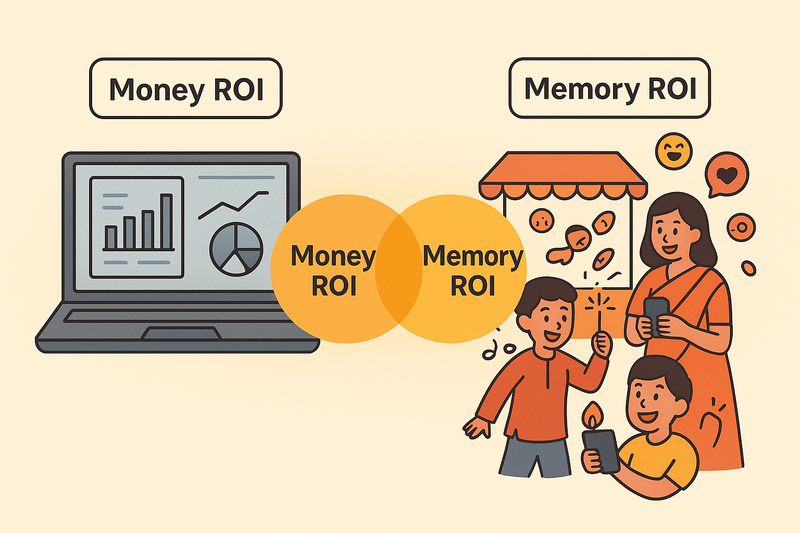
Here’s what the textbooks forget: ROI is as much about memory as it is about money. Did people have fun? Did they talk about it later? Did it shift how they see the brand? A Diwali campaign where 20 families post goofy reels of their kids dancing in front of a pop-up can generate more long-term value than a TV spot most people mute.
The problem, of course, is clients don’t buy “vibes.” They want dashboards. And we get it, dashboards make the invisible feel measurable. But if all you track are clicks and conversions, you’ll miss the real impact. Surya once joked during a review call: “If the colony WhatsApp group blows up with memes about the campaign, that should be worth at least 10,000 impressions.” He wasn’t entirely wrong.
Dashboards Keep You Sane (Mostly)
Clients love dashboards. They open them up, see numbers climbing, and instantly feel better about life. We love them too, which is why we built our CupShup ROI Dashboard- our way of making sense of the madness. It doesn’t just log leads or footfall. It stacks things in layers: the immediate conversions, the engagement value, and the softer long-term signals like repeat users and recall.
When Sidharth demoed it the first time, he called it “the MRI scan of a campaign.” Divyanshu muttered under his breath, “Yeah, except ours also catches hangovers and chai breaks.” But he wasn’t wrong, it does more than just show activity, it shows the ripple effect.
For Tata 1mg, the dashboard lit up with all the juicy numbers: 200k+ engagements, 95k leads, 35k test bookings. ROI you could print on a T-shirt. For Flipkart Minutes, the dashboard told a subtler story: fewer immediate spikes, but steady adoption curves, repeat app opens, and even referral chains. The kind of ROI that looks boring at first glance but is actually where the gold lies. That is marketing attribution working: every number traces back to a source.
The point is, dashboards tell stories if you feed them the right data. If you only plug in clicks, you’ll miss the uncle screaming “zindabad” or the 40 aunties WhatsApping their BP test photos. Those don’t show up on graphs, but they’re ROI all the same. Pick marketing metrics that fit the goal, not the dashboard.

The Blunders We’ve Survived
Read next: Dashboards That Actually Help You Decide What to Do Next, Inside the Playbook: How Brands Can Measure the Impact of..., and Why BTL Is Becoming the New Performance Marketing.
Read next: Dashboards That Actually Help You Decide What to Do Next, Inside the Playbook: How Brands Can Measure the Impact of..., and Why BTL Is Becoming the New Performance Marketing.
We’ll admit it: we’ve bungled ROI more than once.
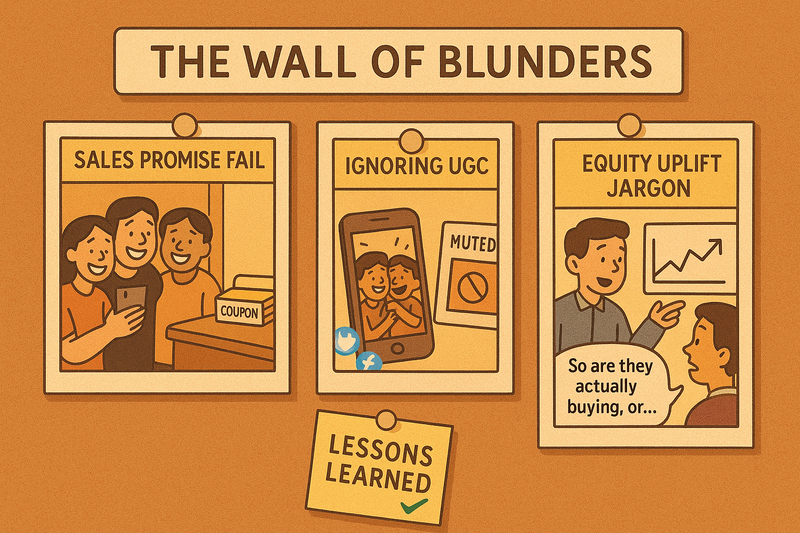
There was the time Maaz confidently promised a client that the activation would “100% drive sales” only for the crowd to love the photo booth but ignore the coupons. Sourav still brings it up in Monday meetings. Then there was our phase of ignoring UGC because “likes aren’t leads.” Big mistake. The next week, one small reel about a chocolate sampling drove more buzz than a month of media spend. Now UGC has its own sacred row in our dashboard.
And yes, we’ve also done the “brand equity uplift” jargon thing. Once, during a review, Surya said “equity uplift” three times in a row. The client looked confused and asked, “So are people actually buying, or just uplifting?” We laughed, they didn’t. Lesson learned: fancy words don’t save you when the ROI story doesn’t add up.
Why Brands Choose CupShup as Their Performance Marketing Agency
CupShup isn't just another performance marketing agency. We build it into every campaign we run for 400+ brands across 30+ Indian cities. From hyper-targeted campaign planning and real-time ROI dashboards to conversion-optimized activations and AI-powered audience insights, our approach is built to work on the ground and online.
Marketing ROI You Can Trace: SBI Life's QR-Coded Chai Cups
Marketing ROI is easier to defend when every piece of the plan leaves a trail. For SBI Life, CupShup ran a 10-day hyperlocal lead-generation activation across corporate clusters, built around 10 lakh+ QR-coded chai cups, cluster-level advisor pods and chai-time conversations.

SBI Life's branded chai cups
The result was 10,000+ verified insurance leads, turning lunch-break moments into qualified consultations without cold calls. Because every cup carried a code, each lead could be traced back to a cluster, which is exactly what marketing attribution is meant to do.
What is marketing attribution?
Marketing attribution is the practice of tying a lead or sale back to the touchpoint that earned it. Online, that is a UTM tag or a pixel. Offline, it can be a QR code on a cup, a coupon code or a callback number. Without marketing attribution, your marketing ROI is a guess with a formula attached.
Which marketing metrics matter for ROI?
The marketing metrics that matter are the ones tied to a decision: cost per qualified lead, lead-to-sale conversion, repeat purchase and payback period. Impressions and likes can sit beside them, but should never replace them. Pick three marketing metrics before launch and report the same three every week.
To benchmark your own numbers, try our free AI Traffic Checker. It estimates monthly organic traffic for any domain and compares it against competitors, with source breakdown and trend analysis.
For ROI-led campaigns with tracking built in, talk to our Performance Marketing team. We run Meta, Google and programmatic campaigns with ROI-led creative, audience and bid strategy.
Tell us which number you need to defend and we'll show you how to trace it. Let's talk.
Numbers Need Narratives
The truth? ROI is part spreadsheet, part storytelling. The spreadsheet proves you didn’t just wing it, and the story explains why the numbers matter. A campaign that got 1,000 test sign-ups is good. A campaign that got 1,000 test sign-ups and made people see your brand as the one that cares about their health? That’s great.
At CupShup, we’ve realised ROI isn’t about making Excel sing. It’s about showing how campaigns moved people, not just numbers. That’s why our dashboard and our debriefs always travel together: the data and the human story. Put the story next to the number and marketing ROI becomes a conversation, not a defence.
The Final Word
So, how do you measure marketing ROI? Start with the formula, of course. But don’t stop there. Ask what really changed. Did people act differently? Did they talk differently? Did they trust differently? That’s ROI too. Then add the marketing metrics that explain it.
Because the best campaigns aren’t the ones that just sold units. They’re the ones people remembered, laughed about, and shared long after the Excel sheets were closed and the dashboards archived. And if you can measure that, congratulations, you’ve just cracked marketing’s biggest headache… and maybe saved Maaz from another late-night Excel meltdown.
Ready to Get Started? Talk to CupShup
Whether you're planning a high-ROI campaign, optimizing your marketing spend, or looking for a performance marketing partner who gets results — CupShup's team is ready to help. Book a Free Performance Marketing Strategy Call →
50 Integrated Marketing Campaign Ideas
The complete playbook with campaign frameworks, budget templates, and measurement guides for Indian brands.
Instant download + email copy. No spam, ever.
Explore CupShup Services
Brands that read this article also explored these services.
Digital Marketing Agency
Full-stack digital marketing, performance, social, content, and programmatic campaigns.
Learn more AIAI-Powered Digital Marketing
AI-first marketing campaigns powered by data, automation, and predictive analytics.
Learn more MarTechTechnology Marketing Agency
Marketing tech infrastructure, automation, data pipelines, and martech integration.
Learn moreYuvana Singh
Creative Director passionate about storytelling and brand innovation. Yuvana leads CupShup's creative team, bringing fresh perspectives to campaign development and helping brands connect with their audiences through compelling narratives.
Related Stories


Go Deeper with Our Free Guides
Comprehensive, in-depth marketing guides created by CupShup's experts.
The Ultimate Guide to Brand Activation
Everything you need to know about bringing your brand to life, strategies, examples, and frameworks.
The Ultimate Guide to Digital Marketing
Master every channel in the modern digital marketing ecosystem, from SEO to paid media.
The Ultimate Guide to SEO
The definitive guide to search engine optimization, on-page, technical, and link building strategies.