
How Experiential Content Shortens the Sales Cycle for D2C Brands
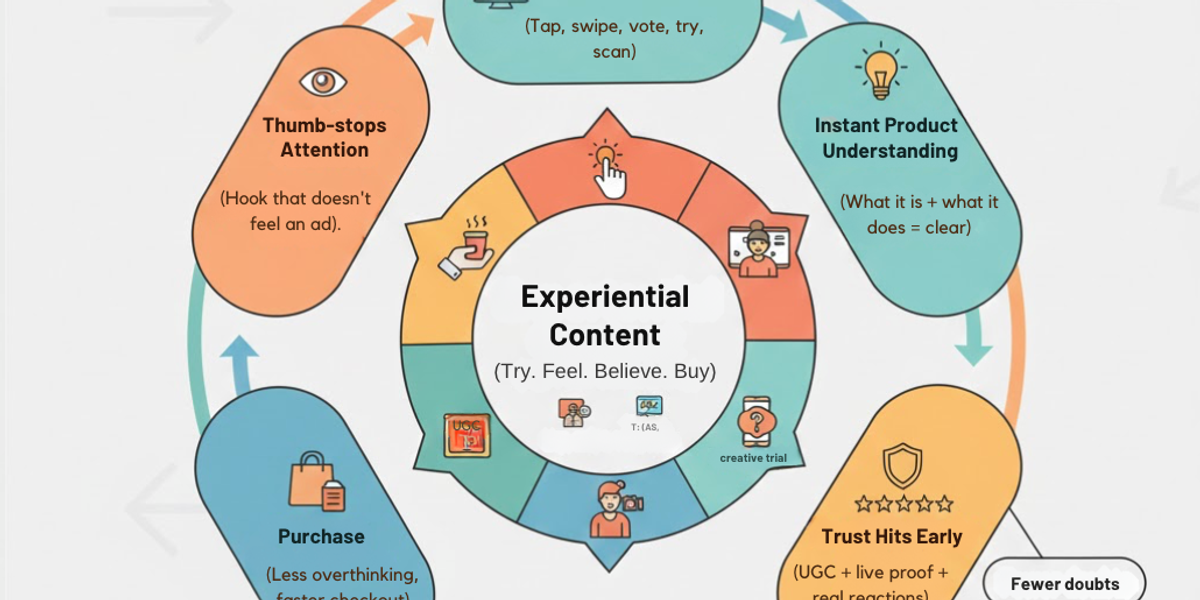
Quick answer: Experiential content shortens the sales cycle for d2c brands by combining awareness and proof in a single touchpoint, a customer who has tried the product in person skips the research phase entirely. This is why an activation-sourced lead often converts faster and at a lower cost than a cold digital ad click.
For D2C brands, the sales cycle is everything. The faster you move a person from first awareness to first purchase, the lower your acquisition cost and the faster you grow. Experiential content, real-world brand moments captured and distributed as content, is one of the most effective ways to compress that sales cycle. This guide explains how experiential content shortens the sales cycle for D2C brands, and how to build it into your funnel. A best digital marketing agency ties experiential content to pipeline. Quick commerce compresses the D2C sales cycle even further.
What Is the Sales Cycle for D2C Brands?
The sales cycle is the time and steps it takes to move a prospect from first contact to purchase. For most D2C brands it runs: awareness, interest, consideration, trial, purchase. Every stage adds delay and cost. A long sales cycle burns budget on repeated retargeting; a short one converts intent before it cools. The best digital marketing agency shortens the cycle with measurement. Pairing experiential content with quick commerce drives same-day conversion.
The levers that shorten a sales cycle are trust and proof. The faster a prospect trusts your product and sees proof it works, the fewer touches they need before buying. That is exactly what experiential content delivers. Ask the best digital marketing agency how content drives conversion. Quick commerce turns interest into an order in minutes.
How Experiential Content Compresses the buying journey
Experiential content is what you get when a real-world brand moment, a sampling, an activation, a live demo, is captured and distributed digitally. It collapses several sales-cycle stages at once:
- Awareness plus proof in one hit. A video of real people trying the product builds awareness and credibility simultaneously.
- Trust without the wait. Seeing genuine reactions shortcuts the trust-building that normally takes many touches.
- Trial by proxy. Watching someone experience the product is the next best thing to trying it, moving viewers straight to consideration.
CupShup's Paper Boat Zero launch shows experiential moments feeding content that shortened the path from awareness to trial for a new D2C product.
The buying journey: With vs Without Experiential Content
- Awareness -- Without experiential content: Paid ads, slow trust; With experiential content: Real moments build instant credibility
- Consideration -- Without experiential content: Multiple retargeting touches; With experiential content: Trial-by-proxy shortcuts it
- Trial -- Without experiential content: Requires separate push; With experiential content: Already seeded by the content
- Purchase -- Without experiential content: Delayed; With experiential content: Intent captured while warm
The result is fewer touches, lower cost per acquisition, and a faster buying journey, exactly what a D2C growth team optimises for.
Building Experiential Content Into Your Funnel
- Create the real moment, a sampling, activation, or demo worth filming.
- Capture authentic reactions, not scripted testimonials.
- Distribute across the funnel, from awareness ads to retargeting.
- Connect to performance, so warm viewers convert via performance marketing.
- Measure the buying journey, track time-to-purchase before and after.
Pair experiential content with a content marketing agency approach and the same real moment fuels social, search, and retargeting at once, compounding the sales-cycle gains.
Work With CupShup
CupShup creates experiential content that shortens the buying journey for D2C brands, across 50+ Indian cities and 400+ brands. We build the real-world moment, turn it into content, and wire it to performance marketing so intent converts while it is warm.
Want a shorter buying journey for your D2C brand? Talk to CupShup.
Why the Traditional D2C Funnel Is Too Slow
A typical D2C brand runs a funnel of awareness, consideration, and purchase, each stage powered by a different ad format and each stage leaking a large share of the audience. Consideration is usually the slowest and leakiest stage: a customer sees an ad, visits the site, reads reviews, compares alternatives, and often abandons the decision entirely before checkout. Experiential content collapses awareness and consideration into a single touchpoint, because a person who has already touched, tasted, or tried the product in person has effectively completed the "research" phase on the spot.
Case in point: how sampling compresses the funnel
When direct-to-consumer brands run an in-person sampling activation instead of a pure digital funnel, the sequence changes from "see ad, research, maybe buy" to "try it, decide immediately, buy same week." CupShup has run this exact model for FMCG and wellness D2C brands: an on-ground trial paired with a same-day discount code converts at multiples of the rate a cold digital ad achieves, because the biggest objection (does this actually work for me) is answered on the spot rather than left to a reviews page.
Turning One Activation Into a Month of Content
The sales-cycle advantage does not end when the event does. A single well-run activation generates raw material, participant reactions, before-and-after moments, real testimonials, that a content marketing agency can repurpose across weeks: short clips for social, a case-study page for the website, and quote cards for retargeting ads. This is where experiential content earns its name; it is not a one-day event but a content asset with a long shelf life.
- Day 1-3: publish raw reaction clips and behind-the-scenes content while the moment is fresh.
- Week 1: publish a recap video and testimonial quotes as retargeting creative.
- Week 2-4: build a landing page or case study using the best moments, and link it into the sales sequence for every future lead.
For online-first brands operating on tight margins, this compounding content value is often the real ROI of the activation, not just the same-day sales it generates.
Measuring the Sales-Cycle Shortening Effect
- Baseline: track the average number of days from first ad impression to purchase for your current funnel.
- Run a controlled experiential pilot in one city or one channel segment.
- Compare days-to-purchase for activation-sourced leads against the digital-only baseline.
- Track cost-per-acquisition alongside days-to-purchase, since a faster but costlier lead is not automatically a win.
Most D2C players that run this comparison for the first time are surprised by the gap; activation-sourced leads frequently convert in under a week where the digital-only baseline runs two to four weeks. That difference compounds fast when a brand is trying to hit a quarterly revenue target on a fixed marketing budget.
When Experiential Content Does Not Make Sense
This approach is not universal. Categories with very low average order value may not justify the cost of an in-person activation relative to the incremental sales-cycle improvement. And purely digital-native products (a SaaS subscription, for instance) have no physical sampling equivalent, so the sales-cycle compression has to come from other levers, like a free trial or interactive demo, rather than an on-ground event. Knowing when not to run experiential content is as important as knowing how.
A Real Timeline: From Activation to Repeat Purchase
Here is what the compressed sales cycle actually looks like in practice for a wellness D2C brand running a sampling activation. Day 0: a customer samples the product at a mall counter and scans a QR code for a first-order discount. Day 0, same evening: the order arrives via quick commerce before the discount window closes. Day 7: an automated WhatsApp or email touchpoint checks in and offers a subscription discount. Day 14 to 30: if the customer reorders, they are moved into a loyalty flow; if not, a light-touch reminder captures any residual intent before it fully decays.
Where most d2c brands drop the ball
The most common failure is stopping the sequence after day 0. Brands invest heavily in the activation and the same-day conversion, then have no structured follow-up, leaving the day 7 and day 14 touchpoints to chance. Experiential content only shortens the full sales cycle, first purchase to repeat purchase, when the follow-up sequence is planned with the same rigor as the activation itself.
Choosing Between In-House and Agency-Led Experiential Content
- In-house: works when the brand already has a content team and just needs occasional activation support.
- Agency-led: works better for these brands scaling activations across multiple cities simultaneously, since consistency of execution matters more than any single activation's creative flair.
The right best digital marketing agency partner should be able to show a repeatable playbook across cities, not just a single hero campaign case study.
Frequently Asked Questions
What is a buying journey for D2C brands?
The buying journey is the time and steps to move a prospect from first awareness to purchase, typically awareness, interest, consideration, trial, and purchase. A shorter buying journey means lower acquisition cost and faster growth.
How does experiential content shorten the buying journey?
It delivers awareness and proof at once. Real-world moments captured as content build trust and act as trial-by-proxy, collapsing several sales-cycle stages and reducing the number of touches needed to convert.
What is experiential content?
Experiential content is real-world brand moments, sampling, activations, and live demos, captured and distributed digitally, combining the credibility of a live experience with the reach of content.
How do you measure the impact on the buying journey?
Track time-to-purchase and touches-to-conversion before and after introducing experiential content, and monitor cost per acquisition as the cycle compresses.
Why does this matter for D2C companies specifically?
D2C growth depends on efficient acquisition. A shorter buying journey lowers cost per acquisition and speeds up revenue, and experiential content is one of the most effective levers to achieve it.
A content marketing agency can turn one activation into weeks of proof-driven content.
Pair this with performance marketing retargeting so the trial converts while intent is still high.
See a real example in our case studies.
Turn the activation footage into a landing-page asset with CupShup's AI blog writer, and follow up leads instantly with an email copy writer.
What is the fastest way to test if experiential content shortens my sales cycle?
Run a single-city pilot activation with a trackable discount code, then compare days-to-first-purchase for activation-sourced customers against your existing digital-only average over the same period. Most brands see a measurable gap within one pilot.
Do I need an agency to run experiential content for a D2C brand?
Not always for a single pilot, but scaling across cities usually needs agency support for consistent execution, trained promoters, and a follow-up sequence that does not depend on one internal team member managing everything manually.
50 Integrated Marketing Campaign Ideas
The complete playbook with campaign frameworks, budget templates, and measurement guides for Indian brands.
Instant download + email copy. No spam, ever.
D2C Experiential Marketing: Related Resources
Explore more about experiential content strategies for D2C brands with these related resources from CupShup.
Brand Activation Services
On-ground activation for D2C brands entering offline
Video Production Services
Capture experiential content for digital amplification
Handpickd Brand Activation
How a D2C fresh produce brand used experiential marketing
Beco Sustainability Campaign
How Beco used on-ground activations to build D2C brand trust
Explore CupShup Services
Brands that read this article also explored these services.
Experiential Marketing Agency India
Immersive brand experiences, pop-ups, product launches, live demos, and phygital events.
Learn more ActivationBrand Activation Services
On-ground engagement campaigns with tech-enabled tracking and verified results.
Learn more ContentContent Strategy & Marketing
Content strategy, editorial planning, and distribution for brand authority and SEO growth.
Learn moreAakriti Mishra
Senior Marketing Strategist at CupShup with over 8 years of experience in brand activation and integrated marketing campaigns. Aakriti specializes in creating data-driven strategies that deliver measurable results for modern brands.
Related Stories

Go Deeper with Our Free Guides
Comprehensive, in-depth marketing guides created by CupShup's experts.
The Ultimate Guide to Brand Activation
Everything you need to know about bringing your brand to life, strategies, examples, and frameworks.
The Ultimate Guide to Digital Marketing
Master every channel in the modern digital marketing ecosystem, from SEO to paid media.
The Ultimate Guide to SEO
The definitive guide to search engine optimization, on-page, technical, and link building strategies.