
Quick Commerce in India: Meaning, Top Apps and How D2C Brands Win

Quick commerce has changed how India buys. When a shopper can get a product in ten minutes, the gap between seeing a brand and buying it shrinks to almost nothing. That makes an on-ground activation tied to quick commerce one of the highest-leverage plays for D2C brands in India in 2026. This guide explains how quick commerce activations work, why they suit D2C brands, and how to run one so the offline moment drives the online order.
Quick answer: quick commerce brand activations work for D2C brands because they compress the funnel: a customer samples in person and orders on a 10-minute delivery app within the hour, before intent fades. This same-hour handoff is the single biggest advantage 10-minute delivery gives d2c brands over a traditional e-commerce checkout.
How does quick commerce work?
Quick commerce, or q-commerce, delivers groceries and everyday items in about ten to thirty minutes. Platforms run small local warehouses, often called dark stores, close to where customers live, so a rider can reach a home within minutes of an order. Baskets are small and frequent, which makes it a habit-driven channel where visibility on the app and trust in a brand decide who gets picked.
What Is Quick Commerce, and Why It Matters for D2C Brands
Quick commerce (q-commerce) is the ten-to-thirty-minute delivery model run by platforms like Blinkit, Zepto, Swiggy Instamart, and Flipkart Minutes. It compresses the buying journey: discovery, decision, and delivery happen in the same hour, often in the same neighbourhood.
For online-first brands, that compression is the opportunity. A traditional D2C funnel relies on paid ads, a website visit, and a wait for delivery. 10-minute delivery removes the friction: a shopper who discovers your brand on the ground can order it and receive it before the impression fades. Activation plus q-commerce closes the loop that digital alone leaves open.
Why Quick Commerce Activations Work for D2C
- Instant conversion. The offline nudge and the online order happen minutes apart, in the same pin code.
- First-party data. On-ground capture (QR, sampling sign-ups) gives D2C players data the platforms otherwise keep.
- Hyperlocal targeting. Activate exactly where q-commerce demand is densest, so trial converts to repeat.
- Lower CAC. A measured on-ground trial that converts on q-commerce often beats the cost-per-acquisition of pure paid digital.
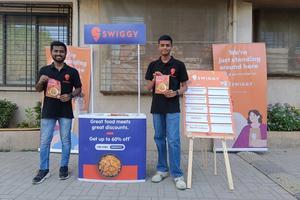
The Swiggy quick-commerce hyperlocal activation is a clear example of on-ground presence engineered to convert into immediate platform orders.
Watch: the Kumari Jewellery quick-commerce activation
The Quick Commerce Activation Playbook
- Discover -- On-ground action: Sampling, society or mall activation; Quick-commerce link: QR to the product on Blinkit/Zepto/Instamart
- Decide -- On-ground action: Promoter demo, offer, taste test; Quick-commerce link: Instant discount code redeemable on the app
- Order -- On-ground action: Scan and buy on the spot; Quick-commerce link: Delivery in the same neighbourhood, same hour
- Repeat -- On-ground action: Capture contact for follow-up; Quick-commerce link: Retarget via WhatsApp and performance ads
The magic is in the link column. An activation with no q-commerce capture is just sampling. An activation that pushes the shopper straight to a same-hour order is a conversion engine.
D2C Brands: Where Quick Commerce Activation Fits Your Funnel
Most direct-to-consumer brands run a funnel that looks like awareness, consideration, purchase, retention. Q-commerce activation accelerates the middle two:
- Awareness -- Without q-commerce activation: Paid social, influencers; With q-commerce activation: Same, plus on-ground presence
- Consideration -- Without q-commerce activation: Website visits, retargeting; With q-commerce activation: Live trial and demo in-market
- Purchase -- Without q-commerce activation: Online checkout, delivery wait; With q-commerce activation: Same-hour q-commerce order
- Retention -- Without q-commerce activation: Email, ads; With q-commerce activation: First-party data plus performance marketing
This is why a quick commerce activation pairs so well with a performance marketing engine: the activation generates first-party demand and data, and performance scales the retargeting.
How to Run a Quick Commerce Activation (Step by Step)
- Pick dense q-commerce pin codes where your category already has delivery demand.
- Choose the activation format that fits the product: sampling for FMCG, demo for gadgets, experience for premium.
- Build the q-commerce bridge with QR codes that deep-link to your product on the platform.
- Add an instant incentive redeemable only on the app, so the order happens now.
- Capture first-party data at every touchpoint for retargeting.
- Measure cost per order, not footfall, and shift budget to the pin codes that convert.
Cupshup's brand activation team plans exactly this kind of q-commerce-linked campaign, and connects it to digital so the data does not leak.
Quick commerce activations in practice: what we have run
Theory is easy. Here is what the same playbook produced on real programmes, all run by Cupshup on the ground and tracked to the app.
Bistro by Zomato: a three-month programme across Bangalore and Gurgaon with 120+ RWA activations, 45+ tech parks and 80+ high-footfall hotspots, with promoters helping people place a first order on the spot. It reached 2.8M+ people, drove 1,80,000+ app downloads and 65,000+ first orders, and converted 35%+ of downloads into orders.
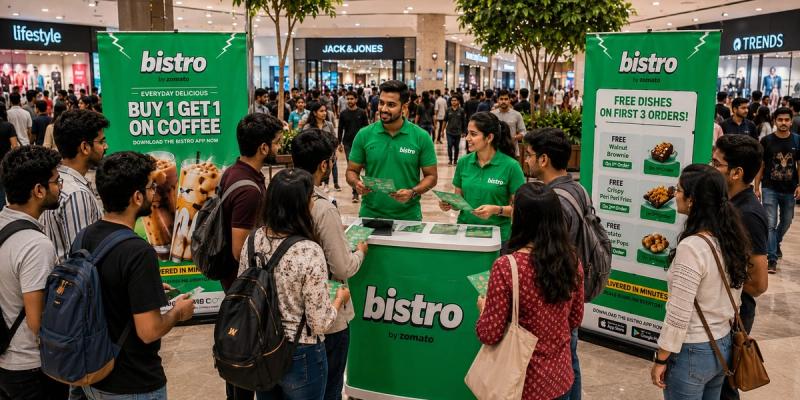
Bistro by Zomato: assisted first orders on the ground
Swiggy Instamart: activations at society gates, tech parks and retail-adjacent zones across five cities engaged 1.8 lakh+ users, issued 40,000+ QR-linked samples and lifted repeat orders by 24%.
Zepto: geo-mapped RWA, tech park and transit placements across 8 cities and 29 micro-markets drove 46 lakh+ app downloads and 28% retention, against a 15 to 18% category benchmark.
Flipkart Minutes: as a late entrant, it used RWA society-gate sampling and an offline-to-online funnel to acquire 2 lakh+ users.
Swish: promo tables in tech parks and office hotspots in Bangalore and Delhi produced 5,000+ orders on the ground, with 1 in 3 conversations turning into an order.
Where to run it
For D2C brands in India, pin codes matter more than venues. We plan quick commerce activations city by city: see how we work in Bangalore, Delhi and Mumbai, or read our brand activation guide for the wider planning framework.
Work With Cupshup
Cupshup is an on-ground and digital marketing partner for 400+ brands across 30+ cities. We plan quick commerce brand activations that turn neighbourhood trial into same-hour orders, then connect the captured demand to performance marketing and WhatsApp for retention.
Want quick commerce activations that convert for your D2C brand? Let's talk. We plan the activation, the QR-to-app handoff and the performance follow-up as one programme.
Why D2C Companies Need a Brand Activation Agency for Quick Commerce
Winning on 10-minute delivery is not only a media buy; it is an on-ground trust job. A brand activation agency bridges the gap between a Blinkit or Zepto listing and the shopper's real-world decision, using sampling, society programs, and hyperlocal visibility. The best brand activation agency for D2C ties each activation to downloads and orders, so spend is accountable. Cupshup ran exactly this for Swiggy, detailed in our Swiggy quick-commerce case study, and plans D2C campaigns through our brand activation agency team.
Why Quick Commerce Changes the Activation Math
Before 10-minute delivery existed, a brand activation could generate excitement, but converting that excitement into a sale still required a trip to a store or a multi-day e-commerce delivery wait, and a large share of intent decayed in that gap. Quick commerce closes the gap to under an hour. A customer samples a product at a mall kiosk, opens the app, and has it delivered before they have even left the parking lot. This same-hour handoff is the single biggest structural advantage the app-delivery model gives direct-to-consumer brands that traditional retail or e-commerce cannot match.
Designing the activation around the app, not the venue
The activation format itself needs to change for this channel to work. Instead of a generic sampling booth, the most effective versions place a QR code directly on the product sample that deep-links into the specific product page on the delivery app, sometimes pre-loaded with a first-order discount. This removes every point of friction between "I liked this" and "I ordered this" down to a single tap.
Which D2C Categories Benefit Most
- Food and beverage: near-instant repeat purchase after a positive sampling experience.
- Personal care and beauty: low-risk, low-price items that customers are happy to try on impulse.
- Wellness and supplements: benefits from in-person explanation paired with immediate ordering.
- Home and kitchen essentials: works well with demo-style activations (a chopping demo, a cleaning demo) that show the product in use.
Categories with longer consideration cycles (high-ticket electronics, for example) see a smaller lift from quick commerce pairing, because the decision genuinely needs more than an hour. Matching the format to the category is what separates a quick commerce activation that converts from one that just generates footfall.
A social media marketing agency should be briefed to capture the moment of ordering itself, since watching someone go from sample to delivered order in one video is some of the most persuasive content a D2C brand can produce.
Building the Same-Hour Funnel Step by Step
- Step 1: Choose a venue with genuine app delivery coverage in that pin code (verify before booking).
- Step 2: Print a unique, trackable QR code per venue so you can attribute orders back to the specific activation.
- Step 3: Offer a first-order discount that expires within 2 hours, creating urgency without feeling like a generic coupon.
- Step 4: Brief the ground team to walk customers through the exact app steps, since friction at this stage kills conversion.
- Step 5: Reconcile attributed orders daily, not weekly, so underperforming venues can be swapped out mid-campaign.
The brands that get the most out of this same-hour approach treat it as a live, adjustable campaign, not a fixed event, moving budget toward whichever venue or city is converting best within the first 48 hours.
Quick commerce platforms have done more than add a new sales channel for direct-to-consumer brands; they have compressed the entire consideration window down to the length of a single conversation at a sampling counter. A brand that once needed a multi-touch retargeting sequence over several days can now close the sale before the customer has even left the activation site, provided the app experience is frictionless and the incentive is time-boxed correctly.
Frequently asked questions
What is q-commerce in India?
Q-commerce is the ten-to-thirty-minute delivery model run by platforms like Blinkit, Zepto, Swiggy Instamart, and Flipkart Minutes. It compresses discovery, decision, and delivery into the same hour and often the same neighbourhood.
Why is quick commerce good for online-first brands?
It collapses the gap between awareness and purchase. A shopper who discovers a D2C brand on the ground can order it on a q-commerce app and receive it within the hour, which lifts conversion and lowers acquisition cost.
What is a quick commerce brand activation?
It is an on-ground campaign (sampling, demo, society or mall activation) deliberately linked to a quick-commerce platform via QR codes and instant offers, so the offline trial converts directly into an online order.
How do you measure a q-commerce activation?
Measure cost per order and trial-to-order conversion by pin code, not footfall. Capture first-party data at every touchpoint and shift budget toward the neighbourhoods that convert best.
Which D2C categories work best with quick commerce?
FMCG, food and beverage, beauty, and everyday essentials work best because they suit impulse trial and same-hour delivery. Premium and considered products can also work with a demo-led activation.
Which quick commerce platforms should a D2C brand activate around?
Start with whichever of Blinkit, Zepto, Swiggy Instamart and Flipkart Minutes has the densest delivery coverage in your target pin codes, and verify coverage before booking any venue. Most programmes use two platforms so the shopper can order on the app they already have.
Pair the launch with influencer marketing to seed trial before the quick-commerce listing even goes live.
Build a same-day nurture sequence with the AI email sequence builder, and check keyword demand for your category using SEO keyword research.
Who are the top quick commerce companies in India?
Blinkit, Zepto and Swiggy Instamart are the best-known quick commerce platforms in India. Others such as BigBasket, Flipkart Minutes and Amazon Now also offer fast delivery, and the market keeps changing.
Is Zomato a quick commerce company?
Zomato itself is food delivery. Its parent company Eternal also owns Blinkit, which is the quick commerce business.
Is Amazon quick commerce?
Amazon has launched a quick delivery service called Amazon Now in Indian cities, alongside its regular e-commerce delivery.
How Cupshup runs this as one system
Cupshup is an AI-led, integrated marketing partner, so none of this runs as a separate tool. We plan it smart, run it everywhere and prove it worked, across four connected areas: Discover (search and audience insight), Perform (paid media and conversion), Influence (creators and community) and Activate (on-ground and experiential). See how our AI-led approach sits inside our integrated marketing work.
For quick commerce brands, that means digital marketing services to drive installs and first orders, influencer marketing to build trust around a launch, and a clear read of results using our performance marketing guide.
50 Integrated Marketing Campaign Ideas
The complete playbook with campaign frameworks, budget templates, and measurement guides for Indian brands.
Instant download + email copy. No spam, ever.
Explore CupShup Services
Brands that read this article also explored these services.
Brand Activation Agency India
India's leading brand activation agency, 400+ campaigns, pan-India reach, real-time dashboards.
Learn more ExperientialExperiential Marketing Agency
End-to-end experiential campaigns that create memorable brand moments and drive measurable ROI.
Learn more BrandBrand Strategy Services
Brand identity, positioning, and messaging frameworks built for competitive Indian markets.
Learn moreGodhuli Vyas
Related Stories
Go Deeper with Our Free Guides
Comprehensive, in-depth marketing guides created by CupShup's experts.
The Ultimate Guide to Brand Activation
Everything you need to know about bringing your brand to life, strategies, examples, and frameworks.
The Ultimate Guide to Digital Marketing
Master every channel in the modern digital marketing ecosystem, from SEO to paid media.
The Ultimate Guide to SEO
The definitive guide to search engine optimization, on-page, technical, and link building strategies.