
Performance Marketing Agency in India: Why BTL Wins
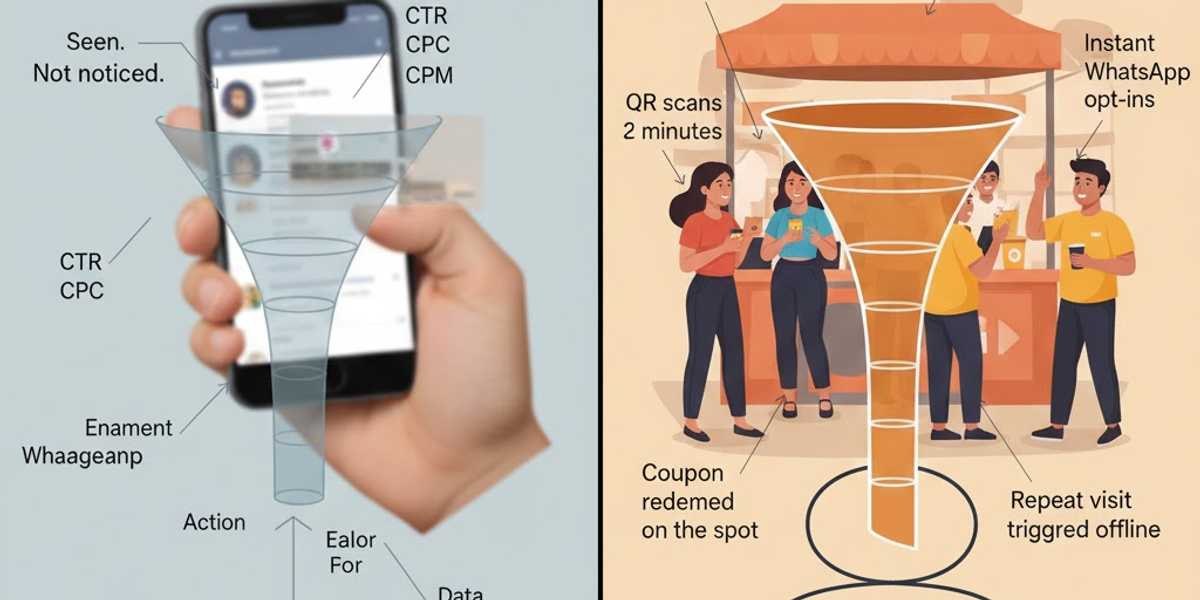
For a decade, "performance marketing" meant digital: search, social, and programmatic, measured to the click. But as digital costs rise and attribution gets murkier, a quiet shift is underway. BTL, done with modern measurement, behaves exactly like a performance channel: targeted, attributable, and optimisable. This is the case for BTL vs performance marketing being a false choice, and why the smartest brands now run on-ground activity as part of the performance mix. CupShup treats the BTL vs performance marketing split as one funnel from day one, built on real-world data. That is the mark of the best performance-led agency in India: measurement first. Most paid media companies in India optimise clicks; the leaders optimise customers.
What "Performance Marketing" Really Means
Performance marketing is not a channel. It is a discipline: spend against a measurable outcome, capture the result, and optimise toward what converts. Digital earned the label because it was the first channel where every action could be tracked. But the discipline is channel-agnostic. Anything you can measure to an outcome can be run for performance, including BTL. What makes a performance-led agency in India different is on-ground signal. Where BTL vs performance marketing gets decided is proof: first-party data wins the ROI argument. The strongest paid media companies in India own the full funnel.
Why BTL Now Qualifies as Performance
Three things changed that let BTL join the performance conversation: Ask any vendor the BTL vs performance marketing question directly: show attribution from activation to conversion. CupShup stands apart from typical paid media companies in India on measurement.
- Capture got cheap. QR codes, promoter apps, and lead forms turn every on-ground contact into a tracked event.
- Integration got easy. Captured leads flow straight into CRM, WhatsApp, and retargeting.
- Attribution got real. Promo codes and unique offers tie on-ground activity directly to sales.
| Capability | Digital performance | Modern BTL | |---|---|---| | Targeted audience | Yes | Yes | | Per-contact capture | Yes | Yes, via QR and forms | | Cost per outcome | Yes | Yes | | Optimisation | Real-time | Market by market | | Real-world trust | Limited | High, direct contact | The best performance marketing agency in india blends BTL proof with paid scale.
BTL vs Performance Marketing: Not a Choice, a Stack
The brands getting the most from their budgets stop arguing BTL vs performance marketing and stack them instead: CupShup treats every rupee as accountable, whichever channel earns it.
- BTL generates real-world trial and first-party leads.
- Digital captures, nurtures, and retargets those leads at scale.
- Marketing automation services keep the follow-up running without manual effort.
- Measurement spans both so you see the full-funnel cost per outcome.
The result is a loop: on-ground contact feeds digital, digital amplifies on-ground, and every rupee is accountable. That is paid media in its truest sense, just not confined to a screen. The real BTL vs performance marketing takeaway is that a modern agency runs offline and online as one funnel.
For the foundation, read our complete BTL marketing guide, and to see why BTL deserves performance budgets, BTL is not a budget line.
What This Means for Your Budget
If you ring-fence BTL as "brand" spend and performance as "digital" spend, you are optimising two silos that should be one funnel. Move to a single performance view: one KPI, one cost-per-outcome, both channels competing and cooperating inside it. The channel that converts cheapest gets more budget, whether it runs on a street or a screen.
Proof: BTL Run as Performance
These campaigns were measured on the same metrics a performance marketer would recognise.
- App downloads. The Bistro x Zomato app-download campaign drove a digital conversion directly from on-ground activity.
- Qualified leads. The SBI Life activation produced 10,000+ leads, a pipeline number, not a footfall number.
- Quick-commerce conversion. The Flipkart Minutes activation tied on-ground presence to immediate online orders in the same neighbourhood.
Each result is a conversion metric. That is the whole point: when BTL captures and converts, it competes for performance budget on equal terms.
The Integrated Performance Loop
| Stage | Channel | Metric | |---|---|---| | Generate | BTL activation | Contacts captured | | Capture | QR, lead form, app | Leads, downloads | | Nurture | WhatsApp, email | Engagement rate | | Convert | Retargeting, performance | Cost per acquisition | | Measure | Unified dashboard | Full-funnel ROI |
Run this loop and the old BTL vs paid channels debate disappears. They are two stages of one funnel, measured end to end.
Work With CupShup
CupShup runs BTL as a performance channel and connects it to a full digital and performance stack, for 400+ brands across 50+ Indian cities. Our brand activation team instruments every campaign and ties it to the digital engine that scales it.
Want BTL and digital running as one performance loop? Talk to CupShup.
Closing the Loop With Automation
BTL captures high-intent leads; marketing automation services make sure none slip away. Once an activation collects a contact, these automated workflows trigger the right nurture sequence, score the lead, and hand sales a warm prospect. Treating BTL as the top of the funnel and this follow-up layer as the connective tissue is what makes on-ground spend perform like a channel, not a cost. CupShup wires activations into marketing automation services so every lead is followed up, not forgotten in a spreadsheet.
Frequently Asked Questions
Is BTL the same as digital advertising?
growth marketing is a discipline, spending against a measurable outcome and optimising toward conversion, not a single channel. Modern, instrumented BTL meets that definition, so it can be run as a performance channel alongside digital.
How is BTL measured like paid acquisition?
Through QR codes, promoter apps, lead forms, and promo codes that capture every contact and tie it to a KPI, producing a cost per qualified outcome you can compare directly to digital.
Should I choose BTL or paid media?
Neither alone. Stack them: BTL generates real-world trial and first-party leads, digital scales and retargets them, and a single measurement view spans both.
Does BTL work with marketing automation?
Yes. Leads captured on the ground flow into marketing automation services for nurture, WhatsApp follow-up, and retargeting, so the value compounds after the activation ends.
Why is BTL becoming more important now?
Rising digital costs and weaker attribution make first-party, real-world leads more valuable. Modern BTL delivers exactly that, measurably, which is why it is rejoining the performance conversation.
50 Integrated Marketing Campaign Ideas
The complete playbook with campaign frameworks, budget templates, and measurement guides for Indian brands.
Instant download + email copy. No spam, ever.
BTL Performance Marketing: Related Resources
Explore more about BTL as performance marketing with these related resources from CupShup.
Performance Marketing Services
Data-driven marketing with measurable performance outcomes
BTL Marketing Agency
Performance-oriented BTL campaigns across India
Brand Activation Agency
Why brands cannot afford to skip BTL in their marketing mix
Bata Hyperlocal Campaign
How Bata used performance-driven BTL for retail activation
Explore CupShup Services
Brands that read this article also explored these services.
Integrated Marketing Agency
360-degree campaigns that connect offline activations with digital amplification for compounded ROI.
Learn more BrandBrand Strategy & Positioning
Brand architecture, positioning frameworks, and messaging strategy for market differentiation.
Learn more BTLBTL Marketing Services
On-ground activations, sampling drives, RWA events, and experiential campaigns across India.
Learn moreAakriti Mishra
Senior Marketing Strategist at CupShup with over 8 years of experience in brand activation and integrated marketing campaigns. Aakriti specializes in creating data-driven strategies that deliver measurable results for modern brands.
Related Stories

Go Deeper with Our Free Guides
Comprehensive, in-depth marketing guides created by CupShup's experts.
The Ultimate Guide to Brand Activation
Everything you need to know about bringing your brand to life, strategies, examples, and frameworks.
The Ultimate Guide to Digital Marketing
Master every channel in the modern digital marketing ecosystem, from SEO to paid media.
The Ultimate Guide to SEO
The definitive guide to search engine optimization, on-page, technical, and link building strategies.