
Projection Mapping: When Buildings Stop Behaving Like Buildings
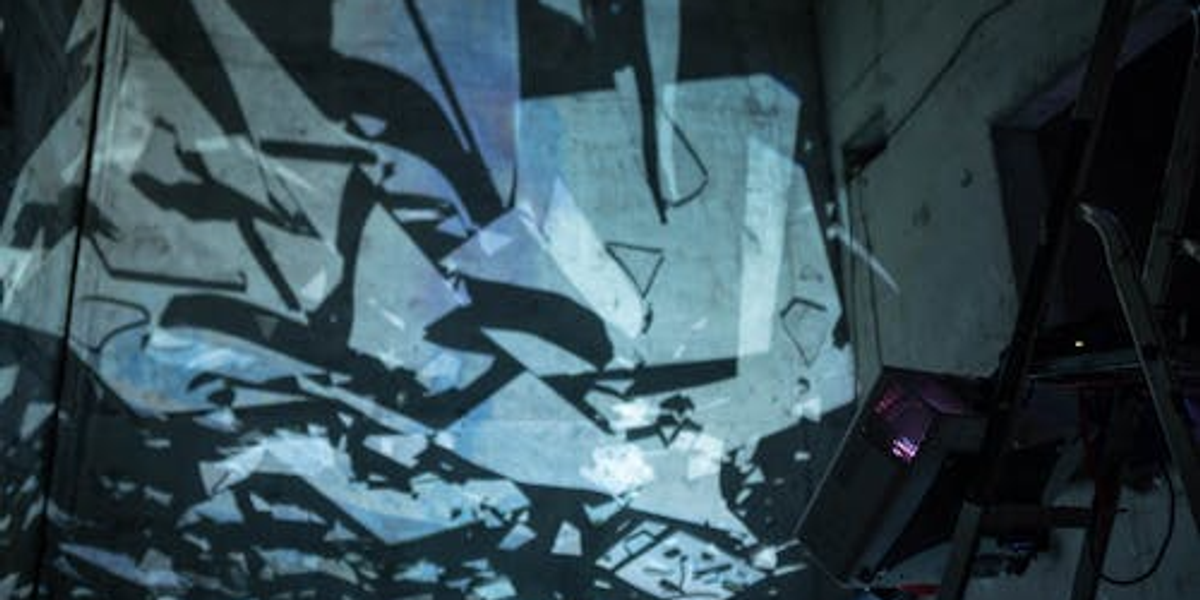
Our not-so-secret guide to turning architecture into pure drama
Looking for an experiential marketing agency that creates moments people never forget? CupShup combines AI-powered planning with on-ground experiential marketing across 10,000+ campaigns, helping brands connect with audiences through immersive, measurable experiences.
Every marketer has had that moment where someone on the team says, “Boss, kuch hatke karna hai". And suddenly the entire room goes silent, because hatke usually means budget, tension, approvals, late nights… and then someone whispers the magic words: projection mapping.
Projection mapping is that rare creature in marketing that makes everyone go ohhh and woww at the same time. Even the finance team. And if Bhavika from CA nods even slightly, you know it's truly magical.
Let’s be honest. Projection mapping isn’t just a marketing technique. It is a performance. It is theatre. It is technology wrapped in storytelling. It is the closest we can get to saying dimag ka dahi mat karo to a building before making it do backflips.
Welcome to the world where buildings behave better than influencers on tight deadlines.
So What Is Projection Mapping Really
The technical answer is spatial augmented reality.
The real answer is simple: projection mapping makes static surfaces behave like they just drank two cups of strong South Indian filter coffee.
It lets you project visuals on anything. A palace. A mall. A fort wall. A giant elephant statue. Even Maaz's daily planner if you want to dramatize it enough (his exact words were, “Aakriti, if my to-do list starts moving, I’m resigning".)
Once the visuals are mapped correctly, they don’t sit on the surface. They interact with it. They peel the building open, make it breathe, collapse, glow, dance, erupt… all without touching a single brick. The building suddenly feels alive and intentional, like it has been waiting its whole life to do exactly this.
This is why projection mapping fits so naturally into modern marketing campaigns, especially when you want both spectacle and amplification.
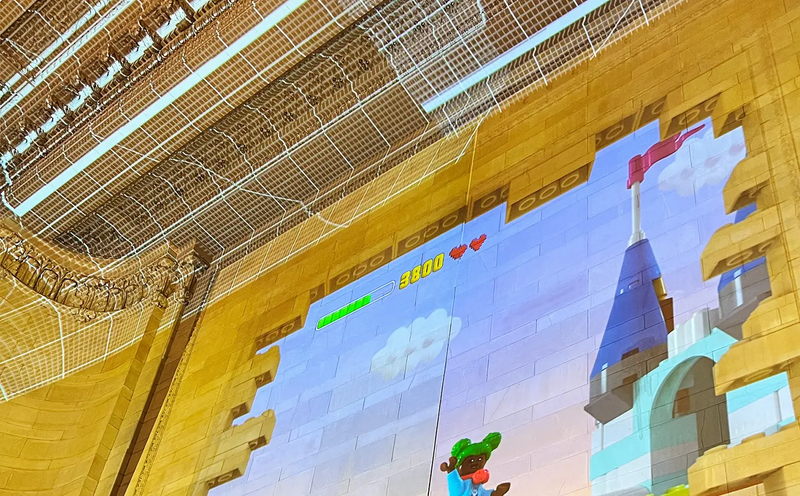
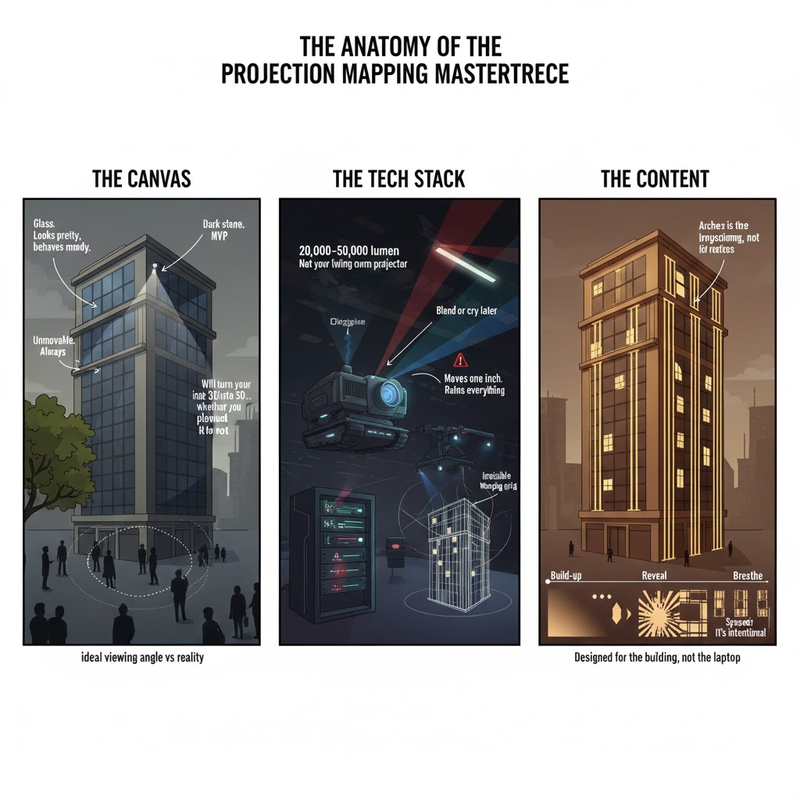
The Three Real Pillars Of Projection Mapping
(And no, it is not projector plus video)
Anyone who has ever been part of a mapping all-nighter knows the real pillars are very different. These pillars decide whether your campaign management becomes a smooth ride or a collective emotional breakdown.
1. The Canvas
Buildings have personalities. Some are cooperative friends. Others are total drama queens.
Glass surfaces behave like they have trust issues.
Dark stone is your best ally.
Intricate architecture gives beautiful illusions but demands painful precision.
Protrusions, curves and balconies can turn a simple animation into a full-blown 3D illusion.
During scouting sessions someone always says things like “This façade looks cute but definitely has main character energy". And usually they’re right. The building decides how the campaign's story flows. If the structure has charm or character, half your visual appeal is already sorted.
An additional insight most people miss is the viewing angle. Where will the audience stand? How far is the ideal viewing distance? Can people see the entire façade or only 70% of it because of a random tree that refuses to shift? These things matter more than most campaign management decks mention.
2. The Tech Stack
This part is the make-or-break and yes, break happens more than anyone would like to admit.
To get this right you need projectors with huge brightness, sometimes 20,000 to 50,000 lumens each depending on the surface. These aren’t home cinema projectors. These are heavy-duty, back-breaking beasts that need strong rigging, clean power and stable placement.
You need blending tools to stitch multiple projectors so perfectly that nobody can tell where one ends and another begins. You need warping tools to bend visuals around curves. You need media servers like Disguise, Resolume or Watchout that can run animations like a racecar during a high-stakes campaign launch.
And you need stable mounts. Sidharth has said this many times that if a projector moves one inch on the ground, the entire façade starts behaving like it forgot its choreography and ruins the amplification potential of the whole mapping campaign.
3. The Content
Content is where the soul sits. This is where the team spends the most time because content decides whether the audience gasps or checks WhatsApp.
Good content does not just play on the building. It talks to the building. It romances the building. It uses its arches as dramatic entrances, its windows as rhythm beats, its pillars as visual anchors and its curves as moments of surprise.
We always remind ourselves to design content for the building’s exact geometry, not our laptop screens. That one decision saves weeks of heartbreak during campaign management.
Another pro-level insight is pacing. Buildings don’t like overcrowded frames. Slow builds, smart reveals and intentional breathing space work far better than chaotic VFX storms. These choices also make amplification smoother because viewers get clear visually memorable moments.
Why Projection Mapping Works On Humans
Projection mapping cuts through everything. Noise. Fatigue. Boredom. Even existential questions sometimes. This is why it has become such a powerful tool across large-scale marketing campaigns globally.
It works because the human brain loves contradictions. A building is not supposed to move. So when it does, your brain sends a “what sorcery is this” alert. This reaction creates instant curiosity and attention.
It is familiarity interrupted. It is surprise at scale. It is collective emotion. When an entire crowd gasps together, the moment becomes unforgettable. Even Yukta says this is the kind of content that travels naturally on social media without needing paid boosts because amplification happens organically.
Projection mapping also hits nostalgia and novelty at the same time. People have seen the building for years, but never like this. That tension is powerful.
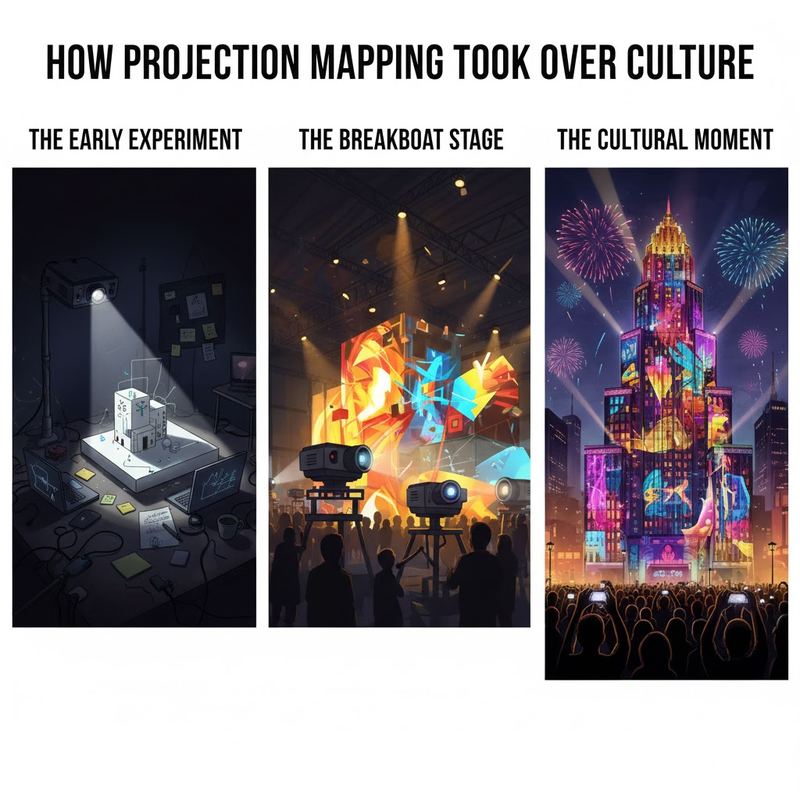
The Evolution Of Projection Mapping
(Or how a nerdy experiment became a cultural moment)
Projection mapping started as a futuristic idea in theme parks. As hardware improved and creatives got bolder, projection mapping stepped out of controlled rooms and onto entire cityscapes.
Today it powers festivals, national celebrations, product launches, brand campaigns, retail experiences and public art. Internationally it is used on Christmas, New Year’s Eve, festival seasons and even protest art. It is no longer a gimmick. It is a language. A medium. A spectacle.
And audiences have grown smarter. They expect more than just light. They want story. They want rhythm. They want emotion. That is where projection mapping shines.
Why Brands Should Care
(Aka the part where projection mapping becomes marketing gold)
Traditional ads have become digital wallpaper. People scroll past them without blinking. Digital fatigue is real and brutally high.
But a giant building collapsing into animated dust before blooming into brand imagery? That makes people stop. That makes them record. That makes them share. It is amplification at its most dramatic.
Projection mapping hits all modern marketing sweet spots:
- Offline impact
- Online virality
- Visual storytelling
- Campaign management clarity
- Community experience
- Press attention
- Social buzz
- High memorability
Surya from marketing once said projection mapping is the most camera-friendly medium ever created, and honestly, that is the best summary of the whole thing.
The Stuff That Makes Projection Mapping Fail
(Spoiler: 90% of the problems come from real life)
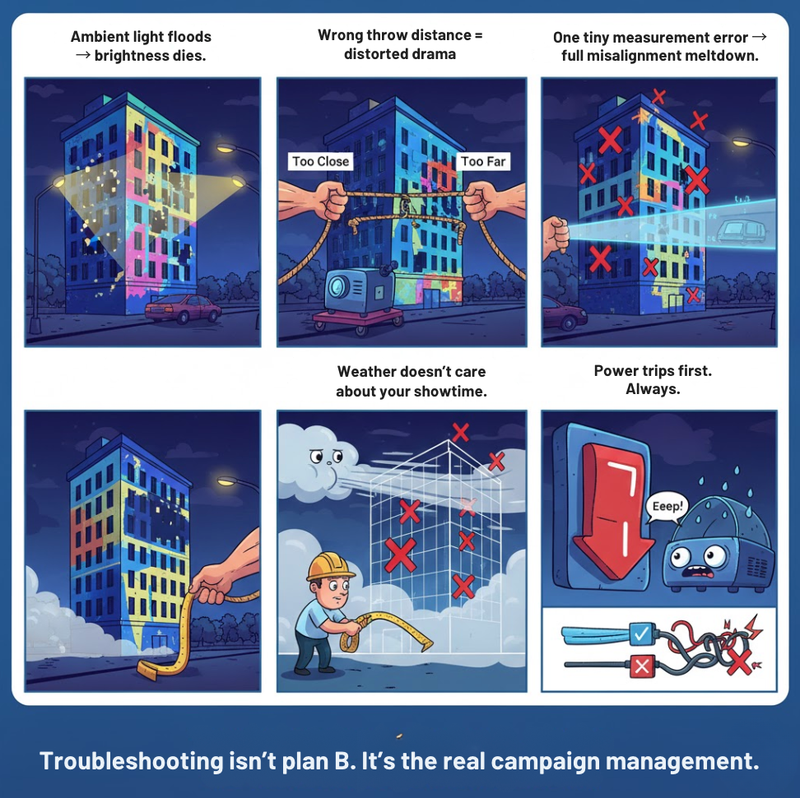
Ambient light
Streetlights, headlights, storeboards all fight your projection.
Read next: AR + Offline: When Digital Layers Meet Real-World Fun in ..., TAP, TRACK, WOW: How NFC and RFID Are Quietly Taking Over..., and D2C Marketing Strategy: How Experiential Content Shortens....
Read next: AR + Offline: When Digital Layers Meet Real-World Fun in ..., TAP, TRACK, WOW: How NFC and RFID Are Quietly Taking Over..., and D2C Marketing Strategy: How Experiential Content Shortens....
Fix: Night recce at the exact show time.
Wrong throw distance
If the projector is too close or far, the visuals distort.
Fix: Use proper throw calculators. Guesswork never works.
Incorrect 3D model
Small measurement errors create huge misalignments.
Fix: Laser scanning is always safer than manual measurement.
Weather
Humidity, fog, rain, wind all ruin brightness and stability.
Fix: Waterproof housings and backup windows are essential.
Why Brands Choose CupShup as Their Experiential Marketing Agency
CupShup isn't just another experiential marketing agency — we're a team that's built experiential thinking into the DNA of 10,000+ brand activations across 300+ Indian cities. From immersive brand experiences and pop-up activations to AI-powered audience insights and real-time engagement tracking, our hybrid experiential + tech approach delivers impact that traditional agencies can't match.
Power
Projectors trip quicker than anyone expects.
Fix: Dedicated clean power line only.
Teams who have done this know that troubleshooting is not a backup plan. It is the plan. It is also a critical part of campaign management that nobody talks about enough.
The Secret Tricks Only Experienced Teams Know
Create a visibility heatmap before designing content.
- Test animations on a 3D-printed miniature.
- Build in layers. Start simple. Add complexity after.
- Avoid projector keystone tools.
- Keep an emergency loop ready.
- Always add one shock moment. That gasp is your virality engine and the heart of your amplification strategy.
These small decisions separate good mapping from memorable mapping. Even Yuvana says the goal is not just spectacle but to give people a moment that stays with them. She is right. Projection mapping is memory-making, not just marketing.
The Money Part Nobody Talks About
(But should)
Typical costs look like this:
- Small façade: 15 - 30 lakhs
- Medium scale: 30 - 75 lakhs
- Larger installations: 80 lakhs - 2.5 crore
- Landmark-scale: 3 - 10 crore
People think projection mapping is expensive. The truth is that poorly planned mapping is expensive. Well-planned mapping pays back in reach, recall, amplification and buzz.
Brands that dare to go bold usually get disproportionate attention.
The CupShup Conclusion
Projection mapping is the perfect example of Marketing That Moves. It transforms spaces into experiences. It brings people together. It turns architecture into a living storyteller. It blends art, creativity, tech and emotion into one moment that people talk about long after the lights go off.
As a team, we often say buildings are no longer silent. They are waiting for a script. They are waiting for a story. They are waiting for the right brand to step up and let them perform. In the world of creative marketing campaigns, projection mapping is one of the strongest tools for large-scale amplification.
This is not just light on stone. This is narrative at scale. This is culture meeting creativity. This is what modern campaign management should feel like.
Before You Go
If you want your brand to light up the sky, own the night and turn an ordinary building into your next viral marketing moment, reach out to us.
Let’s create a projection mapping campaign that people will remember, record and rave about.
Ready to Get Started? Talk to CupShup
Whether you're planning a high-impact campaign or looking for a experiential marketing agency that delivers real results — CupShup's team is ready to help. Book a Free Experiential Marketing Strategy Call →
50 Integrated Marketing Campaign Ideas
The complete playbook with campaign frameworks, budget templates, and measurement guides for Indian brands.
Instant download + email copy. No spam, ever.
Explore CupShup Services
Brands that read this article also explored these services.
Guerrilla & Ambient Marketing
Creative ambient placements that make consumers stop, engage, and share.
Learn more OOHOOH & DOOH Advertising
Strategic outdoor media placement, billboards, transit media, and digital OOH screens.
Learn more ActivationBrand Activation Agency India
India's leading brand activation agency, 400+ campaigns, pan-India reach, real-time dashboards.
Learn moreAakriti Mishra
Senior Marketing Strategist at CupShup with over 8 years of experience in brand activation and integrated marketing campaigns. Aakriti specializes in creating data-driven strategies that deliver measurable results for modern brands.
Related Stories


Go Deeper with Our Free Guides
Comprehensive, in-depth marketing guides created by CupShup's experts.