
What India’s Local Culture Teaches Us About Experiential & Hyperlocal Marketing
How tradition, place & ritual become powerful levers for brands that want more than eyeballs
Looking for a btl marketing agency that delivers measurable offline impact? CupShup brings 10 years of work for 400+ brands, with AI-led planning and on-ground execution across 30+ cities.
Why Local Culture = Experiential Gold
Let’s be honest, India doesn’t have one culture. It has thousands. All running side by side, sometimes colliding, always coexisting, and somehow making perfect sense over a cutting chai. Cultural marketing in India means respecting that range.
That’s exactly why experiential and hyperlocal marketing in India is such a thrilling puzzle. You can’t copy-paste a global playbook here. You have to listen - to the streets, the snacks, and the slang. Hyperlocal marketing is the answer to that puzzle.
Experiential marketing here thrives not because of tech or tools, but because of touch. It’s knowing that when someone in Delhi says, “Arrey yaar, kya scene hai”, it’s not about a scene. It’s about belonging.
As Sourav says, “In India, you don’t enter a market, you enter a mood”. And he’s right. You can’t just launch a brand here. You have to arrive with the same humility you’d have when stepping into someone’s home, shoes in hand.

That’s the soul of experiential and growth marketing in India: not just reaching people, but joining them.
What the Data & Case Studies Tell Us
Let’s not just sip the chai, let’s stir it. Data and drama go hand in hand in India, and both matter.

Here’s something Surya shared recently: Hyperlocal campaigns in 2025 show up to a 30% higher engagement rate when rooted in community rituals and local customs. The keyword? Rooted.
Because painting a mandala on a wall isn’t ‘cultural integration’. It’s decoration. And India can smell tokenism from ten feet away.
Deep Insights: What Local Culture Offers (and What to Watch Out For)
Working in growth marketing in India feels like playing gully cricket - everyone has rules, but none are written. You learn them by showing up, reading the pitch, and respecting the game.
Here’s what our chai-fueled campaigns have taught us over the years:
1. Rituals + Routines = Trust Portals
In India, rituals are relational. Morning chai, evening walks, Friday temple visits - these are the country’s real meeting rooms.
Show up there with respect, and you don’t need a 10-crore ad budget. You’ve earned your seat.
Don’t just interrupt behaviour; join it. CoinDCX didn’t create a new ritual; they made an existing one cooler.
Pro tip: Don’t enter rituals waving your logo. Enter with curiosity. Be part of the moment, not the center of it.
2. Artisanship, Local Aesthetics & Ambient Advertising
India’s design DNA is loud yet delicate, ancient yet meme-ready. From Madhubani to Warli, these are more than art forms, they’re conversations.
When Maaz led our Mumbai activation, he brought in local muralists instead of printers. People photographed the wall and they took selfies with the artists. That’s the difference between decoration and participation.
This is the essence of ambient advertising - turning everyday spaces into storytelling surfaces that invite interaction.
Tip: If your campaign doesn’t smell like the place it’s born in, you’ve missed the plot.
3. Community + Participation > Spectacle
Here’s something they don’t teach in B-schools - Indians don’t just want to watch your story; they want to be in it.
That’s why our campaigns are always interactive. Dance, doodle, sip, click - anything that gets people moving.
A few years ago, Sourav and I ran a doodle-on-cups campaign. People drew their “mood of the day”, traded cups, and created a “CupShup gallery”.
It started as marketing. It ended as memory. That’s hyperlocal growth marketing at its best.
4. Spaces, Senses & Ambient Impact
Think Holi: can you smell the gulal, hear the laughter, feel the splash? That’s how sensory Indian marketing is.
Divyanshu, our resident data whisperer, says campaigns that engage multiple senses see 65% higher recall. And he’s right. India remembers through senses, not slogans.
This is also where ambient advertising shines. It transforms the sensory world around people into an extension of the brand experience.
Tip: Anchor every campaign in one sensory detail - smell, sound, or texture. That’s your campaign’s heartbeat.
5. Local Language = Local Love
Language in India isn’t just communication, but comfort. Say “Kaapi?” in Chennai or “Chai piyoge?” in Delhi, and suddenly you’re one of us. Regional marketing starts with language, but it does not end there.
When Maaz and I write regional copy, we don’t translate, we transplant. A “Tu” in Mumbai feels warmer than a “You”. That’s emotion engineering.
Hyperlocal language is more than just a tactic; it’s a trust trigger.
6. Festivals as Amplifiers for Growth Marketing
Festivals in India aren’t just events, they’re emotion economies. But here’s the catch: everyone’s shouting. Sometimes, the smartest move is to whisper.
As Yuvana says, “If everyone’s shouting, whispering wins”. The best festival campaigns don’t compete with the noise; they connect quietly.
Pro tip: Think mohalla, not metro. Smaller, warmer, deeper. That’s the future of growth marketing in India. That is hyperlocal marketing in a sentence.
7. Constraints = Creativity Catalysts
Every marketer in India knows half your creativity goes into figuring out what you can’t do.
No liquor ads? Bacardi made music.
No hoardings? Brands painted staircases.
At CupShup, we call it Jugaad Genius. Constraints make us sharper. As Sidharth jokes, “If you don’t have permissions, make it look intentional”.
And honestly, that spirit built some of India’s most legendary ambient advertising and guerrilla campaigns.

Read next: Winning the Quad: Lessons to Nail College & Society Activ..., How Street-Level Marketing Still Wins in a Digital World, and More Than Free: How to Turn Sampling into Strategy.
Read next: Winning the Quad: Lessons to Nail College & Society Activ..., How Street-Level Marketing Still Wins in a Digital World, and More Than Free: How to Turn Sampling into Strategy.
A CupShup-Style Example: “Local Legends Chai Mela”
Picture this: a Friday evening during Ganesh Chaturthi in Pune. CupShup sets up chai stalls co-run by local vendors. Each cup carries a story about local heroes: the poet rickshaw driver, the aunty who feeds 100 strays, the chaiwala who hasn’t missed a day in 25 years.
QR codes on cups lead to mini-videos shot on phones by Sidharth’s team, and people can submit their own stories online.
No influencers. No filters. Just real humans, hot chai, and heart.
That’s marketing that works - from cups to conversations, from offline warmth to online waves. A perfect blend of hyperlocal storytelling and ambient engagement.

Hyperlocal Marketing at a Tea Stall: Partnr by Hero
The best hyperlocal marketing starts where the audience already spends its day. For Partnr by Hero, an app for bike mechanics, that place was the tea stall and the workshop. CupShup ran trust-first activations across Bangalore, Hyderabad, Mumbai and Delhi, with tea stall branding and workshop activations rather than ads.
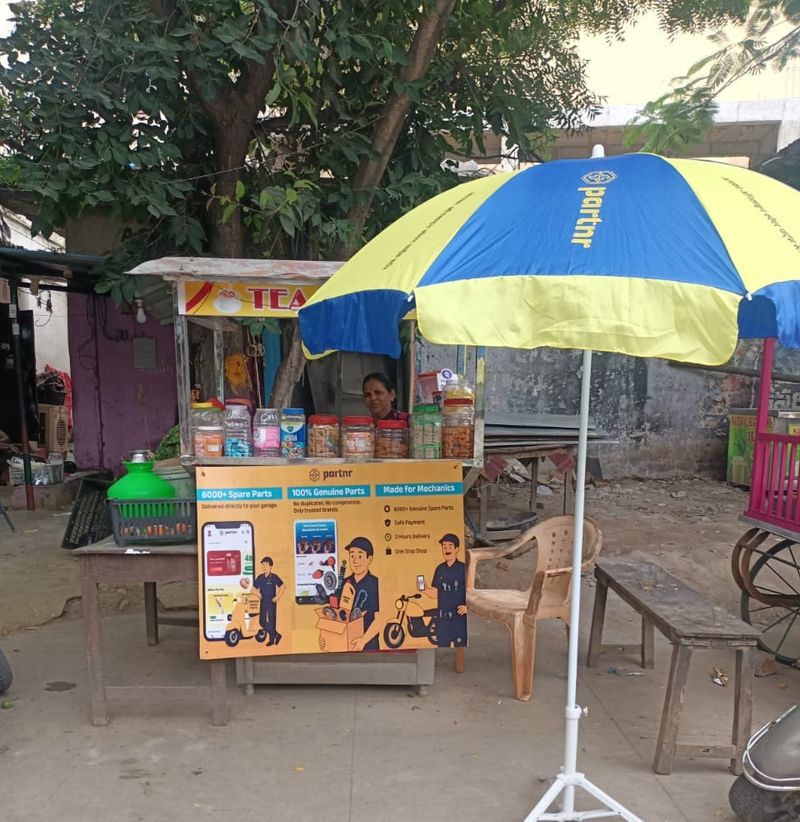
Partnr by Hero branding at a roadside tea stall
It engaged 14,500+ mechanics, generated 5,700+ app installs and achieved a 38% repeat rate in 30 days.
No translation exercise could have done that. It took knowing that a mechanic trusts the tea stall more than the hoarding, and that a conversation over chai is worth more than a banner. That is the cultural logic this post is about.
What is hyperlocal marketing?
Hyperlocal marketing targets a very small area, such as a neighbourhood, a society or a single street, with messages, places and formats that suit it. It works because relevance is highest close to home. In India, hyperlocal marketing usually means local language, local rituals and local meeting points.
How is regional marketing different from cultural marketing?
Regional marketing adapts a campaign to a state or language market. Cultural marketing goes deeper, into the rituals, symbols and habits of a community. The strongest campaigns do both: regional marketing for the language, cultural marketing for the meaning.
Local language and local tags travel together. Our free AI Hashtag Research tool ranks hashtag sets by reach for Instagram, LinkedIn, Twitter/X and Facebook, in high-reach, balanced and niche tiers.
To plan hyperlocal media across street and screen, talk to our OOH and DOOH team. We plan and buy OOH and DOOH across India, including digital billboards, transit media, airports and malls in 30+ cities, with impression tracking included.
Tell us which neighbourhood you want to win and we'll show you how. Let's talk.
What Brands Need to Be Careful About
Here’s where most brands trip up. India rewards authenticity, not appropriation. Cultural marketing that borrows without belonging gets noticed for the wrong reasons.
Why Brands Choose CupShup as Their BTL Marketing Agency
CupShup isn't just another btl marketing agency. We build it into every campaign we run for 400+ brands across 30+ Indian cities. From hyperlocal sampling drives and mall activations to AI-powered audience mapping and real-time campaign dashboards, our approach is built to work on the ground and online.
Here’s what seasoned marketers always double-check before launch:
- Don’t turn devotion into decoration. Religious and cultural symbols deserve respect.
- Test local nuance. What’s playful in one city might be offensive in another.
- Beware of “festival fatigue”. Every Diwali doesn’t need a discount; sometimes it needs a story.
- Always involve local voices. Run ideas by residents, artisans, or local agencies. They’ll spot tone-deafness before Twitter does.

At CupShup, we have a simple rule: if someone from that region doesn’t smile instinctively, we go back to the drawing board.
Why CupShup’s Hyperlocal & Guerrilla DNA Fits Right In
CupShup isn’t just another agency chasing clicks. We chase connection.
We call ourselves an integrated growth partner because we turn offline moments into online movements. Our activations live on streets first, screens second.
We don’t make ads. We make anecdotes.
When someone says, “Yaar, kal ek mast campaign dekha”, we’ve already won.
This is what true hyperlocal growth marketing looks like - grounded in community, powered by creativity, and amplified through ambient advertising.
Key Takeaways for Growth Leaders & Brand Managers

Final Thoughts
Culture in India isn’t a layer you add, it’s the fabric you weave through.
When brands stop marketing to people and start marketing with them, everything changes.
Because here, marketing doesn’t just move products, it moves people.
And as we like to say at CupShup, it all starts with one question that never fails to open hearts (and deals):
“Ek cup chai piyoge?”
Ready to brew your next big conversation?
Let’s turn your brand into India’s next chai-time story.
Reach out to CupShup - an integrated growth partner
Ready to Get Started? Talk to CupShup
Whether you're planning a high-impact campaign or looking for a btl marketing agency that delivers real results — CupShup's team is ready to help. Book a Free BTL Marketing Strategy Call →
50 Integrated Marketing Campaign Ideas
The complete playbook with campaign frameworks, budget templates, and measurement guides for Indian brands.
Instant download + email copy. No spam, ever.
Explore CupShup Services
Brands that read this article also explored these services.
BTL Marketing Services
On-ground activations, sampling drives, RWA events, and experiential campaigns across India.
Learn more ActivationBrand Activation Agency
400+ brand activations across corporates, colleges, societies and transit hubs. Tech-enabled tracking.
Learn more ExperientialExperiential Marketing Agency
Immersive on-ground experiences that convert consumers into customers and brand advocates.
Learn moreAakriti Mishra
Senior Marketing Strategist at CupShup with over 8 years of experience in brand activation and integrated marketing campaigns. Aakriti specializes in creating data-driven strategies that deliver measurable results for modern brands.
Related Stories
Go Deeper with Our Free Guides
Comprehensive, in-depth marketing guides created by CupShup's experts.
BTL Marketing: The Complete Guide to Below-the-Line Strategies in India
Practical below-the-line strategies and field examples tailored to the Indian market. Covers in-store activations, product sampling, retail engagement, and measurable ROI.
ATL and BTL Marketing: The Complete 2026 Guide for Indian Brands
Uncover the differences between ATL and BTL marketing. Learn which strategy drives better ROI for your brand in the evolving Indian market.