
Interactive Campaigns: When Tech Turned Consumers Into Co-Creators
A long-form, slightly masaledaar look at how participation quietly became the most powerful tool in modern marketing and content marketing.
Looking for an event marketing agency that creates experiences people remember? CupShup uses AI-powered planning and real-time analytics to design, execute, and measure events that deliver lasting brand impact.
Let’s be honest.Marketing used to be a lot like a one-sided shaadi speech. Long, loud, and nobody really asked for it.
Brands spoke. Consumers listened. Or pretended to. Or went to the kitchen mid-ad.
Today, attention is expensive, patience is limited, and audiences have developed a sixth sense for anything that smells like “hard sell”. This is exactly why interactive campaigns did not arrive with a bang. They arrived because they had to. Modern marketing and content marketing simply could not survive without deeper participation.
Interactivity is not marketing being fancy. It is marketing being practical.Because when people are invited to do something, they stop scrolling and start caring. Thoda sa involvement, thoda sa ownership, and suddenly the brand is not an ad anymore. It is a moment that fuels participation, ugc, and organic amplification.
The Big Shift: From Reach to Participation in Marketing
For years, success was measured by reach. Kitne logon ne dekha?But anyone who has sat through enough post-campaign reviews knows reach alone does not build recall, loyalty, or love in marketing or content marketing.
Interactive marketing flips the metric. The real question becomes:What did people actually do, share, or create?
According to Harvard Business Review, customers who actively engage with brands show higher lifetime value and stronger advocacy than passive audiences . As Sourav often says, if someone is already doing something for the brand, half the job is done. Bas ab unko bore mat karo.
Participation builds emotional investment. Emotional investment builds behaviour. Behaviour leads to ugc, and ugc leads to amplification that paid marketing solutions can rarely match.
Why Interactivity Holds Attention When Everything Else Loses It
Attention today is like a Mumbai auto. You blink, it’s gone.
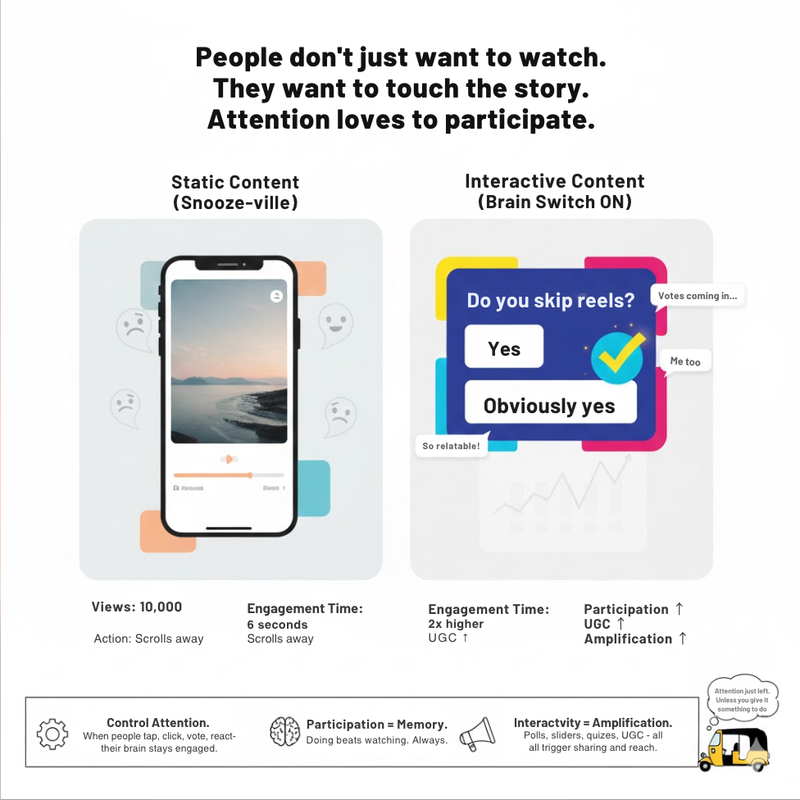
A Content Marketing Institute study found that interactive content delivers nearly 2x higher engagement time than static formats . This happens because interactivity gives people control, and control keeps the brain switched on, which is exactly what modern content marketing aims to achieve.
Doing something beats watching something. Always.
Yuvana once laughed about how people skip beautifully edited reels but will happily tap a poll asking “yes or obviously yes”. That tiny tap feels effortless, yet it drives participation, ugc, and reach in a way traditional marketing rarely can.
Interactivity Is Not a Format. It Is Behaviour Design.
This is where experience really shows in marketing solutions.
Interactivity fails when it is treated like a feature. It succeeds when it is treated like behaviour design.
People do not wake up thinking, “Aaj main ek interactive brand activation karunga”.They wake up wanting convenience, curiosity, validation, or a small dopamine hit.
The smartest marketing and content marketing campaigns do not force new behaviour. They slide into existing habits. Tech stays invisible. The idea leads.
As Sidharth from the tech team often reminds everyone during feasibility chats, if people have to ask how it works, we have already made it too complicated for participation and amplification to happen naturally.
LEGO’s “Build to Give”: When the Product Becomes the Interface
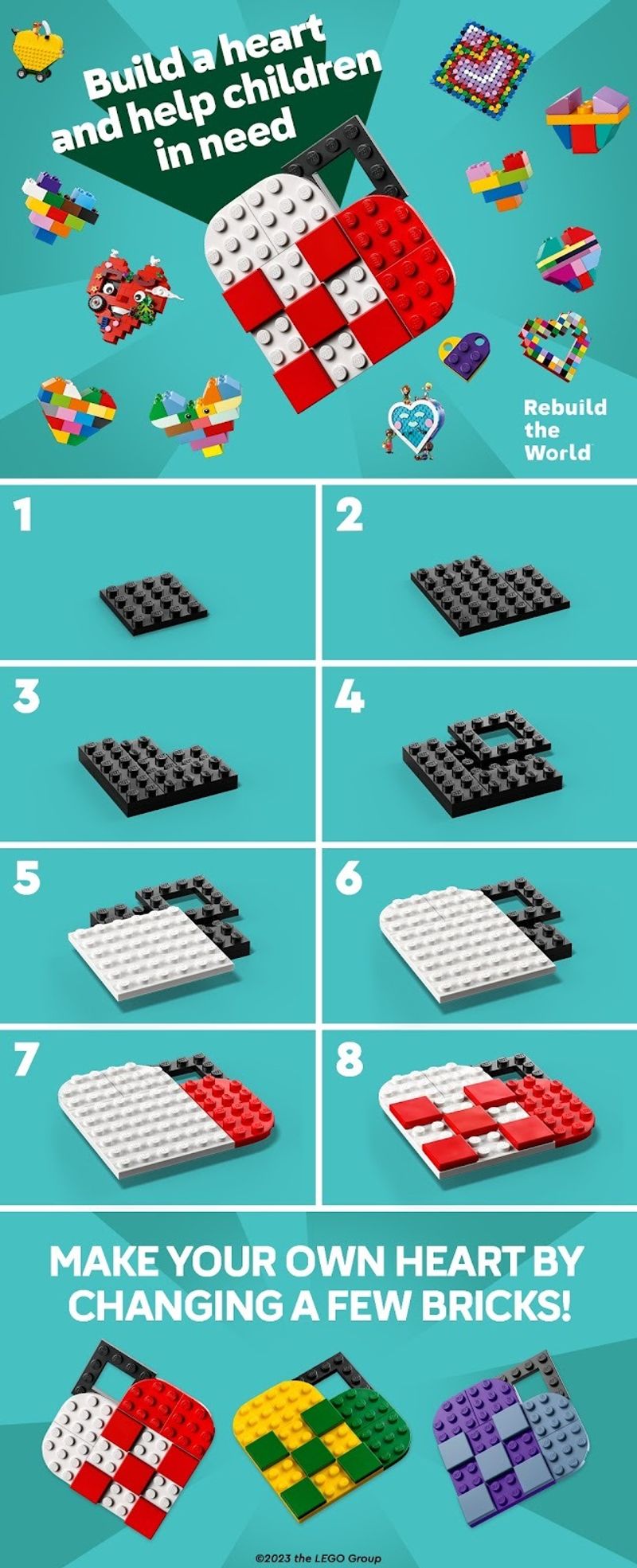
With Build to Give, LEGO showed that interactivity does not need bells and whistles to succeed in marketing.
People were invited to build a LEGO heart, share it online, and for every share, LEGO donated sets to children in need. No tutorials. No confusion. Just play.
What really worked here was how naturally the campaign fit into existing behaviour. LEGO fans already build. The campaign simply gave that action a bigger purpose and turned it into large-scale ugc.
The result was millions of user-generated posts globally and a strong boost in positive brand sentiment during the holiday season . Deeksha from client servicing summed it up perfectly during a review: when the product itself becomes the idea, participation and amplification follow almost automatically.
IKEA Place: Interactivity That Solves Real Problems
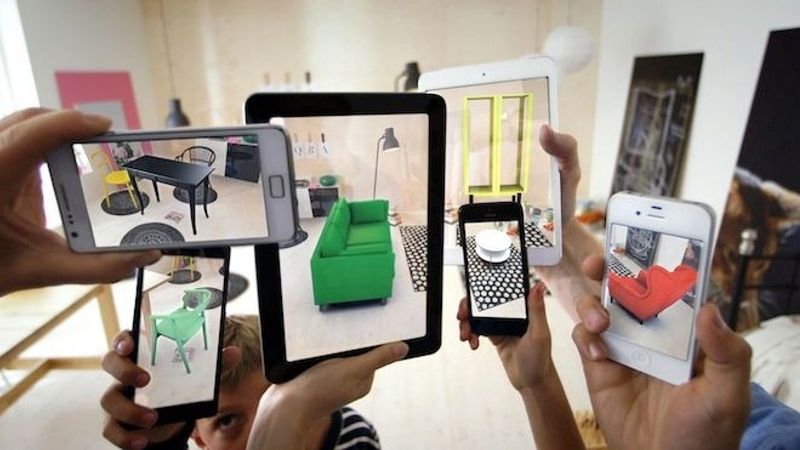
AR often gets used for wow value in marketing. IKEA used it as a practical marketing solution.
The IKEA Place app let users see furniture at true scale inside their own homes. This turned browsing into confident decision-making.
From a content marketing lens, this matters because furniture buying comes with doubt. Will it fit? Will it look right? Will I regret this purchase at 2 am?
According to TechCrunch, the app improved purchase confidence and reduced uncertainty in high-consideration categories . Yukta once put it simply in a brainstorm: interactivity works best when it reduces tension and increases participation, not just excitement.
Burger King’s “Burn That Ad”: Participation With a Reward Loop
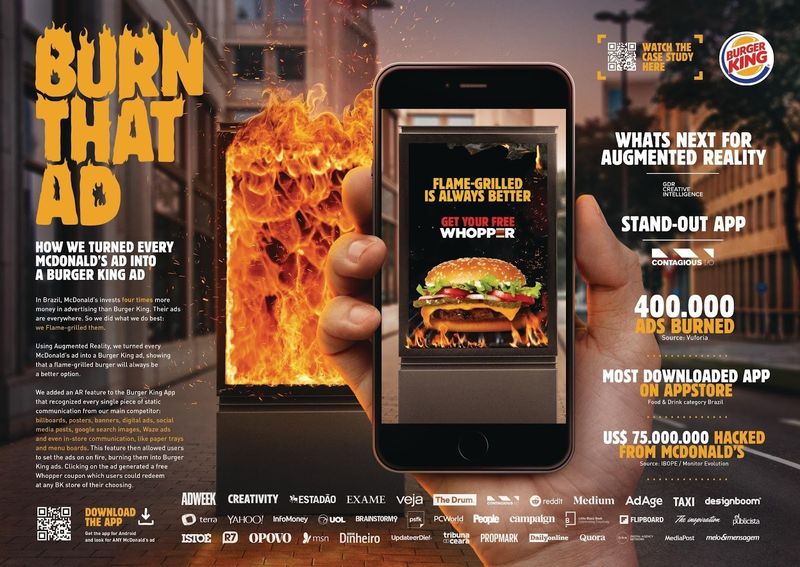
Some campaigns choose elegance. Some choose chaos. Strategically, as part of their marketing playbook.
With Burn That Ad, Burger King invited people to point their phones at competitor ads and virtually burn them using AR. The reward was a free Whopper.
The magic here was balance. The effort was low, the reward was instant, and the experience felt playful and slightly rebellious. Perfect conditions for ugc and social amplification.
The campaign drove over 1 million app downloads in weeks and picked up multiple industry awards, as reported by Adweek and Campaign Asia . Maaz from sales joked later that free burgers can motivate almost anyone, but only if the marketing experience feels smooth and worth sharing.
What High-Performing Interactive Campaigns Get Right
Read next: Behind The Scenes: The Hidden Ops Monster Inside Every Ac..., The Queue Is Your Runway: Turning wait times into engagem..., and Why Permissions & Safety Should Be Planned Before the Idea.
Across industries and markets, strong interactive campaigns follow a few clear rules that experienced marketing teams swear by.
They focus on one clear action. Not five steps. Not a manual. Just one instinctive behaviour.
They give immediate feedback. Visual change, reward, or acknowledgement. Kuch toh mile.
They respect context. Culture, location, and everyday habits matter more than platform trends in both marketing and content marketing.
And they often start offline, designed to travel online. Bijoy from ops likes to remind everyone that if something does not work on the ground, no amount of digital amplification will save it.
One more thing teams never ignore is scalability. Interactivity must hold up not just for 100 people, but for 10,000 and beyond. Otherwise, it is not a real marketing solution.
Why Brands Choose CupShup as Their Event Marketing Agency
CupShup isn't just another event marketing agency — we combine immersive experience design with AI-driven attendee insights and real-time performance tracking. With 10,000+ campaigns across 300+ cities, our events don't just create moments — they create measurable business outcomes.
Measuring Interactivity Without Overcomplicating It
Interactive campaigns are not hard to measure. They are just measured differently.
Teams usually look at participation rate, completion rate, share-to-participation ratio, post-interaction recall, and cost per meaningful action.
Divyanshu from data once pointed out how a smaller interactive campaign delivered better recall than a much larger media burst because people spent more time with it. Depth beats width, almost every time, especially in content marketing.
The CupShup Point of View: Participation at Street Level
At CupShup, interactivity is not about flashy tech. It is about understanding where people are and how they behave in real life.
A QR on a chai cup works because the cup is already in the consumer’s hand. The moment is relaxed. Curiosity comes naturally. No extra effort required.
That is how offline behaviour fuels online buzz.That is how ugc finds its way into feeds.That is how amplification happens without shouting.That is how marketing actually moves.
As the team often reminds itself while reviewing campaigns together, agar logon ko lag raha hai yeh unke jaisa hai, wahi sabse badi jeet hai.
The Real Takeaway
Technology did not change marketing. Agency did.
When brands stop trying to control the narrative and start inviting participation, marketing becomes memorable, scalable, and genuinely share-worthy.
In a world full of noise, the brands that win are the ones that make people pause, act, create ugc, and share.
Aur honestly, agar log khud aapki kahani ka hissa ban rahe hain, toh usse better marketing kya hi ho sakti hai.
That is not a trend.That is the future of marketing that moves.
Want to Build Marketing Campaigns People Actually Want to Be Part Of?
If you are done chasing impressions and ready to build marketing solutions driven by participation, ugc, and real amplification, CupShup is always up for a chai and a conversation.
Check out our blogs, follow us on LinkedIn or Instagram, or simply drop us a line at contact@cupshup.co.in.
Let’s turn everyday moments into interactive stories that travel from the street to the screen.
Get Started with CupShup Today
Ready to see real results? Book a Free Event Marketing Strategy Call → Join 500+ brands that trust CupShup.
50 Integrated Marketing Campaign Ideas
The complete playbook with campaign frameworks, budget templates, and measurement guides for Indian brands.
Instant download + email copy. No spam, ever.
Explore CupShup Services
Brands that read this article also explored these services.
Brand Activation Agency India
India's leading brand activation agency, 400+ campaigns, pan-India reach, real-time dashboards.
Learn more ExperientialExperiential Marketing Agency
End-to-end experiential campaigns that create memorable brand moments and drive measurable ROI.
Learn more BrandBrand Strategy Services
Brand identity, positioning, and messaging frameworks built for competitive Indian markets.
Learn moreAakriti Mishra
Senior Marketing Strategist at CupShup with over 8 years of experience in brand activation and integrated marketing campaigns. Aakriti specializes in creating data-driven strategies that deliver measurable results for modern brands.
Related Stories


Go Deeper with Our Free Guides
Comprehensive, in-depth marketing guides created by CupShup's experts.