
Why Culture Changes Every 10 km in Indian Cities
A street-smart guide to understanding India’s most misunderstood reality
Looking for a btl marketing agency that delivers measurable offline impact? CupShup combines AI-powered targeting with on-ground BTL activations across 10,000+ campaigns, helping brands cut through digital noise with real-world experiences that convert.
If you have spent enough time living, working, or even aimlessly wandering around Indian cities, you have probably said this at least once: “Yaar, bas 10 km door jao, sab kuch badal jaata hai”. The food tastes different. People talk differently. The vibe feels off or suddenly comforting. Even the chai somehow hits differently.
This is not nostalgia or overthinking. It is how Indian cities are wired.
At CupShup, while writing, planning, selling, servicing, and reviewing campaigns together, this reality keeps popping up in conversations. Someone will say it during a brainstorm, someone else will confirm it during execution, and by the end of the day, it becomes obvious that the city behaved exactly how culture said it would.
Let’s break down why this happens, without turning it into a sociology lecture.
Cities in India Grow Bottom-Up, Not Top-Down
Indian cities are not built like neat PowerPoint slides. They are more like shared Google Docs, edited daily by millions of people with very strong opinions.
Culture here is not decided by policies or master plans. It grows from homes, galiyan, mandirs, parks, evening walks, kirana stores, and those corners where people stop to chat without realising how long they have been standing there.
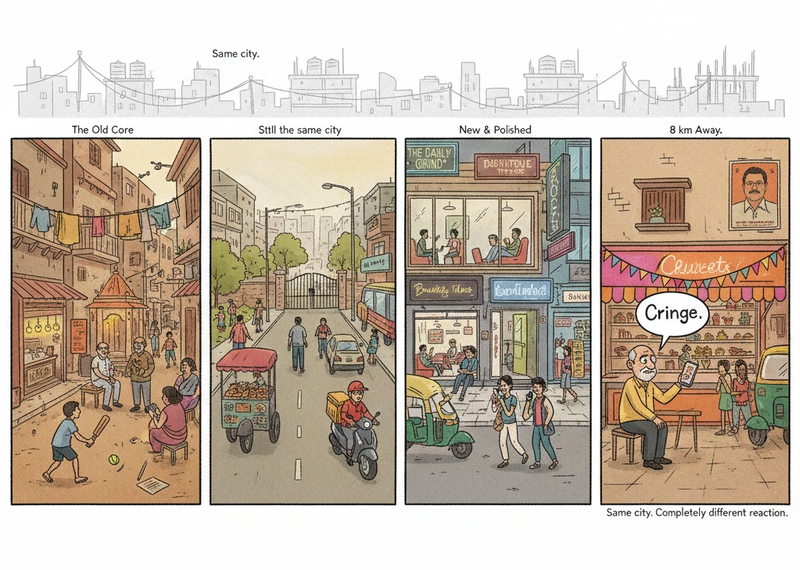
Someone from the team once joked during a content discussion, “Same reel CP mein chalega, par 8 km door log bolenge cringe”. Everyone laughed, because everyone had seen it happen.
That is not social media randomness. That is culture doing its thing.
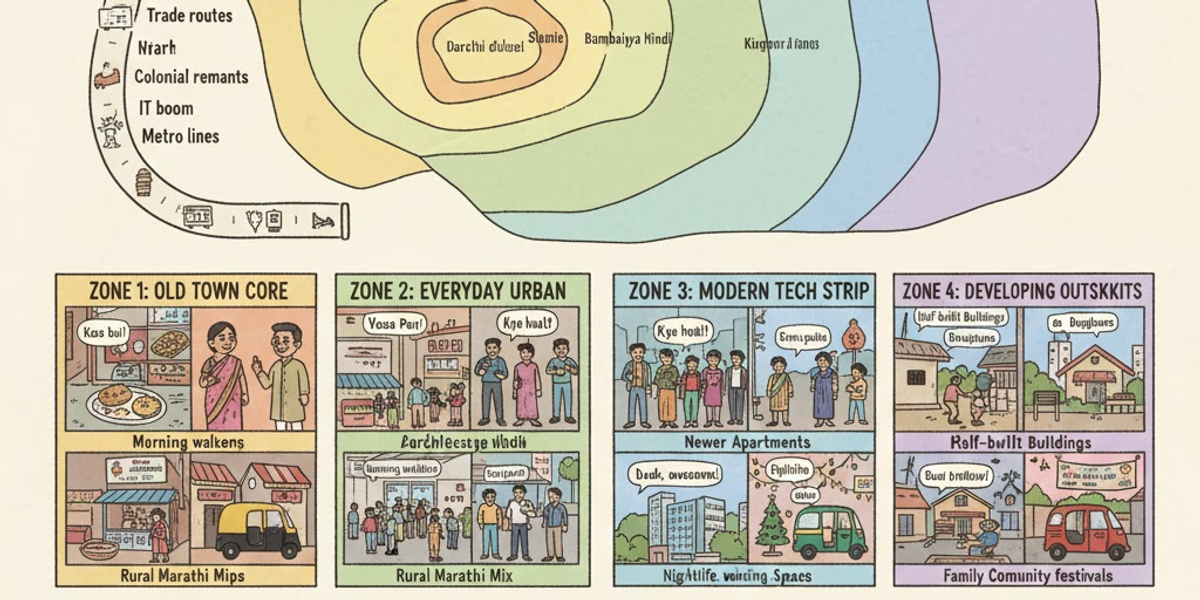
India’s diversity does not disappear in cities. It gets packed tighter. What exists across states starts existing across neighbourhoods. That is why Indian cities feel like multiple small towns stitched together, rather than one smooth cultural surface.
Neighbourhoods Are Cultural Containers
In Indian cities, neighbourhoods do not just give people addresses. They give people belonging.
Take Chittaranjan Park in Delhi. It is not just a residential area. It feels like a full Bengali ecosystem. The language you hear, the food you smell, the festivals people prepare for, everything signals familiarity. People do not move here to adjust who they are. They move here so they do not have to.
The same shift is easy to spot in Bengaluru when moving between Basavanagudi and Jayanagar. On the map, they are close. On the ground, the rhythm changes. One leans deeply into tradition and legacy. The other reflects a more planned, structured lifestyle.
As someone from the marketing team once pointed out during location planning, “Area same lagta hai map pe, par log bilkul alag cheezon pe react karte hain”. That one line explains more than most reports.
Culture clusters because familiarity feels safe. Aur log naturally wahi jaate hain jahan cheezein samajh aati ho.
History Still Shapes Behaviour
Indian cities do not forget their past. They just stop announcing it loudly.
Older neighbourhoods were built around trade, religion, caste occupations, or colonial systems. Even today, those original roles quietly shape behaviour.
In Bengaluru, Bengaluru Pete still feels dense and transactional. Markets are specialised. Conversations are direct. Trust is built over time, not introductions.
In Kolkata, Chitpur Road carries a completely different energy. Trade, publishing, performance, and culture have shaped how people speak, move, and interact there.
This is why execution teams often say, half seriously, that the ground reality always has a mind of its own. History is usually the reason.
Migration Multiplies Culture, It Does Not Flatten It
There is a common belief that migration makes cities more uniform. Indian cities prove the opposite.
People migrate with their food habits, language comfort, humour, festivals, and daily routines intact. Cities absorb all of this without forcing it into one version.
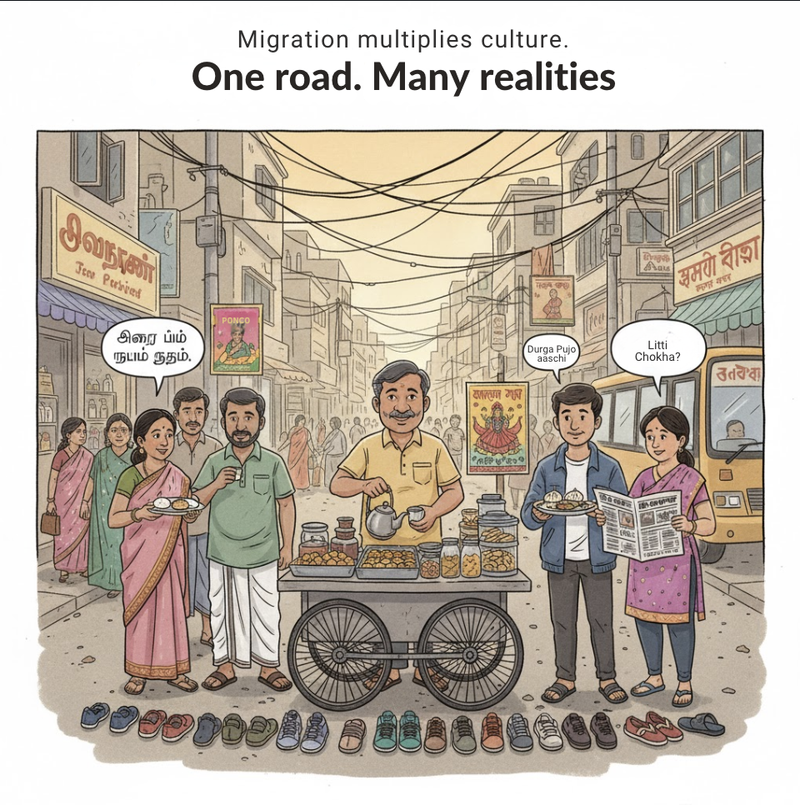
That is why Indian cities rarely feel culturally singular. They feel layered. Parallel realities exist across the same road.
Someone from ops once casually remarked, “Same stall ke dono side alag log khade hote hain”. It sounded funny, but it was also painfully accurate.
Read next: Winning the Quad: Lessons to Nail College & Society Activ..., How Emotions Shape Memory in BTL Experiences, and More Than Free: How to Turn Sampling into Strategy.
Read next: Winning the Quad: Lessons to Nail College & Society Activ..., How Emotions Shape Memory in BTL Experiences, and More Than Free: How to Turn Sampling into Strategy.
Public Life Makes Culture Visible
Culture in Indian cities does not stay behind closed doors.
Markets, temples, parks, community clubs, and evening walks teach people how to behave without ever spelling it out. How loud is okay. How late is acceptable. How celebrations work. How disagreements are handled.
In Kolkata, para culture turns neighbourhoods into living social units. In Chittaranjan Park, Durga Puja is not just a festival. It is the cultural heartbeat of the area.
These rituals create habit. Newcomers adapt quickly, often without realising it, because behaviour is constantly being demonstrated around them.
Why Brands Choose CupShup as Their BTL Marketing Agency
CupShup isn't just another btl marketing agency — we're a team that's built BTL excellence into the DNA of 10,000+ brand activations across 300+ Indian cities. From hyperlocal sampling drives and mall activations to AI-powered audience mapping and real-time campaign dashboards, our hybrid BTL + tech approach delivers results that pure-play agencies can't match.
Why Culture Changes Every 10 km
Culture shifts because each neighbourhood carries a slightly different mix of history, migration, economics, and daily life. Change the mix even a little, and behaviour changes a lot.
That is why the shift feels sudden. The buildings might look similar, but the cultural wiring underneath is different.
What Experienced Professionals Learn to Watch For
Over time, patterns become clear. Culture almost always beats demographics. Language preference tells you comfort levels. Food habits reveal identity faster than surveys. Festivals show how communities organise, spend, and include.
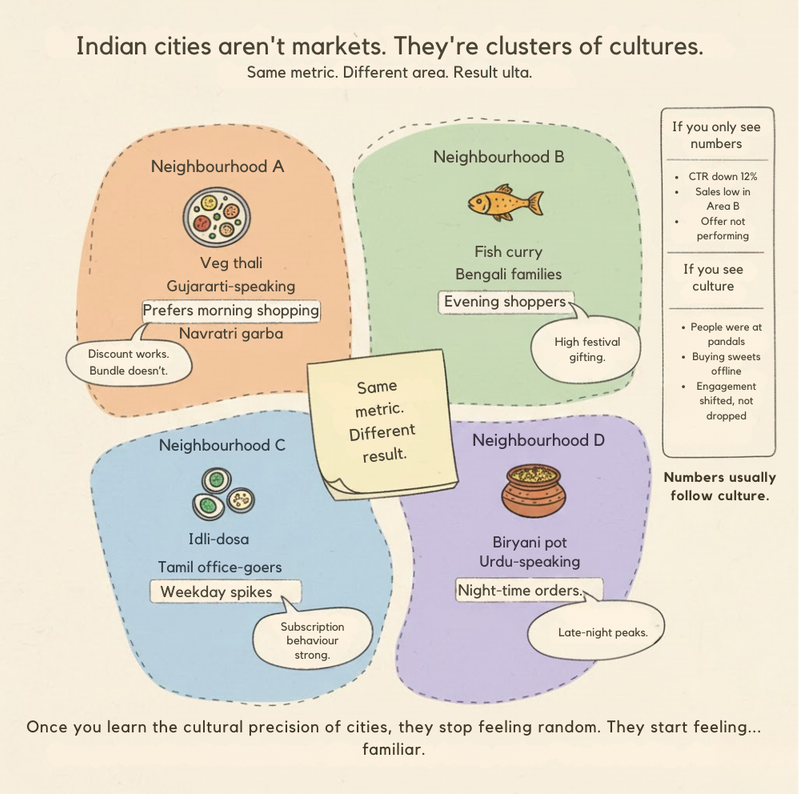
As someone from the data team often says while reviewing results, “Same metric, different area, result ulta aa jaata hai”. Numbers usually follow culture, not the other way around.
Indian cities are not single markets. They are networks of neighbourhood cultures.
Culture does not change every 10 km because India is unpredictable. It changes because India is precise at a very human scale. Once you learn to read that precision, cities stop feeling confusing. They start feeling familiar, even when they are not.
The real question is not whether culture changes every 10 km.
It is whether your brand, content, or campaign is paying attention when it does.
If you are building for India and want to turn street-level insights into work that actually lands, this is where it starts.
Let’s talk culture. Let’s talk hyperlocal. Let’s make marketing that actually moves.
Ready to Get Started? Talk to CupShup
Whether you're planning a high-impact campaign or looking for a btl marketing agency that delivers real results — CupShup's team is ready to help. Book a Free BTL Marketing Strategy Call →
50 Integrated Marketing Campaign Ideas
The complete playbook with campaign frameworks, budget templates, and measurement guides for Indian brands.
Instant download + email copy. No spam, ever.
Explore CupShup Services
Brands that read this article also explored these services.
BTL Marketing Services
On-ground activations, sampling drives, RWA events, and experiential campaigns across India.
Learn more ActivationBrand Activation Agency
400+ brand activations across corporates, colleges, societies and transit hubs. Tech-enabled tracking.
Learn more ExperientialExperiential Marketing Agency
End-to-end experiential campaigns that create memorable brand moments and drive measurable ROI.
Learn moreAakriti Mishra
Senior Marketing Strategist at CupShup with over 8 years of experience in brand activation and integrated marketing campaigns. Aakriti specializes in creating data-driven strategies that deliver measurable results for modern brands.
Related Stories
Go Deeper with Our Free Guides
Comprehensive, in-depth marketing guides created by CupShup's experts.
BTL Marketing: The Complete Guide to Below-the-Line Strategies in India
Practical below-the-line strategies and field examples tailored to the Indian market. Covers in-store activations, product sampling, retail engagement, and measurable ROI.
ATL and BTL Marketing: The Complete 2026 Guide for Indian Brands
Uncover the differences between ATL and BTL marketing. Learn which strategy drives better ROI for your brand in the evolving Indian market.