
Visual Marketing: Why Content Marketing is Your Design's Best Friend
You ever scroll through Instagram, pause at a post, and think , “I don’t even know this brand, but I like it?” That’s not magic. That’s design doing its job quietly , your eyes made the decision before your brain did.
Visual marketing is the discipline of using imagery, typography, motion, and layout to communicate brand meaning faster than words can. Done well, it makes a campaign recognisable in three seconds — whether the viewer sees a 6-second Reel, a metro station wrap, or a grocery-aisle poster.
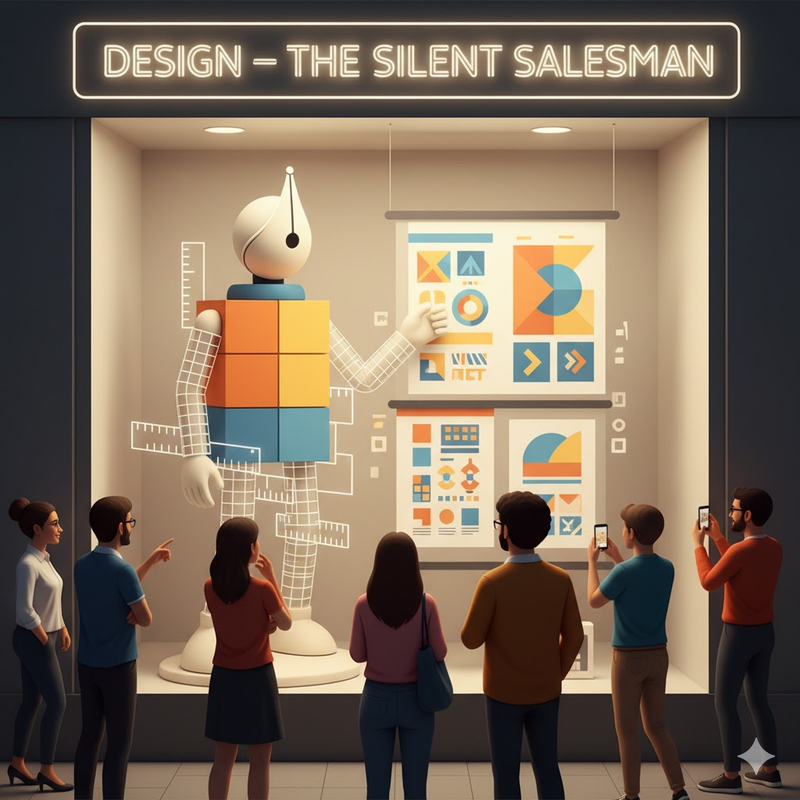
In marketing, visuals are the unsung heroes , the silent salesmen working 24/7 without saying a word. Copy convinces, but design attracts. Before anyone reads your headline, they’ve already judged your brand by its palette, typography, and layout.
At CupShup, we treat design as the first pitch. Every creative, every carousel, every in-store poster is our brand shaking hands before the conversation even starts.
What is Visual Marketing?
At its simplest, visual marketing is every piece of design a brand uses to sell, educate, or entertain — photography, illustration, video, infographics, packaging, retail design, and motion. It's the 80% of a campaign that your audience decodes before they read a single word.
The shift matters more now than it ever has. Instagram users spend an average of 53 minutes a day on the app — most of it scrolling through visual-first feeds. On TikTok that figure is 58 minutes. On YouTube Shorts, 40. Consumers have trained themselves to judge brands from a thumbnail. If your visual layer doesn't earn the next tap, your copy, offer, and product never get a chance.
That's why the best Indian marketers — Zomato, Cred, Blinkit, boAt, Nykaa — have moved visual marketing from "one of the channels" to the operating system of their brand. Every touchpoint, from a WhatsApp sticker to a Diwali OOH, carries the same design DNA.
Why Visuals Matter
You can write the most poetic caption in the world, but if the creative looks like it was made in a rush on MS Paint circa 2009, people are gone. Attention is a luxury, and visuals are how you buy that first three seconds of someone’s time.
Visuals don’t just ‘look good’ , they communicate. They tell people what kind of brand you are before you say a word.
Good design can make your campaign:
- Recognisable: Consistent colour, tone, and typography build instant recall.
- Relatable: Visuals reflect your audience's world — what they wear, feel, share.
- Reliable: Clean, cohesive design signals professionalism and trust.
That’s why we call design the ‘silent salesman’. It sells without selling.
The CupShup Approach
Scroll through our socials and you’ll see what we mean. Whether it’s a case study carousel or a meme-style post about agency life, our creatives always look like us. There’s a certain CupShup-ness to them , bold fonts, smart color play, clean balance between text and negative space.
🎨 Want creatives that earn the scroll instead of buying it? Request a free visual marketing audit from CupShup → — Trusted by 500+ brands across India.
Our designer Stuti jokes that every post has to pass the “scroll test” , if it doesn’t make you stop mid-scroll for at least two seconds, it’s not going up.
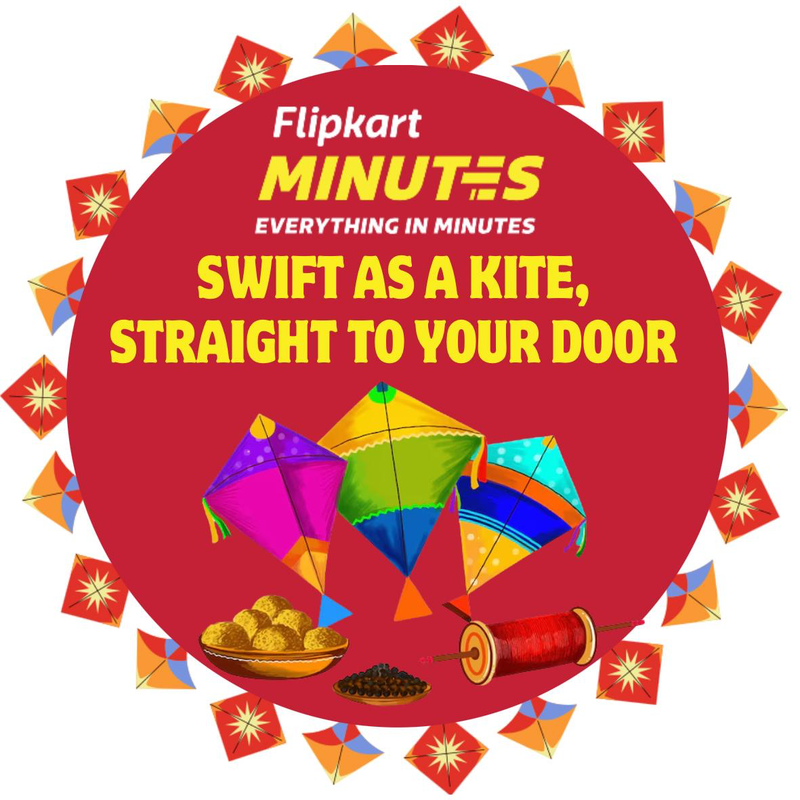
And it’s not just about looking good. Every design is built around the campaign’s story. When we worked on Spencer’s festive campaigns, each visual element tied back to the core thought , warmth, inclusivity, festivity. For Flipkart Minutes, the creatives carried speed, convenience, and community right in their layout , motion, clocks, quick swipes, instant gratification.
Because visuals aren’t decoration. They’re direction. They tell the audience where to look, how to feel, and what to remember.
What Makes a Good Visual?
We’ve made thousands of creatives (and yes, a few flops too), and here’s what we’ve learned works every time:
Clarity over clutter
The eye should know where to go first. If your creative makes the viewer hunt for the message, you've already lost the scroll. Strip the frame to one dominant focal point and let everything else support it.
Emotion over excess
A good visual makes you feel something, not everything. Pick one emotion — trust, joy, desire, urgency — and make every element (colour, typography, composition) push that emotion. Brands that try to feel all things to all people end up feeling like nothing to anyone.
Hierarchy matters
Headlines, imagery, and logos should guide the gaze in a deliberate order. A three-second viewer should see the hook first, the product second, the brand third — not all three fighting for attention in the same 100 pixels.
Consistency is credibility
If your posts look like they were made by five different people (and one of them was in a hurry), your audience reads that as unprofessional — even if they can't articulate why. A visual system done well compounds. Every post invests in the next.
Visual design isn’t just aesthetics , it’s psychology. Colors evoke emotions. Fonts create tone. White space builds confidence. Every line and layer speaks, even when you don’t.
Design That Speaks (Even When You Don’t)
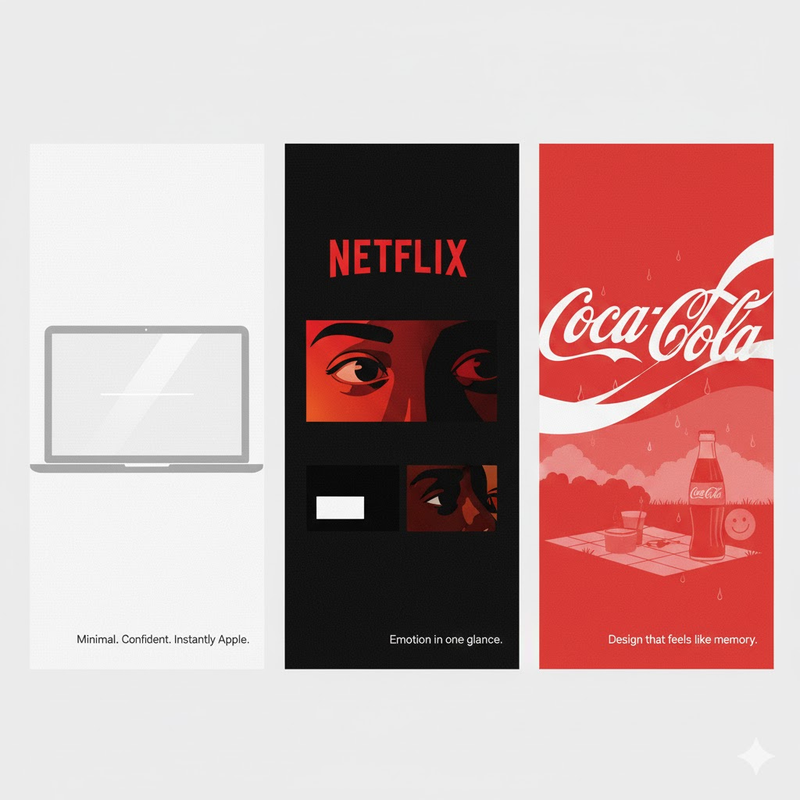
Some of the best brands in the world have mastered this. Think Apple , minimal, confident, no wasted space. You could remove the logo, and you’d still know it’s them. Netflix? Every thumbnail is engineered to make you feel something in one glance , tension, humor, heartbreak. And Coca-Cola, with its red-white balance and curved typography, has turned design into nostalgia.
✨ Ready to build a visual system that compounds? Book a free design teardown with CupShup → We'll audit 10 of your recent creatives and tell you what's working, what's guessing, and what to fix next.
That’s the secret: you recognize the emotion before you even process the product.
At CupShup, we aim for that level of clarity. Whether it’s an offline poster or a digital carousel, each creative has to say: “This looks like CupShup”. For instance, in our campaign for Zomato Hyperpure, the visuals weren’t about showing vegetables and warehouses. They were about freshness you could feel. Greens that popped, clean lines, and textures that said “quality” without needing a headline.
The Science (and Art) of Recall
Design works because our brains love shortcuts. You see a blue bird , you think Twitter (well, X). You see yellow arches , McDonald’s. You see black, white, and bold typography with clean humor , probably CupShup on your feed.
But consistency isn’t about repetition. It’s about recognition.
Here’s how we build that:
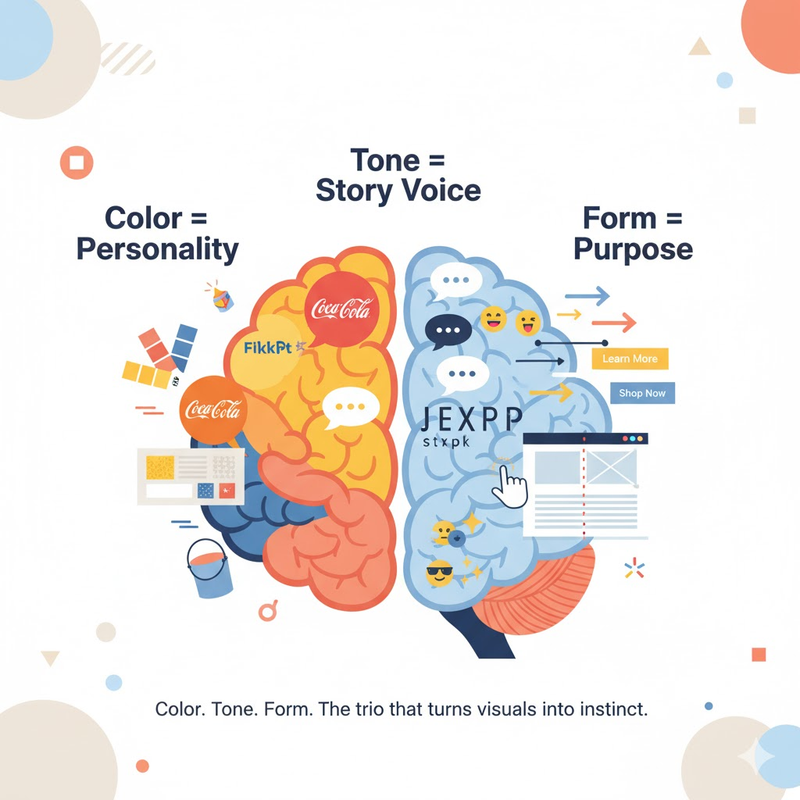
Colour as a character
Brands need a palette that behaves like a personality. Spencer's warm tones signal familiarity. Cred's deep blacks signal premium. Boat's loud reds signal energy. The colour is doing 40% of the positioning work before the product even enters the frame.
Tone as a signature
Whether playful, bold, or minimal, the tone of the visual must match the brand's story. A fintech brand using the same whimsical illustration style as a kids' snack brand will confuse every viewer — even if both designs are 'nice' on their own.
Form as function
The design should do something — guide, highlight, evoke. Pretty without purpose is just decoration. Every element in a strong creative has a job: the headline earns the scroll, the imagery carries the emotion, the CTA makes the click feel obvious.
And we’ve learned this the hard way. The one time we tried to go ‘experimental’ with a client known for its simplicity, the visual looked so off-brand that even the client said, “This looks nice, for someone else”. Lesson learned: just because it looks good doesn’t mean it fits.
The 7 Types of Visual Marketing
Not every brief needs the same visual answer. The strongest marketing teams treat these seven formats as a toolbox — not a checklist.
1. Branded Imagery & Photography
Still the foundation. Product shots, lifestyle photography, studio sets — these assets fuel every downstream format: ads, landing pages, PDPs, packaging. Invest once, use everywhere.
Where it wins: e-commerce, D2C, hospitality, real estate. Where it fails: when brands reuse stock imagery that doesn't match their audience or market.
2. Infographics & Data Visualisation
When the message involves numbers — benchmarks, processes, pricing — a clean infographic outperforms a 500-word caption. On LinkedIn, infographic carousels drive 3× the engagement of plain text posts.
Where it wins: B2B, fintech, SaaS, education. Where it fails: when the data is thin or the design chokes on jargon.
3. Short-Form Video (Reels, Shorts, YouTube Shorts)
6- to 60-second videos dominate every major platform feed. Reels now account for more than 50% of time spent on Instagram in India. The hook lives in the first 1.5 seconds — usually a bold visual, not a spoken line.
Where it wins: consumer brands, D2C, entertainment, food, fashion. Where it fails: when brands try to compress a 3-minute film into 15 seconds instead of writing short-form from scratch.
4. Carousel & Static Social Posts
The most underrated format. A well-built 6-slide carousel keeps viewers on your post for 20-40 seconds — longer than most Reels. Instagram's algorithm reads that dwell time as a signal to serve the post to more people.
Where it wins: educators, founders, agencies, thought-leadership brands. Where it fails: when slide 1 doesn't earn the swipe.
5. Motion Graphics & GIFs
Animated logos, loading sequences, micro-interactions, and explainer GIFs give life to product pages and emails. A Litmus study found animated GIFs in emails lift CTR by 26%.
Where it wins: SaaS product pages, email newsletters, onboarding flows, fintech apps. Where it fails: when motion distracts instead of directing.
6. User-Generated Content (UGC)
Real customers, real phones, real lighting. UGC converts because it breaks the "this is an ad" filter. For D2C beauty and food brands, UGC-led ads typically cut CAC by 20-35% versus studio-polished ads.
Where it wins: beauty, food, fitness, travel, fashion. Where it fails: when brands try to fake it — audiences can sniff out a scripted "real customer" immediately.
7. Experiential & OOH Visuals
Billboards, metro wraps, mall activations, pop-ups. Still one of the few formats that can't be skipped. The best brands now design OOH to be photographed and reshared — making offline a feed of social content.
Where it wins: launches, festive campaigns, category-defining moments. Where it fails: when the visual only works at 3 metres and 4 seconds — but the viewer is 30 metres away at 60 km/h.
Visual Marketing Tools Every Brand Should Use
Tools don't make the marketer, but in 2026 they do define speed. A lean brand team with the right stack can ship 10× the creative of a team still routing every asset through a design agency.
Design & creation
Canva for speed and templates. Figma for collaboration and design systems. Adobe Creative Cloud (Photoshop, Illustrator, Premiere) when craft matters — hero campaigns, packaging, pitch decks. Pick one as your home base and stop switching.
For motion specifically, CapCut (mobile) and After Effects (desktop) cover 90% of use cases. LottieFiles is where every web-native animation lives.
AI & automation
Midjourney and DALL-E 3 for concept art and moodboards. Runway ML for short-form video generation and background removal. Adobe Firefly for commercially safe generative fills. Treat these as a speed multiplier for concepting — not a replacement for human craft at the finishing stage.
On the asset-management side, Brandfolder and Frontify keep brand guidelines, logos, and approved assets in one source of truth. Critical when 20 agency partners are all producing creative for you.
Testing & analytics
VWO and Hotjar for on-site visual A/B testing (which hero image converts? which product shot earns scroll?). Meta Ads Library to see which creatives your competitors are running. Later Analytics to measure which visual formats drive your social engagement rate.
The brands that win visual marketing aren't guessing. They run five versions of every key creative, measure, and double down on the winner.
Visual Marketing Examples That Worked (India)
Theory is cheap. Below are five Indian campaigns where visual decisions were the real product — the thing that moved the business metric.
Zomato — weather-triggered creatives
In the 2023 monsoon, Zomato ran a programmatic OOH campaign where billboard creative auto-switched based on real-time rainfall data. When it rained, the billboard read "It's raining. You know what to do." The visual was one ingredient — a steaming biryani bowl. Orders on rainy days were reported to lift by 20-25%.
The visual lesson: minimal copy + contextual imagery + one product hero = a creative that writes itself into the viewer's situation.
Cred — a minimalist visual system
Cred's entire brand is a visual argument. Black backgrounds, one accent colour per campaign, serif typography, Bollywood-tier celebrity talent shot deadpan. The visual system is so distinctive that viewers recognise a Cred ad in 400 ms — before the logo ever shows.
The visual lesson: consistency is a growth lever. A rigid visual system is worth more than a dozen "creative" experiments that each burn brand recall.
Swiggy — "Voice of a City" billboards
Swiggy built 100+ hyperlocal billboards referencing specific neighbourhoods — "Koramangala, your pad thai is here", "Bandra, the biryani knows your address". Every creative used the same typographic treatment, same illustrated food mark, same tone.
The visual lesson: you can scale personalisation through visual systems. One template × 100 hyperlocal hooks beats 100 one-off designs.
Amul — 60 years of topical visuals
Since 1966, Amul's weekly topical ad (the Amul girl commenting on news and culture) has been the longest-running visual marketing campaign in India. The format never changed — illustrated girl, white/blue wordplay, pun-heavy headline — but the topicality is rebuilt every week.
The visual lesson: a strong visual template is cheap to ship and compounds every year. Don't redesign; refresh.
CupShup × Spencer's — festive visual identity
When we worked on Spencer's festive campaigns (Diwali, Pongal, Onam), each market got its own visual treatment — but every treatment tied back to the same three design anchors: warmth, inclusivity, festivity. The palette shifted (rangoli reds for Diwali, kolam yellows for Pongal), the core typography and layout did not.
The visual lesson: localise the palette, hold the system. It's how national brands stay recognisable across 12 languages and 28 states.
Why Brands Choose CupShup as Their Visual Marketing Partner
CupShup isn't a design shop. We're a marketing partner that builds visual systems designed to sell. Our creative leads sit next to strategy and media — so the visual choices get made with the campaign funnel in mind, not after it. We've shipped 10,000+ creatives across 500+ brands in categories from D2C beauty to Tier 2 real estate. The work has to earn the scroll, the swipe, and the sale — or it doesn't leave the studio.
Visuals Build Trust Before Words Do
In campaigns, visuals are the first impression and the lasting one. They decide if your audience pauses, reads, clicks, or walks away. A good design doesn’t just grab attention , it builds memory.
When we create campaign identities, we treat visuals as conversation starters. They do the heavy lifting while copy, amplification, and storytelling follow through. It’s why we call design our silent salesman. It sells without speaking, persuades without pressure, and often outperforms words.
A Quick Takeaway for Marketers
If you’re planning your next campaign, here’s the visual checklist we swear by:
- Does your creative feel on-brand at a glance?
- Can someone recognize your campaign without reading a word?
- Would your TG stop scrolling for it , even if they didn’t know you yet?
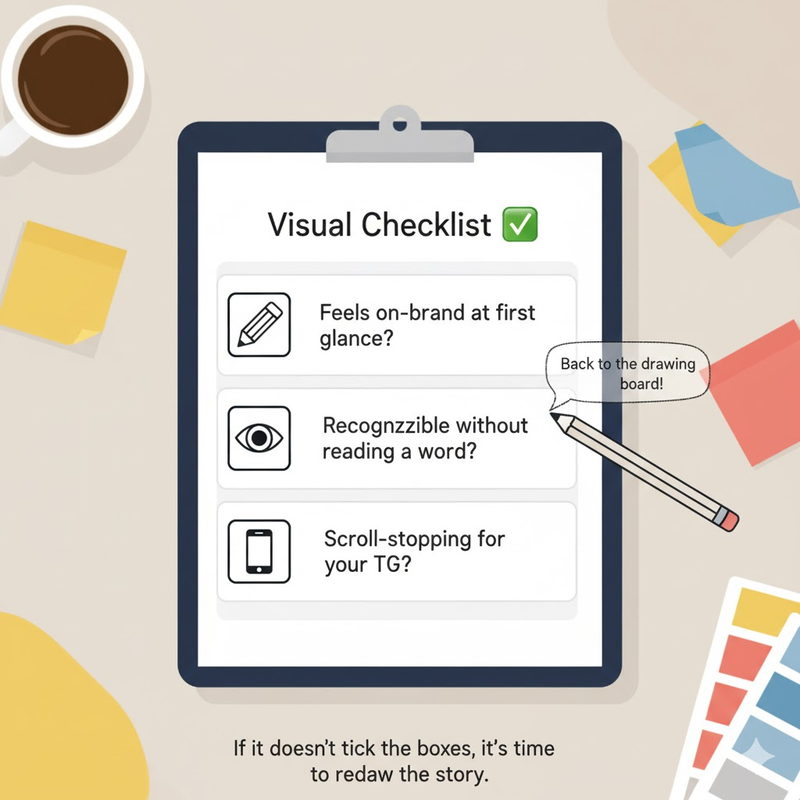
If not, it’s back to the drawing board. Literally.
Frequently Asked Questions
What is visual marketing?
Visual marketing is the use of imagery, typography, motion, and layout to communicate brand meaning across every channel — social media, OOH, email, product pages, packaging, and retail. It's everything a customer sees before they read.
What's the difference between visual marketing and content marketing?
Content marketing includes everything — long-form blogs, podcasts, newsletters, webinars. Visual marketing is the subset focused specifically on what audiences see. Most content marketing campaigns will include visual marketing assets (thumbnails, hero images, infographics), but not every visual marketing campaign needs long-form content.
Which visual marketing format drives the highest engagement?
It depends on the platform. On Instagram, carousels outperform Reels for dwell time but Reels win reach. On LinkedIn, infographic carousels drive 3× the engagement of text posts. On YouTube, thumbnails (a visual asset) account for 70% of whether a video gets clicked. There is no single winning format — only winning combinations.
How much should a brand spend on visual marketing?
Consumer brands in India typically allocate 15-25% of their total marketing budget to creative production (photography, video, design). D2C startups often spend higher — 30-40% — because paid ad performance is more creative-sensitive than channel-sensitive. B2B brands usually spend less, around 10-15%.
What are the best visual marketing tools in 2026?
For most brands: Canva or Figma for design, CapCut or Premiere for video, Midjourney or DALL-E for concepting, and VWO or Hotjar for testing. If you're managing 10+ agency partners, add Brandfolder or Frontify for asset governance.
How do I measure visual marketing ROI?
Measure at two levels. Asset-level: CTR on ads, dwell time on posts, save/share rate on carousels, scroll depth on landing pages. Campaign-level: brand recall (survey-based), branded search volume, and — ultimately — revenue lift on segments exposed to your creative vs. those that weren't.
Final Word
In 2025, visuals aren’t just part of marketing , they are marketing. The right design can tell your story, build your brand, and close the deal , all before the caption loads.
At CupShup, we’ve seen it across hundreds of campaigns: visuals create the first spark, but when done right, they keep the fire going long after the campaign ends.
Ready to Make Your Visuals Work Harder?
If your creatives feel scattered, or your last campaign looked nothing like the one before it, you don't need more design. You need a system. Talk to the CupShup team and we'll audit your last 10 visuals, show you exactly where the brand consistency is leaking, and share the template we use with 500+ brands to fix it.
Because great visuals don't just catch attention — they start conversations that close.
50 Integrated Marketing Campaign Ideas
The complete playbook with campaign frameworks, budget templates, and measurement guides for Indian brands.
Instant download + email copy. No spam, ever.
Essential Digital Content Marketing Tools for Visual Marketing Success
HubSpot Content Hub
Content Marketing PlatformComprehensive content marketing platform with digital content marketing features for visual content strategy
Learn More →Buffer
Social Media ManagementSocial media management platform with content marketing solutions for visual content scheduling
Learn More →Ahrefs
SEO & Content ToolsSEO and content marketing platform for content creation in digital marketing and visual content optimization
Learn More →Related CupShup Content Marketing Solutions and Visual Strategy Services
Explore how CupShup's content marketing expertise and digital content marketing solutions help brands maximize visual marketing through strategic content creation in digital marketing.
Content Marketing Solutions
Expert content marketing for visual storytelling and digital content marketing
Digital Content Marketing Services
Comprehensive digital content marketing for visual content creation and optimization
Visual Brand Strategy
Advanced content creation in digital marketing for visual brand storytelling
Content Marketing Case Study
How content marketing solutions drive visual engagement and brand success
Digital Content Strategy Services
Professional content marketing for scalable visual marketing strategies
Visual Marketing Case Study
How digital content marketing transforms visual storytelling and customer engagement
Explore CupShup Services
Brands that read this article also explored these services.
Digital Marketing Agency
Full-stack digital marketing, performance, social, content, and programmatic campaigns.
Learn more AIAI-Powered Digital Marketing
AI-first marketing campaigns powered by data, automation, and predictive analytics.
Learn more ActivationBrand Activation Agency India
Turn brand awareness into real-world engagement with CupShup's 400+ activation track record.
Learn moreYuvana Singh
Creative Director passionate about storytelling and brand innovation. Yuvana leads CupShup's creative team, bringing fresh perspectives to campaign development and helping brands connect with their audiences through compelling narratives.
Related Stories

Go Deeper with Our Free Guides
Comprehensive, in-depth marketing guides created by CupShup's experts.
The Ultimate Guide to Brand Activation
Everything you need to know about bringing your brand to life, strategies, examples, and frameworks.
The Ultimate Guide to Digital Marketing
Master every channel in the modern digital marketing ecosystem, from SEO to paid media.
The Ultimate Guide to SEO
The definitive guide to search engine optimization, on-page, technical, and link building strategies.