
AI for Marketing Powers Predictive Marketing: Artificial Intelligence in Marketing Strategy
Marketers have always wanted a crystal ball. If only we could peek into what consumers will do next week, next month, or next festive season, life would be simpler. Instead, for decades we’ve relied on surveys where people confidently said they “rarely order food online” and then quietly ordered biryani twice that night.
Looking for an ai marketing agency that combines cutting-edge AI tools with real marketing expertise? CupShup leverages AI-powered strategies across 10,000+ campaigns, helping brands automate, personalize, and scale their marketing with measurable results.
Enter predictive marketing, where AI doesn’t just tell you what consumers say they’ll do, it guesses what they’ll actually do. And in 2025, the guesses are getting scarily accurate.
At CupShup, we’ve been living this shift firsthand. Predictive tools like ChatGPT, Claude, Perplexity, and DeepSeek aren’t just helping us make sense of what consumers did, they’re giving us signals about what they will do. And the magic lies in combining raw data with human psychology. Because let’s face it, consumers are creatures of habit wrapped in emotion. We think we’re rational, but our behaviour is often driven by that little dopamine hit of a discount notification or the social pressure of a neighbour flaunting their new app download.
Why Prediction Beats Reaction
Here’s the difference. Traditional marketing waits for a consumer to act, then responds. Predictive marketing nudges them before they even realise what they want.
Take Snabbit, for instance. Their home-service platform was exploding in demand across NCR this year, but the real challenge was anticipating where demand would spike next. Was it South Delhi maids? Gurgaon electricians? Or Noida’s eternal war against plumbing disasters? Using predictive AI layered on top of local data, we could map hotspots and plan RWAs activations in those areas before competitors got there. By the time rival flyers showed up in society mailboxes, Snabbit was already the talk of the colony WhatsApp group.
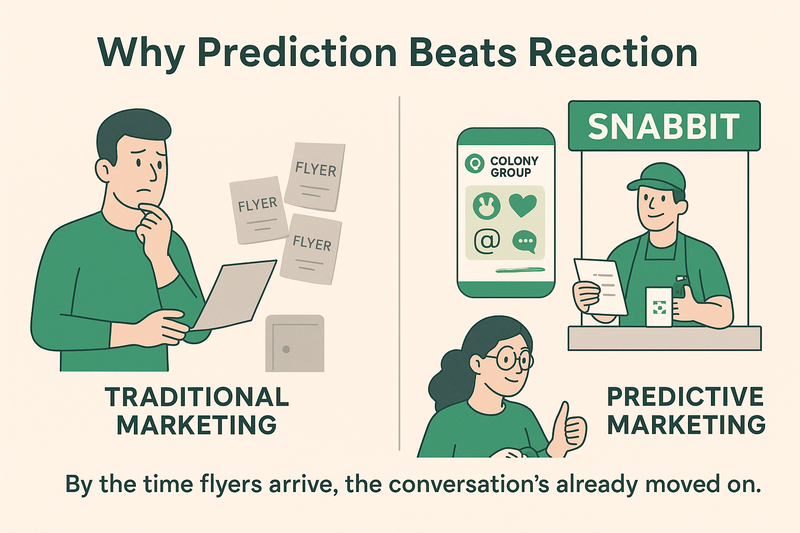
That’s predictive marketing in action: moving first, not faster.
The Psychology Behind It
Why does it work? Because humans are boringly predictable. We stick to routines, follow social cues, and are swayed by subtle emotional nudges. Psychologists call it “heuristics”; we just call it “aunties asking the neighbour which app they use.”
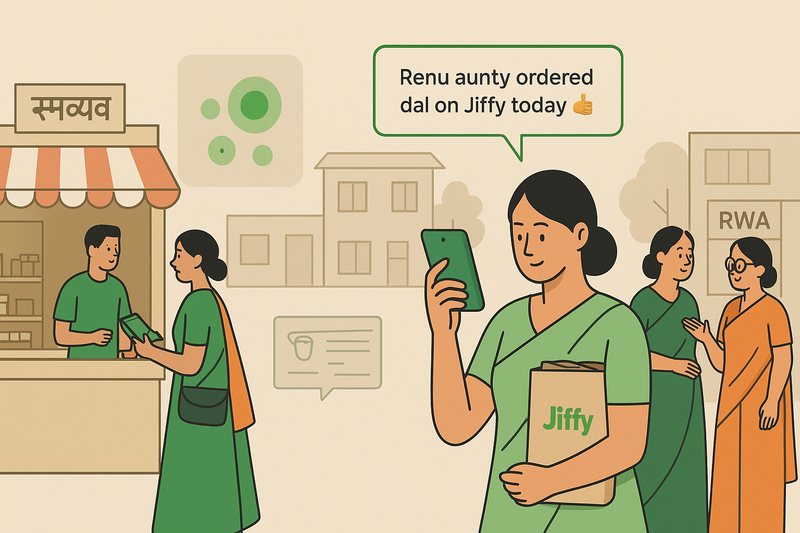
For Spencer’s Jiffy, their e-commerce play, we leaned heavily on this insight. We knew shoppers wouldn’t suddenly abandon their daily kirana trips, but if we could catch them in-store, during activations, and plant the seed of “What if groceries came to you faster?”, behaviour would slowly tilt. RWAs were the second push: see your neighbour order dal on Jiffy, and suddenly it feels safe to try. Predictive AI told us which SKUs and which neighbourhoods had the highest adoption probability, and human behaviour took care of the rest.
Predictive Marketing Analytics: How Data Forecasts Campaign Success
Predictive marketing analytics is the practice of using historical data, machine learning models, and statistical algorithms to forecast future marketing outcomes. Instead of guessing which campaign will work, you let the data tell you — before you spend a single rupee.
At CupShup, we use predictive analytics to answer questions like: Which neighborhoods will respond best to a sampling campaign? What time of day drives the highest engagement at office activations? Which creator partnerships will generate the most UGC? The answers don't come from intuition — they come from patterns in data from 400+ previous campaigns.
The Tools of the Trade
Here’s where AI comes in. Tools like Claude and ChatGPT are brilliant at decoding patterns in consumer chatter, reviews, and campaign responses and turning them into signals. Perplexity helps us run fast, reliable trend scans so we’re not just guessing what Gen Z will meme next week. DeepSeek? It’s the nerd in the corner crunching probabilities at scale.
One of the prompts we often use at CupShup is this: “You are a consumer psychologist and senior strategist at CupShup. The brand is [X]. Based on current consumer trends, predict five micro-behaviours or triggers that would make our target audience adopt this service or product faster. Link each trigger to a practical campaign idea.” Half the time, the outputs are spot on. The other half, they’re weirdly poetic like “Make the consumer feel like a sunflower.” But even that sparks ideas.
How AI in Marketing Is Changing Campaign Decision-Making
AI in marketing isn't just about chatbots and content generation. The real revolution is in decision-making. AI-powered marketing tools can now analyze thousands of data points — location demographics, weather patterns, social sentiment, competitor activity — and recommend the optimal campaign strategy in minutes instead of weeks.
For on-ground marketing agencies like CupShup, this means we can predict which activation format will work best in a specific city, at a specific time, for a specific audience segment. That's not replacing human creativity — it's giving creativity better raw material to work with.
When Prediction Meets Creativity
Prediction alone isn’t enough. If it was, every brand would just stalk data dashboards all day. The trick is to turn those insights into creative, memorable hooks.
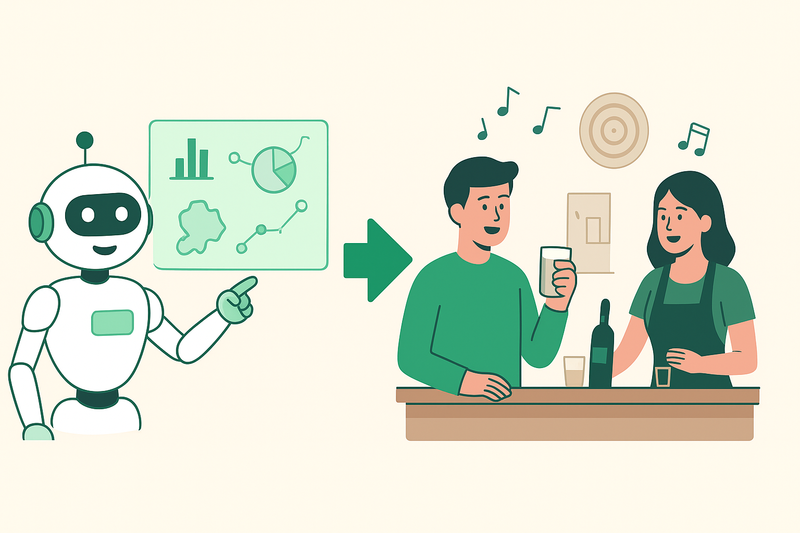
Take William Lawson, the beer brand. We obviously can’t splash pints on billboards, but predictive insights told us young professionals were craving stress-busters post-COVID, especially in corporate settings. So instead of pushing the product, we proposed concepts around corporate party activations, mini-bar canters, and office gamified evenings. Predictive AI showed us the “where” and “when”, creativity gave us the “how.” The result? A sharp, recall-friendly idea without a single can being sold on-site.
Prediction Works Best With Purpose
One of our favourite campaigns where prediction met purpose was with Allen, the career institute. The insight was simple: students and parents were tired of messaging that felt transactional. AI-driven sentiment analysis kept showing us one recurring theme in student forums, frustration around the idea of “settling” or compromising. That became the seed for our “Compromise Mat Kar” campaign. It wasn’t just about coaching classes; it was about identity, ambition, and rebellion against the safe option. Predictive signals showed us the emotional triggers, but the human creative leap turned them into a battle cry.
That’s the magic mix: AI shows you the cracks, humans turn them into slogans people chant.
When Prediction Gets It Wrong
Of course, it’s not always perfect. Early last year, we fed one of our predictive models too much unfiltered Twitter data for a fintech client. The AI confidently predicted that “cryptocurrency-inspired fashion” would trend in Gurgaon. Divyanshu got so excited he even mocked up a hoodie that said Stablecoin Swag. Needless to say, it bombed. Consumers were more interested in financial security than turning Bitcoin logos into drip.
That’s when we realised: prediction without interpretation is just noise. AI can point you at signals, but if you don’t check them against actual human context, you’re one bizarre deck away from proposing Dogecoin-themed footwear.
Read next: Google Gemini & The AI Power Stack: For Marketers Who Hat..., The Best AI Tools for SEO: From Keywords to Clicks (and W..., and Performance vs. Creativity: Where AI Truly Fits in Modern....
Read next: Google Gemini & The AI Power Stack: For Marketers Who Hat..., The Best AI Tools for SEO: From Keywords to Clicks (and W..., and Performance vs. Creativity: Where AI Truly Fits in Modern....
The Psychological Side
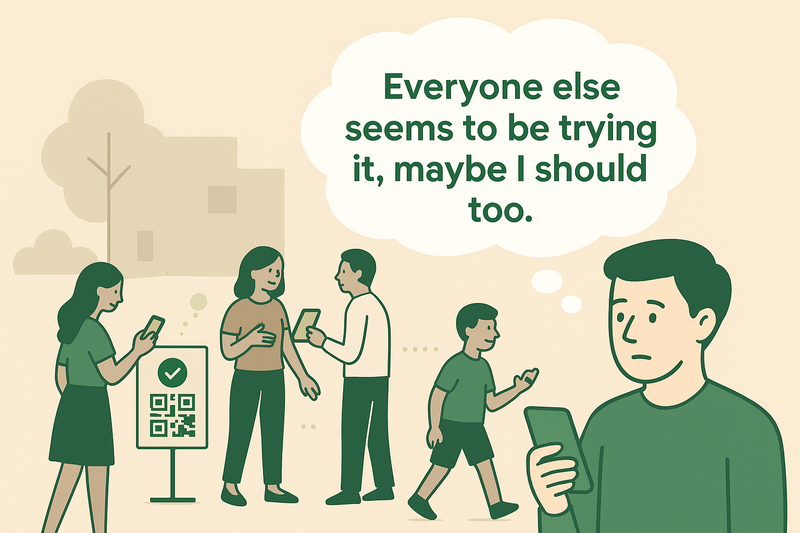
At the end of the day, predictive marketing works because it taps into how our brains cut corners. We crave convenience, copy our peers, and look for emotional shortcuts. A neighbour using a new app, a co-worker talking about a fun activation, a kid bringing home free chocolate samples from a canter all of these are micro-triggers that shape behaviour long before the purchase decision.
That’s why predictive AI isn’t just about spreadsheets; it’s about understanding what little nudges will matter. Consumers are rarely thinking “I will adopt this product today.” More often, they’re thinking “Everyone else seems to be trying it, maybe I should too.” If AI helps us spot those moments before they tip, we can design campaigns that slide neatly into the behaviour gap.
Why Brands Choose CupShup as Their AI Marketing Agency
CupShup isn't just another ai marketing agency — we're a team that's built AI into the DNA of 10,000+ brand activations across 300+ Indian cities. From AI-powered audience targeting and predictive campaign planning to automated performance dashboards and real-time optimization, our hybrid AI + human approach delivers results that pure-play agencies can't match. Whether you need AI-driven content, smart media buying, or marketing automation at scale, CupShup brings the technology and the street-smart execution together.
Knowing Where to Stop
Here’s the bit people don’t say out loud: AI prediction has limits. It can tell you what is likely, not why it matters. It can say “beer conversations spike on Friday evenings”, but it can’t replace the brainstorm where Surya blurts out “Let’s turn that into a mini-bar on wheels.” That’s still human territory.
At CupShup, we’ve learned the balance. AI gives us the map, psychology gives us the context, and creativity decides whether the execution is a quiet nudge or a loud spectacle. Too much reliance on one and you risk being either robotic or reckless.
Marketing Automation AI: From Prediction to Action
The real power of AI predictive marketing emerges when prediction connects to automation. Imagine this workflow: predictive analytics identifies that a protein bar brand's target audience peaks at gym lobbies between 6-8 AM in Bangalore. Marketing automation AI triggers a sampling campaign deployment to those exact locations, schedules social media posts featuring geo-tagged content, and sets up retargeting ads for people in those pin codes — all without manual intervention.
That's the future CupShup is building toward: a system where AI predicts, automation executes, and humans focus on the creative and strategic decisions that machines can't make.
The Final Word
So yes, predictive marketing feels like having a crystal ball, but it’s not magic. It’s data, psychology, and imagination, stitched together. The brands that will win in 2025 aren’t the ones who stalk every consumer keystroke, but the ones who can turn those predictive insights into moments that feel natural, relatable, and even fun.
Because in the end, the future of consumer behaviour isn’t about numbers on a dashboard. It’s about people, their quirks, and the little nudges that shape what they do next. AI can see the future. It’s our job to make sure that future is one they want to be part of.
Predictive Marketing FAQs
What is predictive marketing?
Predictive marketing uses data analysis, machine learning, and statistical models to forecast future customer behavior and campaign outcomes. Instead of relying on gut feelings, predictive marketing analytics helps brands make data-driven decisions about where to spend, what to say, and when to activate — before the campaign launches.
How does AI improve marketing automation?
AI improves marketing automation by adding intelligence to workflows. Traditional automation follows pre-set rules (if X, then Y). AI-powered marketing automation learns from results, adapts in real-time, and predicts optimal actions. For example, AI can determine the best email send time for each individual contact, or predict which leads are most likely to convert — making your automation smarter, not just faster.
Ready to Get Started? Talk to CupShup
Want to put AI to work for your brand's marketing? CupShup's AI marketing team builds custom strategies powered by data, automation, and real-world execution across 300+ cities. Book a Free AI Marketing Strategy Call →
What Marketing Analytics Can Predict (And What It Can't)
Marketing analytics can tell you which customers are likely to churn next month. Marketing analytics can't tell you why a specific person in Bengaluru changed their mind about buying gold last Tuesday - that still takes a real conversation. The best use of marketing analytics is narrowing down who to have that conversation with.
An ai agent can process that marketing analytics data faster than any human team, flagging the highest-probability leads in seconds. But ai for marketing only works when someone still asks the follow-up question the ai agent can't - which is exactly what in-person activation does that ai for marketing alone cannot.
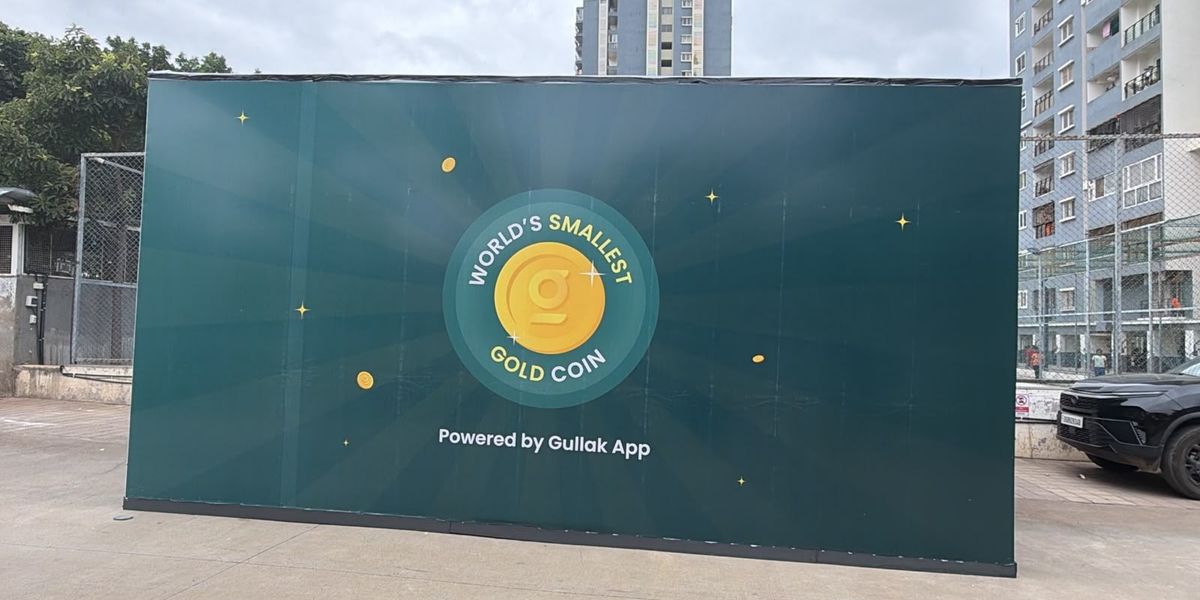
Gullak needed to shift genuinely confused consumer behaviour around digital gold savings. CupShup built an interactive 7-stage Gold Maze activation in Bengaluru that engaged 400+ residents and sparked 200+ one-on-one consultations - the exact kind of qualitative signal that no amount of marketing analytics or ai for marketing could have surfaced on its own.
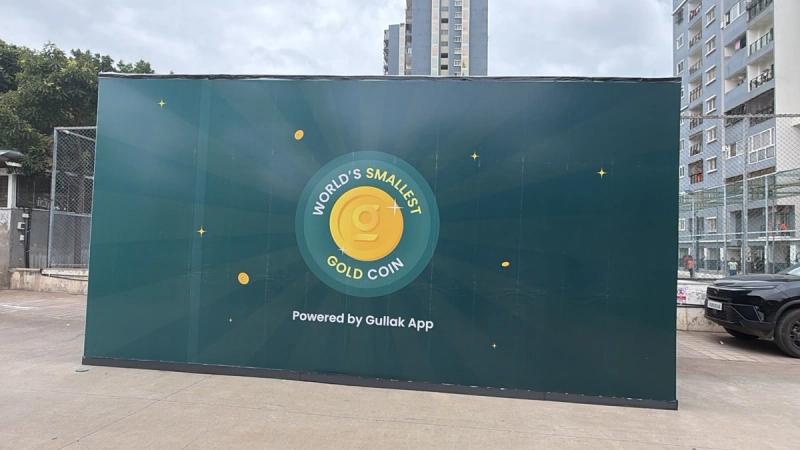
CupShup's Gold Maze activation helping Gullak demystify digital gold savings
That's the honest role of an ai agent in predictive marketing: narrow the list, flag the pattern, then let a real conversation - like the ones Gullak's Gold Maze sparked - close the gap marketing analytics alone can't close.
Want to see this kind of targeting in action? Traffic Checker benchmarks a domain's estimated traffic and keyword footprint in seconds.
For a performance marketing strategy built on real behavioural data, our Performance Marketing team pairs marketing analytics with on-ground validation like Gullak's.
Ready to turn analytics into an actual campaign? Get in touch.
An ai agent's real job in marketing analytics isn't prediction for its own sake - it's ranking. Marketing analytics plus an ai agent turns a flat list of ten thousand leads into a ranked shortlist a human can actually act on. Ai for marketing without that ranking step is just a bigger spreadsheet.
The teams getting real value from ai for marketing right now treat marketing analytics as the first filter, not the final answer. An ai agent narrows; a person still decides.
What Marketing Analytics Services Can and Can't Predict
Marketing analytics services can flag which customers are likely to act next - they can't explain why a specific person changed their mind about a purchase. That gap is exactly where d2c marketing brands, and fintech brands like Gullak, still need a real conversation, not just a dashboard.
Performance marketing services layered on top of marketing analytics services can narrow a list fast. But d2c marketing categories built on genuine behaviour change - not just a discount code - need the qualitative signal that only in-person conversation provides.
Gullak needed exactly this kind of behaviour shift around digital gold savings. CupShup built an interactive Gold Maze activation in Bengaluru sparking 200+ one-on-one consultations - the kind of signal marketing analytics services and performance marketing services alone could never have surfaced.
D2c marketing brands like Gullak show why marketing analytics services and performance marketing services both need a real conversation layered on top - the data narrows the list, the conversation closes it.
50 Integrated Marketing Campaign Ideas
The complete playbook with campaign frameworks, budget templates, and measurement guides for Indian brands.
Instant download + email copy. No spam, ever.
Frequently Asked Questions About AI for Marketing and Predictive Marketing
How does AI for marketing enhance predictive marketing capabilities?
AI for marketing enhances predictive marketing capabilities through artificial intelligence in marketing that analyzes vast datasets, identifies patterns, and forecasts customer behavior with unprecedented accuracy. Best tools for digital marketing leverage AI algorithms to predict purchase intent, churn risk, and optimal engagement timing, enabling AI marketing agency teams to make data-driven decisions and maximize campaign effectiveness.
What are the best tools for digital marketing that offer predictive AI capabilities?
The best tools for digital marketing that offer predictive AI capabilities include Salesforce Einstein, Adobe Analytics with AI insights, and Google Analytics Intelligence. These AI in digital marketing platforms provide predictive analytics, customer lifetime value predictions, and automated campaign optimization. An AI marketing agency can help implement these tools to transform raw data into actionable predictive insights.
How can an AI marketing agency implement predictive marketing strategies?
An AI marketing agency can implement predictive marketing strategies by leveraging artificial intelligence in marketing to build customer journey models, predict optimal touchpoints, and automate personalized experiences. This AI for marketing approach enables businesses to anticipate customer needs, optimize resource allocation, and deliver targeted campaigns that drive higher conversion rates and customer satisfaction.
Best Tools for Digital Marketing: AI for Marketing and Predictive Analytics
Salesforce Einstein
AI CRM PlatformAI-powered CRM platform with artificial intelligence in marketing features for predictive analytics and customer insights
Learn More →Adobe Analytics
AI Analytics PlatformAnalytics platform with AI for marketing tools that provide predictive insights and customer behavior forecasting
Learn More →Google Analytics Intelligence
Marketing IntelligenceMarketing analytics platform with AI in digital marketing capabilities for predictive reporting and insights
Learn More →AI Marketing Agency Services: Best Tools for Digital Marketing and Predictive Analytics
Explore how CupShup's AI marketing agency expertise and artificial intelligence in marketing solutions help brands leverage predictive marketing through strategic AI for marketing implementation.
AI Marketing Agency Services
Professional AI marketing agency for predictive marketing and analytics optimization
Digital Marketing Solutions
Best tools for digital marketing with AI for marketing and predictive analytics integration
AI in Digital Marketing
Advanced artificial intelligence in marketing for predictive customer insights and campaign optimization
Predictive Marketing Case Study
How AI for marketing drives predictive insights and campaign performance
Analytics Strategy Services
AI marketing agency expertise for predictive analytics and data-driven marketing
AI Marketing Case Study
How artificial intelligence in marketing transforms predictive customer engagement
Explore CupShup Services
Brands that read this article also explored these services.
Digital Marketing Agency
Full-stack digital marketing, performance, social, content, and programmatic campaigns.
Learn more AIAI-Powered Digital Marketing
AI-first marketing campaigns powered by data, automation, and predictive analytics.
Learn more ActivationBrand Activation Agency India
400+ brand activations across India, from corporate campuses to RWA societies and malls.
Learn moreYuvana Singh
Creative Director passionate about storytelling and brand innovation. Yuvana leads CupShup's creative team, bringing fresh perspectives to campaign development and helping brands connect with their audiences through compelling narratives.
Related Stories



Go Deeper with Our Free Guides
Comprehensive, in-depth marketing guides created by CupShup's experts.
The Ultimate Guide to Brand Activation
Everything you need to know about bringing your brand to life, strategies, examples, and frameworks.
The Ultimate Guide to Digital Marketing
Master every channel in the modern digital marketing ecosystem, from SEO to paid media.
The Ultimate Guide to SEO
The definitive guide to search engine optimization, on-page, technical, and link building strategies.