
Edu-Marketing: Campaigns That Made Learning Look Cool
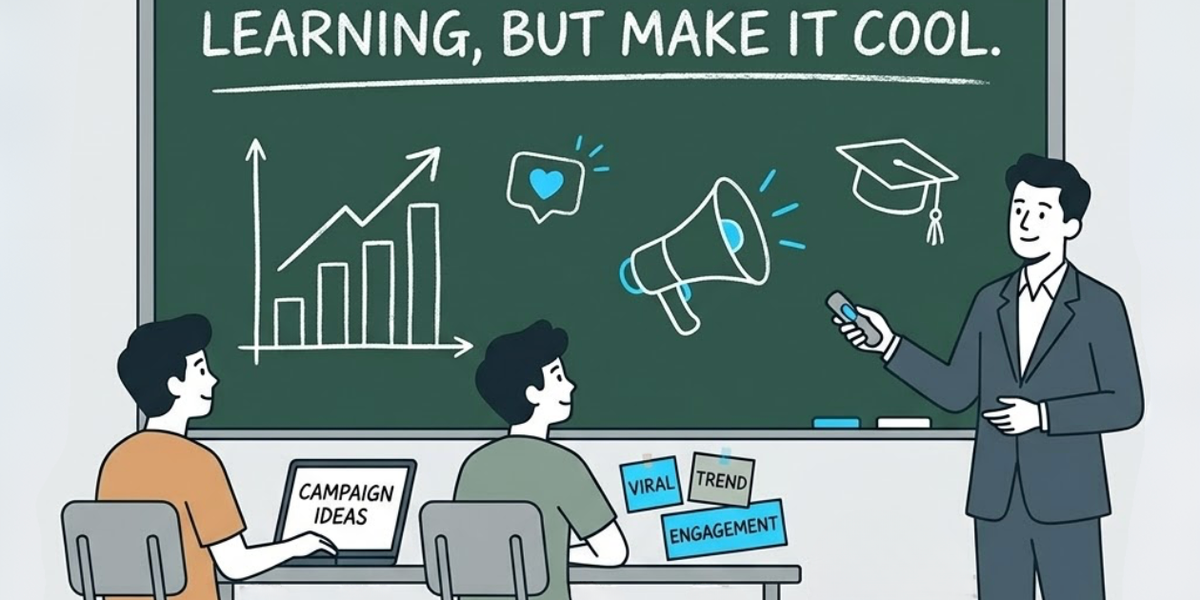
Let’s start with a truth most seasoned marketers eventually realise.
People do not like being sold to. But they absolutely love learning something new.
Think about your own behaviour for a second. You will skip a YouTube ad faster than a Delhi auto changes lanes. But if someone says, “Here’s a quick trick to understand AI in 60 seconds,” suddenly you are watching.
That is the charm of Edu-Marketing.
Instead of saying “Buy this product”, brands say:
“Aao, kuch interesting seekhte hain”.
And the moment a brand teaches you something useful, something magical happens. It stops feeling like marketing and starts feeling like value.
In a world overflowing with ads, the brands that win are often the ones that make audiences say:
“Acha, yeh interesting tha”.
Because the moment a brand teaches you something valuable, it earns something far more powerful than attention.
It earns trust.
Trust builds slowly. But once it is built, it travels further than any advertisement ever could. And in modern marketing, trust often becomes the starting point for deeper engagement, brand recall, and long term loyalty.
Why Edu-Marketing Works So Well for Engagement in Modern Marketing
Edu-Marketing works because it taps directly into curiosity. Humans are naturally curious. We enjoy discovering small insights that make us feel smarter, more informed, or simply more aware.
Good marketing understands this instinct and uses it well. When audiences feel they are learning something useful, their engagement increases naturally.
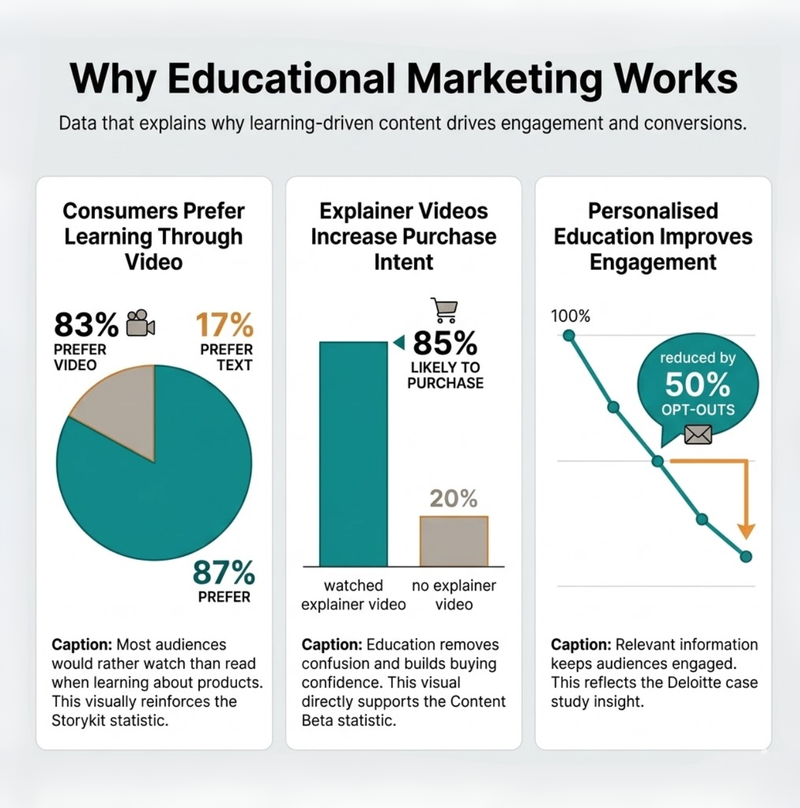
Research supports this behaviour. According to research discussed by Storykit on video marketing trends, 83 % of consumers prefer watching videos instead of reading text when learning about products or services. This explains why educational video content often drives stronger engagement across platforms.
Educational content also influences purchasing behaviour. Research referenced by Content Beta shows that 85 % of people are more likely to purchase a product after watching an explainer video about it. In other words, when education enters the conversation, hesitation leaves the room.
Confusion kills conversions. Clarity builds confidence.
Personalisation makes educational marketing even more powerful. A Deloitte case study found that when a pharmaceutical company personalised its educational email communication, it reduced opt-out rates by 50 % across communications sent to 700,000 healthcare professionals. This shows how relevance improves engagement and encourages deeper audience participation.
The takeaway for any marketing agency or brand is simple. Teaching works best when it feels relevant. Nobody enjoys a lecture, but everyone appreciates a useful insight.
When Brands Turn Learning into Experiences through Experiential Marketing
Some brands have mastered the art of turning education into something memorable.
They do not simply share information. They create experiences around learning through experiential marketing that encourage participation, conversations, and even organic UGC.
IBM: Call for Code
IBM Call for Code initiative invited developers around the world to create technology solutions for disaster response and climate challenges.
Instead of running traditional product campaigns, IBM built a learning community where developers could explore real problems and build solutions using IBM tools.

Participants received mentorship, open source resources, and a global developer community. The program eventually attracted more than 500,000 developers from over 180 countries, according to the Call for Code initiative.
IBM did not simply advertise technology. It helped people understand how technology could solve meaningful problems.
Aur jab marketing meaningful ho jaye, tab engagement automatically badh jaata hai.
This is a classic example of how educational storytelling can drive participation, community building, and long term engagement.
Google: Grow with Google
Google noticed something interesting. Millions of people wanted to learn digital skills but did not know where to begin.
The Grow with Google initiative was created to help solve that problem.
Through workshops, certifications, and training programs, Google teaches people digital marketing, IT support, and online business tools. According to Google, millions of learners have participated globally.
From a strategy point of view, this is extremely smart. The more people learn Google tools, the more comfortable they become using the Google ecosystem in their careers.
Education builds familiarity. Familiarity builds adoption. Adoption builds long term engagement with the brand ecosystem.
National Geographic: Planet Possible
Environmental awareness is important. But complex climate data can easily overwhelm audiences.
National Geographic addressed this challenge through its Planet Possible initiative.

Instead of presenting heavy statistics, the campaign used storytelling, documentaries, and powerful visuals to explain sustainability in ways people could relate to.
Learning felt like exploration rather than education.
Because sometimes the best way to teach something serious is to make it interesting first and informative second.
The campaign also encouraged conversations and organic UGC, where audiences shared insights and stories inspired by the content.
GUVI X CupShup
Education platforms usually depend heavily on digital ads. GUVI decided to try something different.
To grow awareness across cities, GUVI partnered with CupShup, a leading marketing agency, to introduce coding education through hyperlocal experiential marketing and creative offline online integrations.
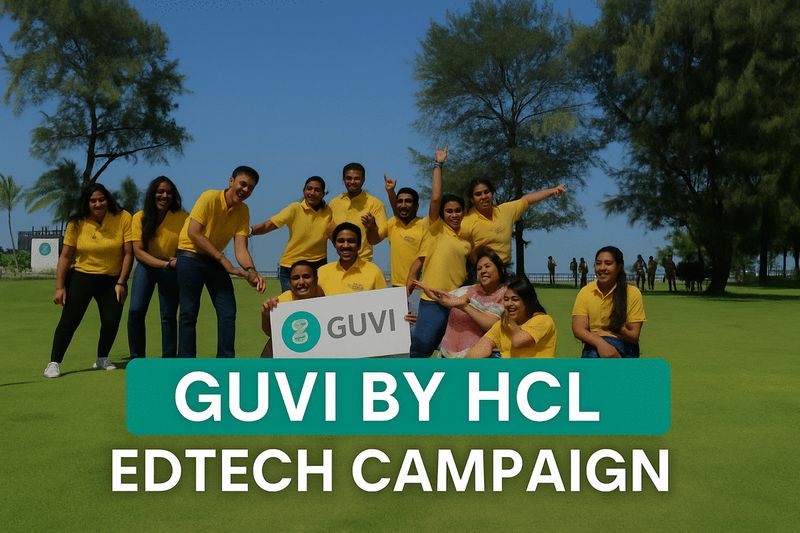
Instead of discovering GUVI only on screens, potential learners encountered the brand in everyday environments. Creative touchpoints and QR codes helped people move from offline curiosity to online learning.
This approach encouraged participation, conversations, and organic UGC, turning simple discoveries into shareable learning moments.
Case study available on the CupShup website shows how offline discovery led to strong online engagement.
The idea worked because it matched how people naturally discover things. Conversations often begin offline before they continue online.
CupShup has refined this offline online marketing model over time. Since 2012, the company has worked with 400 plus brands, delivered more than 10,000 activations, and covered over 300 cities across India.
These experiential marketing campaigns often create strong digital amplification, sometimes generating up to 10 million impressions within 48 hours.
Sometimes the best way to spark a learning journey is through a simple real world interaction.
Jaise chai pe discussion shuru ho jaata hai.
The Strategy Behind Edu-Marketing and Experiential Marketing Participation
Behind successful educational campaigns lies a simple framework that many experienced marketers follow.
First, simplify complexity.
Many products struggle not because they lack value but because people find them difficult to understand quickly. Edu-Marketing breaks complicated topics into clear, simple stories.
Second, encourage participation.
People remember experiences better than information. Activations, challenges, interactive storytelling, and experiential marketing create stronger audience engagement.
Third, connect offline discovery with online amplification.
Offline experiences bring surprise and human interaction. When these experiences reach social media, their impact grows quickly through UGC, conversations, and community participation.
Campaigns executed by CupShup demonstrate this model well. The company has delivered results such as 87 % brand recall for Tata 1mg, five times engagement for McDonald’s campaigns, and 30 million impressions for CoinDCX activations.
That is what happens when learning turns into conversation.
Tips Seasoned Marketers Follow for Engagement and UGC
Experienced marketers know that educational campaigns succeed when they stay simple and focused.
Teach one idea at a time. When too many ideas appear together, audiences lose interest quickly. Too much information can overwhelm people faster than a WhatsApp family group during Diwali.
Curiosity works better than explanation. A question like “Ever wondered how Netflix knows what you want to watch next?” instantly pulls people into the story.
Another useful trick is connecting education with everyday behaviour. When learning relates to real life situations, audiences pay closer attention.
Encourage participation whenever possible. When audiences interact with an idea, they remember it longer and often share it, creating valuable UGC and stronger brand engagement.
In many ways, the best educational marketing feels less like content and more like a conversation.
The Future of Edu-Marketing, Experiential Marketing, and Offline Online Engagement
Edu-Marketing will only grow stronger as audiences expect more value from the brands they follow.
Future campaigns will likely focus on areas such as AI literacy, financial education for Gen Z, sustainability awareness, and skill based learning communities.
Short form videos, community workshops, offline online experiential marketing, and interactive learning experiences will continue to shape modern marketing strategies.
The brands that succeed will not simply promote products.
They will help people understand something useful.
Because when a brand becomes a teacher, marketing stops feeling like marketing.
It starts feeling like a conversation worth having.
Aur jab conversation shuru ho jaaye, brand automatically yaad reh jaata hai.
A Thought to Take Forward
The next time you plan a campaign, ask a simple question.
What can your audience learn from your brand?
Not what they can buy. Not what you want to promote. But what they can genuinely learn.
Because the brands that teach today often become the brands people trust tomorrow.
And if there is one thing marketing history has proven again and again, it is this.
Trust travels further than advertising.
Want to Turn Learning into Marketing That Moves?
If you are looking for a marketing agency that can turn insights into conversations, experiences into shareable moments, and education into real engagement, that is exactly what CupShup specializes in.
Recognised by many brands as the Best marketing agency in India for hyperlocal storytelling, CupShup blends experiential marketing, offline online campaigns, and community driven UGC strategies to spark authentic audience participation.
From hyperlocal activations to experiences that travel from streets to social media, CupShup has helped 400 plus brands across 300 plus cities transform everyday spaces into storytelling platforms.
Sometimes the most powerful campaigns do not start on screens.
They start with a simple conversation.
Want to explore more ideas like this?
You can check out more blogs on the CupShup website or reach out directly at contact@cupshup.co.in
Because sometimes the best marketing begins with a small question.
Aur phir wahi question ek bada conversation ban jaata hai.
50 Integrated Marketing Campaign Ideas
The complete playbook with campaign frameworks, budget templates, and measurement guides for Indian brands.
Instant download + email copy. No spam, ever.
Frequently Asked Questions About Education Marketing Campaigns
What is education marketing and how does it differ from edtech marketing?
Education marketing encompasses all marketing strategies used by educational institutions, ed-tech platforms, and brands targeting students or educators. While edtech marketing focuses specifically on digital learning platforms, education marketing includes campus activations, school outreach programmes, student ambassador campaigns, and offline recruitment drives. In India, where education is a high-consideration decision, on-ground marketing plays a crucial role.
What marketing channels work best for reaching Indian college students?
Indian college students are best reached through campus activations, social media (especially Instagram and YouTube), peer referral programmes, and WhatsApp-based engagement. On-ground campus events like competitions, workshops, and branded experiences have the highest engagement rates. CupShup's campus marketing programmes reach students across 500+ colleges through activations that combine physical experiences with digital amplification.
How can edtech brands build trust through offline marketing campaigns?
Edtech brands build trust offline through free demo sessions at colleges and coaching centres, career guidance workshops at schools, brand activation booths at education fairs, and partnerships with student organisations. Physical presence helps overcome the trust deficit that purely digital edtech brands face, especially when targeting tier 2 and tier 3 cities where students and parents prefer in-person interactions before investing in education products.
Education Marketing: Related Resources
Explore more about education marketing campaigns with these related resources from CupShup.
Enterprise Marketing Services
Large-scale education marketing campaigns across India
Brand Activation Agency
Campus and education sector brand activations
Intel HP Campus Campaign
How Intel and HP used campus activations for gaming laptop awareness
GUVI Hyperlocal Expansion
How GUVI expanded through hyperlocal education marketing
Explore CupShup Services
Brands that read this article also explored these services.
Integrated Marketing Agency
360-degree campaigns that connect offline activations with digital amplification for compounded ROI.
Learn more BrandBrand Strategy & Positioning
Brand architecture, positioning frameworks, and messaging strategy for market differentiation.
Learn more ActivationBrand Activation Agency India
India's leading brand activation agency, 400+ campaigns, pan-India reach, real-time dashboards.
Learn moreAakriti Mishra
Senior Marketing Strategist at CupShup with over 8 years of experience in brand activation and integrated marketing campaigns. Aakriti specializes in creating data-driven strategies that deliver measurable results for modern brands.
Related Stories

Go Deeper with Our Free Guides
Comprehensive, in-depth marketing guides created by CupShup's experts.
The Ultimate Guide to Brand Activation
Everything you need to know about bringing your brand to life, strategies, examples, and frameworks.
The Ultimate Guide to Digital Marketing
Master every channel in the modern digital marketing ecosystem, from SEO to paid media.
The Ultimate Guide to SEO
The definitive guide to search engine optimization, on-page, technical, and link building strategies.