
Building UGC Engines Inside Offline Events
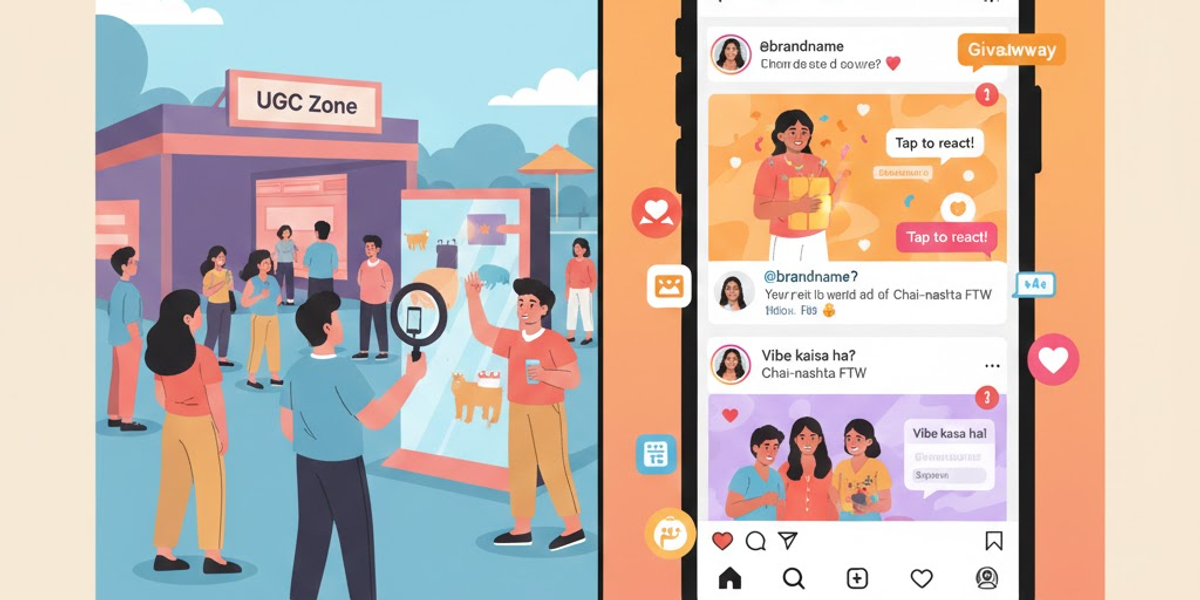
Kyunki agar Story pe nahi aaya, toh kya event hua bhi tha?
Looking for an experiential marketing agency that creates moments people never forget? CupShup combines AI-powered planning with on-ground experiential marketing across 10,000+ campaigns, helping brands connect with audiences through immersive, measurable experiences.
I write and manage blogs for a living, so I spend a lot of time thinking about how stories travel in modern marketing. And if there is one thing I have learned the hard way, it is this: offline events do not fail because people do not want to share. They fail because brands assume sharing will just “happen”.
Spoiler alert. It doesn’t.
Offline events are back in full force. Booths are crowded, experiences are bigger, budgets are healthier, and everyone wants “buzz”. But buzz is not something you order like chai. Buzz is brewed. Slowly. Intentionally. With the right experiential ingredients.
That is where UGC engines come in.
And no, we are not talking about throwing a hashtag on a standee and calling it strategy. We are talking about systems that quietly turn real moments into ugc, driving offline to online movement, without making people feel like unpaid interns in a marketing campaign.
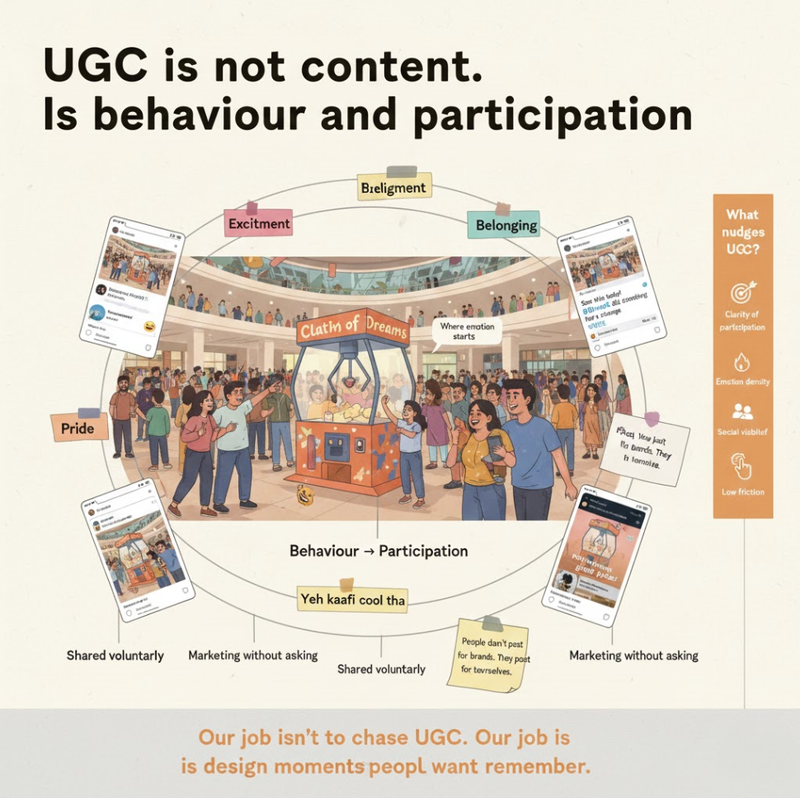
UGC Is Not Content. It Is Behaviour and Participation.
This is the first thing our team reminds each other whenever someone asks how to “get more ugc”.
UGC is not content. It is behaviour. It is participation.
People do not post because brands want impressions. They post because something made them feel something. Excitement. Pride. Belonging. Sometimes just a very simple “yeh kaafi cool tha”.
Offline experiential events work so well because they pack emotion, energy, and people into a small window of time. That is prime territory for ugc participation, but only if it is designed thoughtfully.
As Yuvana once said while we were reviewing a draft together, people do not wake up thinking “aaj main brand ke liye content banaunga”. They wake up thinking “aaj main kuch interesting dekhunga”. Our job in marketing is to make those two thoughts meet naturally.
What a UGC Engine Actually Looks Like in Experiential Marketing
A real ugc engine is not a photo booth hidden in the corner or a hashtag printed in tiny font.
It has four parts that work together to drive participation and amplification.
First, a trigger. A moment that genuinely feels worth capturing in an experiential setup.
Second, ease. The gap between clicking and sharing should be almost invisible. Agar zyada sochna pade, log drop off kar jaate hain.
Third, reward. Sometimes it is visibility. Sometimes it is validation. Sometimes it is just the feeling of being seen during an offline to online journey.
Fourth, amplification. The brand must actively show that this ugc matters by putting it back into the ecosystem, both offline and online.
Miss even one of these and the engine slows down. It might still run, but not smoothly.
The Real Enemy Is Cognitive Load in Offline Participation
One thing our team has learned on ground is that people at experiential events are already dealing with a lot.
Crowds. Noise. Conversations. Schedules. Too much stimulation.
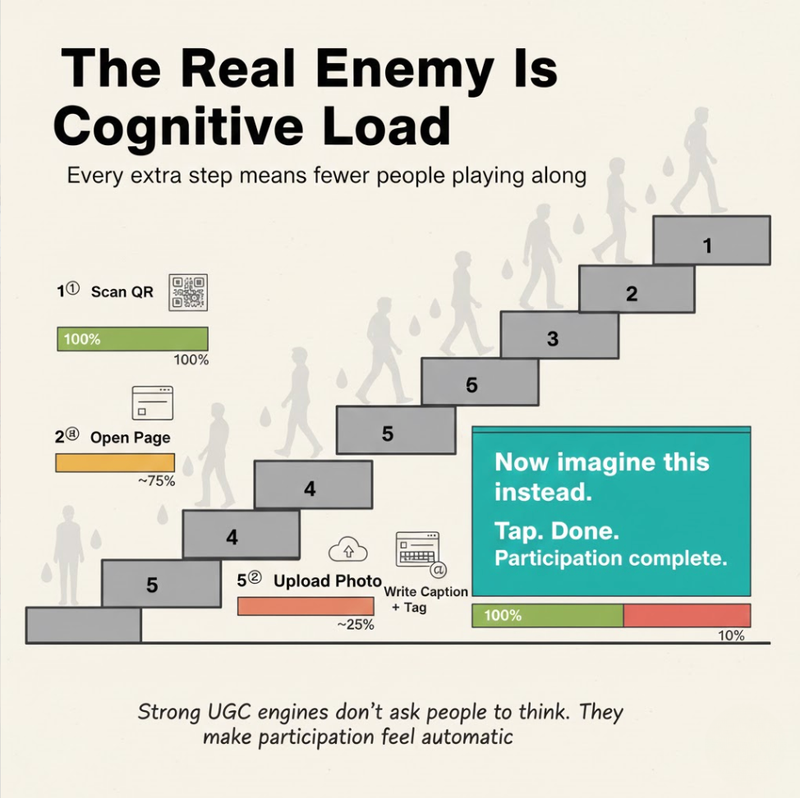
So when participation involves multiple steps, people mentally check out.
Scan this QR. Open this page. Log in. Upload. Caption. Tag.
By step three, most people are already thinking “baad mein dekhte hain”. And baad mein rarely happens in real marketing environments.
Strong ugc engines remove thinking from the process. Participation should feel automatic, not like instructions being followed.
Moments First. Mechanics Later. Always.
No tool can save a moment that is not worth capturing.
That is why experienced experiential marketing teams start with moment design, not tech.
Where will people naturally pause? What will surprise them? What will visually stand out without trying too hard?
As Yukta once joked during a review, if people are already pulling their phones out before anyone tells them to, that is when you know you have done something right. Everything else is just support for offline to online amplification.
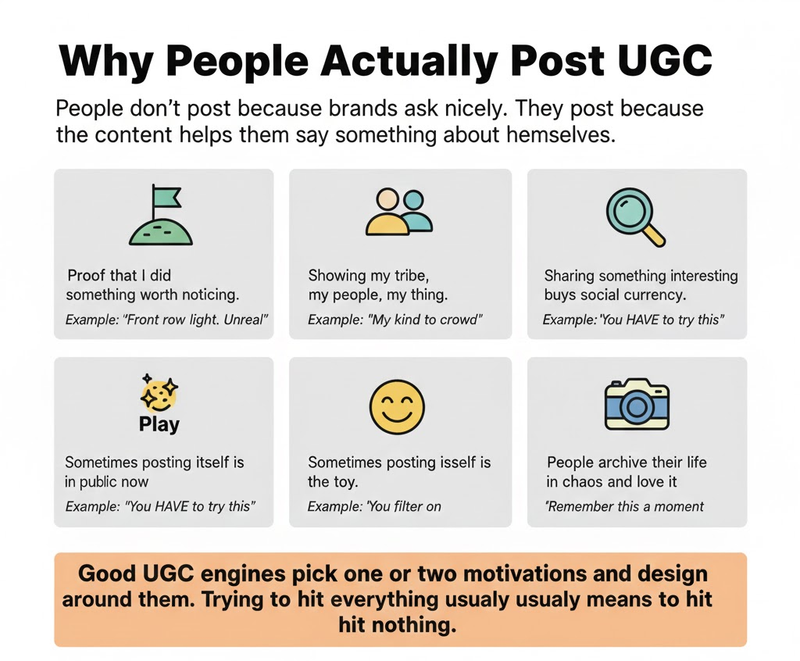
Why People Actually Post UGC
People do not post ugc because a brand asks nicely. They post because the content helps them express something about themselves.
Most ugc participation fits into a few clear motivations.
- Status. I was there.
- Belonging. I am part of this.
- Discovery. Look what I found.
- Play. This was fun.
- Documentation. This mattered.
Good ugc engines pick one or two and design for them. Trying to do everything usually does nothing.
As Krithika once put it during a discussion, if you cannot explain why someone would post this on their own feed, you probably should not expect them to in any marketing plan.
Friction Is Social Too, Not Just Technical
Even when sharing is technically easy, social hesitation can stop ugc participation.
Will this look awkward? Is the brand too loud? Does this fit my vibe?
Good experiential ugc engines reduce that pressure. No forced talking. No awkward posing. Familiar formats people already use. The brand stays in the background while amplification happens naturally.
Deeksha once summed it up perfectly while coordinating on ground. People do not want to feel like walking hoardings. They want to feel like they are sharing a moment.
That mindset makes participation feel safe and real.
Real Time Visibility Is a Cheat Code for Amplification
Read next: AR + Offline: When Digital Layers Meet Real-World Fun in ..., TAP, TRACK, WOW: How NFC and RFID Are Quietly Taking Over..., and D2C Marketing Strategy: How Experiential Content Shortens....
Read next: AR + Offline: When Digital Layers Meet Real-World Fun in ..., TAP, TRACK, WOW: How NFC and RFID Are Quietly Taking Over..., and D2C Marketing Strategy: How Experiential Content Shortens....
One thing that consistently boosts ugc is instant feedback.
When people see their content appear on a screen during the event, participation becomes social. Posting turns into a shared activity and fuels amplification.
As Maaz once laughed, thoda sa fame milte hi sabko aur post karne ka mann karta hai.
This creates momentum. One post leads to another. The room fuels itself, powering offline to online marketing loops.
The Event Is Only Half the Story in Offline to Online Marketing
This is where experience really shows.
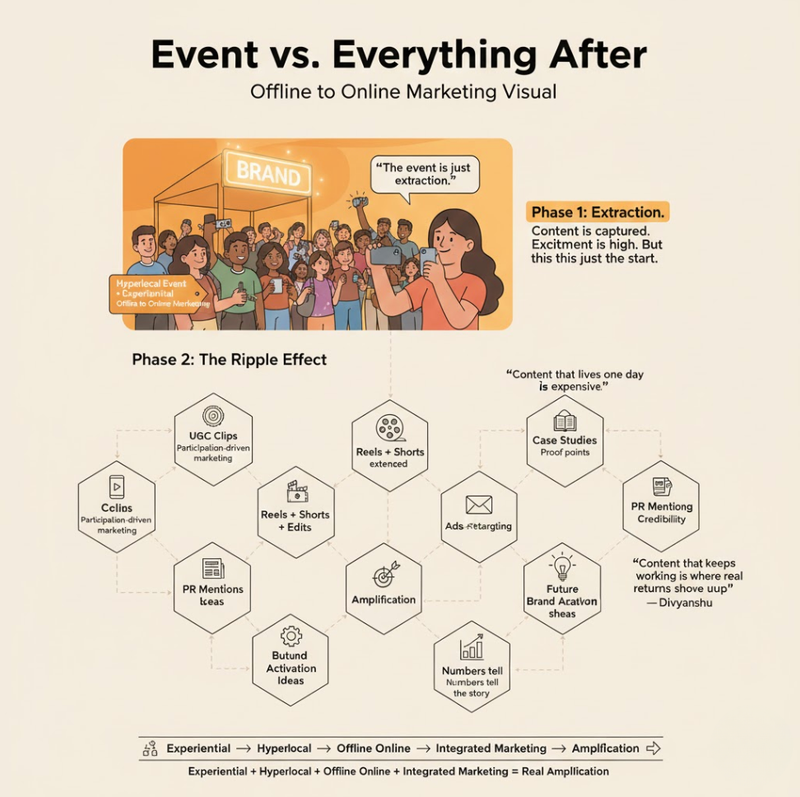
The event is just the extraction phase. The real value comes after through amplification.
UGC is sorted, reused, and repurposed. Social content. Proof points. Future experiential storytelling.
Why Brands Choose CupShup as Their Experiential Marketing Agency
CupShup isn't just another experiential marketing agency — we're a team that's built experiential thinking into the DNA of 10,000+ brand activations across 300+ Indian cities. From immersive brand experiences and pop-up activations to AI-powered audience insights and real-time engagement tracking, our hybrid experiential + tech approach delivers impact that traditional agencies can't match.
As Divyanshu from the numbers side often reminds us, content that lives only for one day is expensive. Content that keeps working across channels is where real marketing returns show up.
Permissions Matter More Than You Think in UGC Marketing
As ugc engines grow, discipline becomes important.
Consent is built into participation. Clearly and transparently.
UGC without rights is a one time win. UGC with rights becomes a long term marketing asset.
Bhavika has often pointed out that clarity upfront saves a lot of trouble later. It may not be glamorous, but it is necessary for scalable amplification.
From One Event to a Repeatable Marketing System
The biggest shift happens when teams stop asking how to make one event trend.
Instead, they ask how to build something repeatable that connects offline to online.
Once the system works, scale becomes easier. New cities. New formats. Same ugc engine.
As Aditi once said during an internal chat, systems reduce stress because everyone knows what to do.
Offline experiential marketing then stops being just an expense and starts behaving like a channel.
The Final Word
Offline events do not fail at ugc because people do not want to share.
They fail because moments are not designed for capture, friction is ignored, and ugc is treated like an output instead of participation.
UGC engines are not about shouting louder. They are about designing smarter.
Aur jab system sahi ho, content apne aap flow karta hai, and amplification follows naturally.
That is when marketing stops feeling forced and starts feeling fun again.
Want to Build a UGC Engine That Actually Works?
If you are planning an offline experiential activation and want it to live beyond the venue, we should talk.
At CupShup, we design offline to online experiences that naturally turn into conversations, content, and amplification. From moments to mechanics to post event ugc marketing, we build systems, not one off stunts.
Check out our blogs to explore how modern brands are turning participation into performance, and let’s turn your next event into content that truly travels.
Ready to Get Started? Talk to CupShup
Whether you're planning a high-impact campaign or looking for a experiential marketing agency that delivers real results — CupShup's team is ready to help. Book a Free Experiential Marketing Strategy Call →
50 Integrated Marketing Campaign Ideas
The complete playbook with campaign frameworks, budget templates, and measurement guides for Indian brands.
Instant download + email copy. No spam, ever.
Explore CupShup Services
Brands that read this article also explored these services.
Content Strategy & Marketing
Content strategy, editorial planning, and distribution for brand authority and SEO growth.
Learn more SEOSEO & Content Marketing
Keyword research, content optimization, and link building for organic search dominance.
Learn more ActivationBrand Activation Agency India
India's leading brand activation agency, 400+ campaigns, pan-India reach, real-time dashboards.
Learn moreAakriti Mishra
Senior Marketing Strategist at CupShup with over 8 years of experience in brand activation and integrated marketing campaigns. Aakriti specializes in creating data-driven strategies that deliver measurable results for modern brands.
Related Stories


Go Deeper with Our Free Guides
Comprehensive, in-depth marketing guides created by CupShup's experts.
The Ultimate Guide to Content Marketing
A comprehensive guide covering content marketing from strategy to execution. Learn about content strategy, audience understanding, the content funnel, blog content, video, podcasts, visual content, long-form content, content creation, writing craft, distribution, promotion, repurposing, operations, and measurement. Includes 50+ term glossary and action plans.
The Ultimate Guide to Social Media Marketing
A comprehensive guide covering social media strategy, platform-specific tactics for Instagram, Facebook, LinkedIn, X, YouTube, TikTok, content creation, community management, paid advertising, influencer marketing, and analytics. From strategy to execution.