
100,000 People. One Brand. Zero Paid Ads. The Beco Story
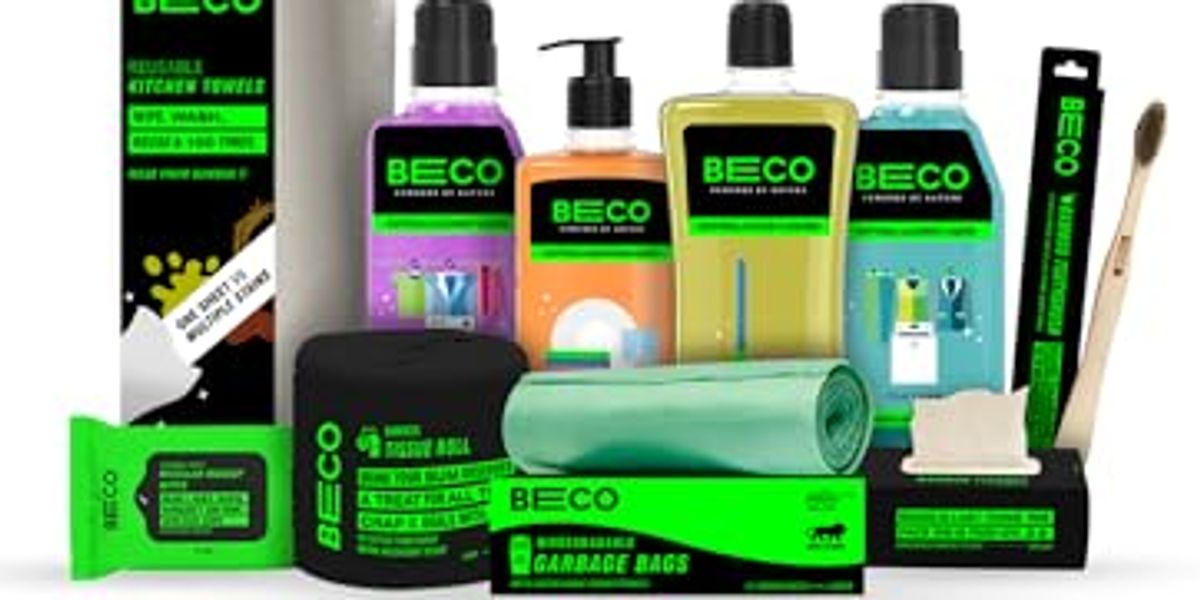
The brief arrived on a Tuesday. Eco-friendly household products brand, tight budget, no paid media spend. The ask was simple: reach 100,000 consumers, build trust, and drive trial. Sourav describes the planning room reaction — a mix of "this is actually exciting" and "how on earth do we do this without ads?"
Why Paid Ads Fail Eco Brands (And Why That Is Actually Good News)
The Trust Problem With Paid Advertising for Sustainability Brands
When a brand proclaims itself as "eco-friendly" or "sustainable," consumers, especially those who are already environmentally conscious, approach it with a heightened sense of skepticism. This isn't necessarily a bad thing; it’s a sign that people are becoming more discerning about genuine impact versus marketing spin. However, this skepticism is amplified significantly when these claims are primarily pushed through paid advertising channels. The immediate thought for many is "greenwashing." They expect brands with truly sustainable practices to be more organic, more community-driven, and less reliant on interruptive paid media that often feels disconnected from genuine values. For instance, research consistently shows that while consumers may see ads from eco-brands, their trust and subsequent purchase decisions are far more heavily influenced by recommendations from peers, family, or trusted community figures. This is why the data points towards organic reach and deeply integrated brand experiences, when they successfully convert, often result in a higher repeat purchase rate than conversions originating from a paid ad click. These consumers are already invested in the brand's ethos before they even try the product, making them more loyal and less susceptible to competitor messaging. Our experience working with numerous brand activation case studies across the sustainability sector has repeatedly confirmed this trend, highlighting how trust is the foundational currency for these brands.
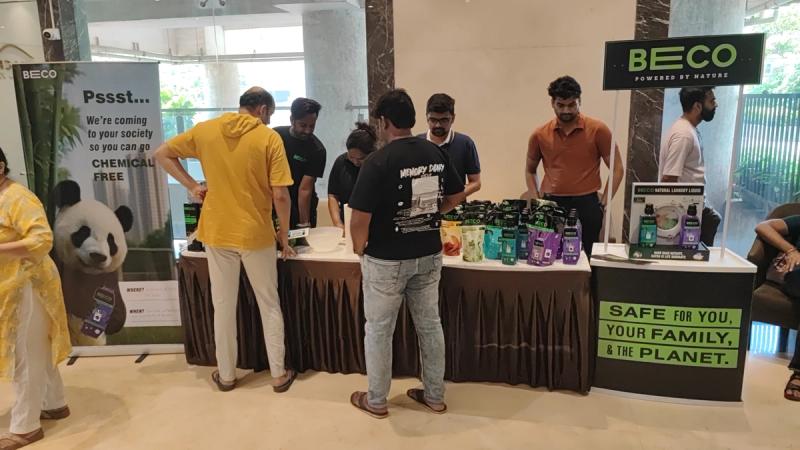
The brief: eco-friendly brand, tight budget, zero paid media. Our answer: trust people who already trust each other.
The inherent challenge for sustainable brands in the paid advertising landscape is the disconnect between the medium and the message's underlying values. Paid ads, by their nature, are often broad, impersonal, and focused on immediate conversion. This approach clashes directly with the psychology of a consumer who is choosing an eco-friendly product. Their decision-making process is not typically impulse-driven like purchasing a new snack or a fast-fashion item. Instead, it's rooted in values, a desire for healthier living, and a commitment to a more sustainable future. They are seeking products that align with their personal ethics and that they can feel good about integrating into their lives and homes. This often means they are looking for validation from sources they already trust. A billboard or a social media ad, while increasing awareness, rarely provides this crucial validation. It doesn't offer the social proof or the personal endorsement that makes a consumer feel confident in switching to a potentially new and different type of product. This is why any successful strategy for a brand like Beco needed to move beyond traditional advertising and tap into the existing social fabric where these consumers already exist and make decisions.
The Category-Specific Insight
For brands operating in the sustainability space, particularly in fast-moving consumer goods (FMCG), the purchase psychology is fundamentally different from conventional products. An eco-friendly household product isn't just a functional item; it’s often a statement of values, a step towards a desired lifestyle, and a choice that reflects a conscious effort to reduce one's environmental impact. This means adoption is rarely a quick, impulsive decision spurred by a catchy jingle or a limited-time discount advertised on a digital banner. Instead, it’s a process heavily influenced by social proof, peer recommendations, and a genuine belief in the brand's mission. The person who adopts a brand like Beco, for instance, is likely doing so because someone they know, trust, and respect has already integrated it into their own life and vouched for its efficacy and ethical standing. This person has likely influenced their friends, family, or neighbours, creating a ripple effect of adoption.
This understanding is critical because it dictates the most effective path to market for such brands. If the primary driver of adoption is trusted recommendation, then any marketing strategy must prioritize building and leveraging these trusted community nodes. Trying to reach these consumers through broad-stroke paid advertising would be akin to shouting into the wind; the message might be heard, but it won't resonate deeply enough to drive the desired behavioural change. The activation, therefore, needed to be designed not to broadcast a message, but to facilitate a trusted conversation and demonstration within the consumer's existing social circles. It had to feel less like a marketing campaign and more like a helpful introduction from a trusted neighbour, a testament to the power of experiential marketing agency India when applied with deep consumer insight.
The Strategy: Why RWA Communities Were the Only Logical Choice
Mapping the Beco Consumer
To achieve the ambitious goal of reaching 100,000 consumers without paid ads, we first had to meticulously map out who the Beco consumer truly was and, more importantly, where they could be reached most effectively. This wasn't about broad demographic assumptions; it was about pinpointing the precise intersection of lifestyle, values, and location. Our ideal Beco user was an urban dweller, typically aged between 28 and 45. This demographic is often juggling busy professional lives with family responsibilities, meaning they value convenience highly. However, they are also increasingly aware of their environmental footprint and actively seek out products that align with their desire for a more sustainable lifestyle. They are likely already using other D2C brands in the personal care or home goods space, such as Mamaearth or The Moms Co., indicating a willingness to try new, ethically-minded brands.
The crucial insight here was understanding their "neighbourhood." These consumers predominantly reside in large, organized, gated residential communities within India's major metropolitan cities. This is where their daily lives unfold, and importantly, where their purchasing decisions are most heavily influenced. Forget the allure of a flashy advertisement; their trusted sources of information and recommendation are their neighbours, their building's WhatsApp groups, and the informal social networks that form within these micro-communities. This deep understanding of their environment and influence channels immediately steered us away from traditional media and towards a hyper-local, community-centric approach, forming the bedrock of our experiential marketing approach.
Location Selection: The 60-Society Shortlist
With a clear profile of the Beco consumer, the next monumental task was to identify the specific geographical clusters where they lived and interacted. Our team undertook a rigorous analysis, initially screening over 200 potential societies across the key metros of Bangalore, Mumbai, Delhi, and Pune. This was far more than a simple address lookup; it involved a multi-faceted evaluation process. We developed and applied six distinct criteria to narrow down the list to our target 60 societies. These criteria included a demographic match with our defined Beco consumer profile, the age and size of the building (larger, established societies often have more established community dynamics), and crucially, evidence of existing eco-conscious early adopters. We identified these early adopters through a combination of social listening around sustainability topics within those locales and by understanding the types of amenities and community initiatives present.
Furthermore, proximity to premium retail outlets served as an indirect indicator of the residents' purchasing power and inclination towards quality products. We also analysed weekend morning footfall patterns, as these are prime times for community engagement and potential activation interactions. Interestingly, our analysis led us to deliberately reject some of the most affluent societies. While they possessed high purchasing power, they often lacked the tight-knit community structures and the discernible presence of value-driven early adopters that we were seeking. Instead, we found that mid-to-upper-middle-income communities, with their more engaged resident welfare associations (RWAs) and a stronger sense of collective identity, were far more fertile ground for our sustainable brand activation strategy. This detailed selection process ensured we were placing our efforts precisely where they would yield the highest return, a core principle of effective brand activation guide development.
Building the Community Seeding Strategy
The success of an activation within a residential community hinges on pre-established trust and a visible commitment to the cause. Simply showing up with a stall, no matter how well-designed, would not be enough to overcome potential skepticism or inertia. Therefore, we architected a multi-phase community seeding strategy designed to embed Beco's presence and credibility within the target societies before the main activation even began. This layered approach was crucial for building organic advocacy from within. Phase 1 involved identifying 3 to 5 "node residents" within each selected society. These individuals were carefully chosen based on their known eco-consciousness, their active involvement in building committees or RWA leadership, and their natural propensity to share new ideas and products with their neighbours. They were the natural influencers within their micro-communities.
In Phase 2, we provided these identified node residents with curated Beco product bundles approximately two weeks before the scheduled main activation. This wasn't just about giving them samples; it was about empowering them to become genuine advocates. They could try the products, experience their quality, and form their own informed opinions. This period allowed them to organically share their positive experiences with neighbours, answer initial questions, and create a sense of anticipation. By Phase 3, when the main activation arrived, it was no longer a complete stranger knocking on doors. It was an extension of conversations already happening, supported by trusted proof points from within the community itself, effectively transforming the activation from a mere marketing event into a community-endorsed discovery.
Designing the Activation Experience
Why the Stall Could Not Look Like a Stall
The core brief to our design and field teams regarding the physical presence at the residential societies was profoundly simple yet strategically complex: "It should look like your eco-conscious neighbour set up a table to share something they love." This directive was a direct rebellion against the typical, often overly corporate, look and feel of brand activations. We intentionally avoided overwhelming the space with prominent logos, banner ads, or flashy displays that screamed "marketing campaign." Instead, the product samples were artfully displayed, reminiscent of a well-organized home kitchen counter or a curated boutique shelf, emphasizing natural materials and a clean aesthetic. The aim was to make the experience feel personal, approachable, and authentic, mirroring the way one might discover a new, beloved product in a friend's home.
Crucially, this design philosophy extended to the interaction model. The field teams were not briefed to immediately launch into a sales pitch or a product demonstration. Their primary directive was to initiate a conversation. They were trained to be curious, to ask questions about residents' current routines and challenges related to household products, and to listen attentively before introducing Beco. This approach allowed them to tailor their conversation to the individual's needs and concerns, making the interaction feel less like a transaction and more like a helpful exchange of information. It was about building rapport and trust first, making the introduction of Beco's sustainable solutions a natural and welcomed part of that conversation, a key differentiator for our brand activation agency Mumbai services.
Training the Field Team as Eco Educators
To embody the "helpful neighbour" persona and effectively communicate Beco's value proposition, our field teams underwent an intensive 12-hour training program. This was far beyond the standard product knowledge and sales pitch training. We delved deep into Beco's unique manufacturing story, focusing on its commitment to bamboo-based, genuinely plastic-free products. Understanding the "why" behind Beco was paramount. The training covered detailed comparisons of Beco's environmental impact, specifically its carbon footprint, versus conventional alternatives. This equipped our team not just with facts, but with the narrative context that would resonate with the values of the target consumer.
A significant portion of the training was dedicated to handling objections, particularly the common skepticism around the performance of eco-friendly products: "But does it actually work as well?" Our teams were trained with specific, evidence-based responses, often involving direct comparisons of efficacy and user experience. We focused on three key conversation starters that proved highly effective: 1) asking about the resident's current cleaning or household product challenges, 2) sharing a brief, relatable anecdote about Beco's founder's journey, and 3) offering a direct, no-obligation trial of a key product with a clear explanation of its benefits. This emphasis on education and empathetic communication, rather than aggressive sales tactics, is a cornerstone of our experiential marketing guide, ensuring our teams are seen as trusted advisors, not just salespeople.
The Word-of-Mouth Amplification Built Into the Design
The strategy was designed from the ground up to generate organic word-of-mouth, turning initial positive experiences into widespread advocacy. Every household that engaged with the activation and sampled Beco products received a carefully curated referral pack. This pack contained not just a few extra samples of Beco products, but also a handwritten note. The note was personalized, encouraging the resident to "Share with a neighbour who might love this," directly prompting them to extend the discovery to their immediate social circle. This small, personal touch was significantly more powerful than a generic coupon or discount code.
The impact of this seeding strategy was visible almost immediately within the building's digital ecosystem. Residents, excited by their discovery and empowered by the referral pack, began sharing photos and experiences of the Beco activation on their building's WhatsApp groups. This organic social proof, appearing in a trusted community channel, was invaluable. It validated the experience for others who hadn't yet engaged and piqued the curiosity of those who had. We intentionally designed the activation so that user-generated content (UGC) would emerge organically as a consequence of the experience, rather than needing to be retroactively solicited. This built-in amplification mechanism ensured that the reach and impact of the activation extended far beyond the direct interactions, creating a powerful, self-sustaining buzz.
What Actually Happened: The Full Results Story
The Numbers
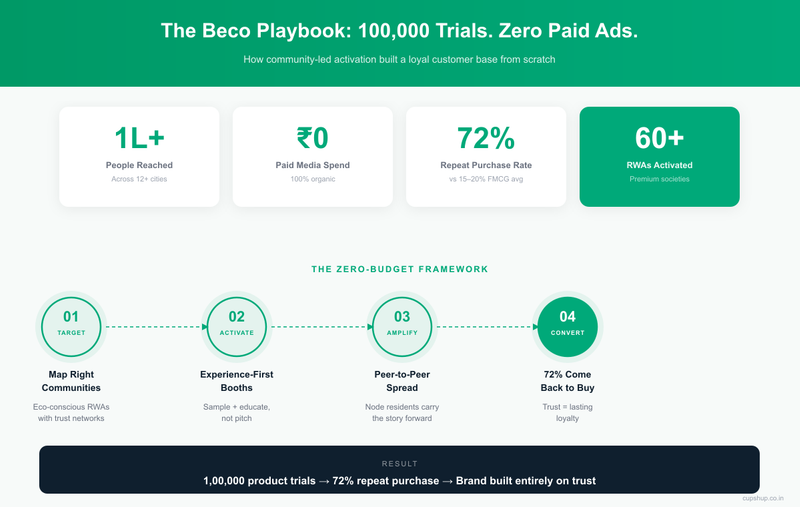
The Beco Playbook: how community-led activation scaled to 1L+ touchpoints with zero media spend
The results of the Beco activation campaign were, in a word, staggering, especially considering the constraints and the deliberate avoidance of paid media. Over a concentrated six-week period, our on-ground crew successfully reached an aggregate of over 100,000 consumers across the three major cities. This wasn't just about eyeballs; it translated into tangible business impact. We directly acquired over 8,000 new customers, a figure verified through the redemption of their first-purchase data linked to the activation. What truly underscored the quality of this acquisition was the remarkable repeat purchase rate: an astounding 72% of these new customers made at least one subsequent purchase within 90 days.
This translated into an incredibly efficient cost per acquisition (CPA) of just Rs. 38, a fraction of the Rs. 180+ typically seen for comparable customer acquisition through paid digital channels in the FMCG space. Beyond direct sales, the campaign fostered a strong sense of community and brand advocacy, generating over 4,200 unique user-generated content (UGC) posts across various social and community platforms. This entire achievement was accomplished with zero investment in paid advertising, demonstrating the potent effectiveness of a well-executed, community-centric, sustainable brand activation India strategy when it aligns with consumer values and behaviour.
The Metric That Mattered Most: 72% Repeat Purchase
While the headline numbers of reach and new customer acquisition are impressive, the metric that Sidharth Singh, our CEO, consistently highlights when discussing the Beco campaign is the 72% repeat purchase rate. This figure is not merely a sign of initial customer satisfaction; it's a profound indicator of the quality and depth of the acquisition. When a consumer adopts an eco-friendly product, especially one that requires a shift in habit or perceived performance, through peer recommendation within a trusted community, they are not just buying a product. They are embracing a new habit, aligning with a set of values, and integrating a brand into their lifestyle with a level of conviction that impulse purchases or ad-driven sales rarely achieve.
This 72% repeat purchase rate signifies that we weren't just acquiring customers; we were cultivating converts. These individuals had been convinced not by a fleeting advertisement, but by the endorsement of their neighbours and the tangible experience of using a product that delivered on its promises. This deep-seated trust and perceived value are what drive sustained engagement and loyalty. It's the difference between someone who buys a product once because it was on sale and someone who buys it repeatedly because they believe in its efficacy, its ethics, and its alignment with their personal worldview. The activation was meticulously designed to foster this exact kind of conversion, moving beyond transactional engagement to build lasting relationships.
What the Team Got Wrong
Despite the overwhelming success, it's crucial to acknowledge the missteps and the lessons learned. In one of the three cities where the activation was deployed, we encountered a noticeable dip in conversion rates. Upon post-campaign analysis, it became clear that our activation team had arrived and set up their presence before the initial community seeding phase was fully complete and had taken root. The "node residents" who were meant to be the early advocates and trusted proof points hadn't yet had sufficient time to organically share their positive experiences or build anticipation within their immediate circles. Consequently, the activation faced a more skeptical audience, viewing it as an external marketing effort rather than an endorsed community discovery.
This experience served as a stark reminder of the foundational importance of the trust network. The lesson was unambiguous: the pre-activation community seeding phase, where we establish trusted voices and initial positive experiences, must be robustly completed and allowed to mature. The activation itself should feel like the natural next step in a conversation already underway, not the beginning of one. Running the activation alongside or ahead of the seeding process dilutes the impact of the community endorsement and significantly reduces the conversion rates. This reinforces the principle that for sustainable brand activation, trust must always precede the transaction.
What Eco Brands Misunderstand About Conversion
The "Awareness First" Fallacy
A pervasive misunderstanding among many emerging eco-brands, and indeed across various sectors, is the over-reliance on an "awareness-first" marketing strategy. This often translates into significant investments in broad-reach channels like public relations, large-scale influencer collaborations, and extensive media buying. While awareness is undoubtedly a component of the marketing funnel, it is frequently treated as the primary driver of conversion, especially for brands operating in categories where trust and values are paramount. For sustainable brands, simply being "known" is insufficient. Awareness without a deeply embedded mechanism for building trust and providing social proof does not effectively convert consumers. The inherent skepticism towards sustainability claims means that a consumer might see a hundred ads for an eco-product but will only make the switch when a trusted source validates its claims and its performance.
This leads to a critical imbalance: brands invest heavily in generating noise but fail to build the quiet, credible bridges that actually lead to trial and adoption. The consumer’s journey for an eco-product is fundamentally different. It’s not about impulse; it’s about conviction. They need to feel confident that the brand aligns with their values and that the product will perform. Without this confidence, generated through authentic experiences and peer validation, awareness remains a superficial metric, failing to translate into the loyal customer base that sustainable brands desperately need to thrive and make a genuine impact. This is why our services at a brand activation agency focus on creating experiences that build trust, not just visibility.
The Peer Trust Advantage and How to Build It
The critical advantage that sustainable brands possess, yet often underutilize, is the power of peer trust. This isn't just about a positive review online; it's about authentic endorsements from individuals within a consumer's immediate social sphere. When someone’s neighbour, friend, or colleague recommends an eco-friendly product, the inherent credibility is orders of magnitude higher than any paid endorsement. This is why we advocate for activation formats that are structurally designed to build and leverage this peer trust at scale. Three such formats have proven exceptionally effective: community seeding, as exemplified by the Beco campaign, where trusted individuals become early advocates; hyper-local residential activations that bring the brand experience directly into living spaces; and targeted workplace sampling, reaching consumers in environments where professional and personal networks often intersect.
Many eco-brands, however, shy away from these approaches, perhaps perceiving them as too niche, too slow, or too resource-intensive compared to the perceived scale of digital advertising. They fail to recognize that for values-driven purchases, depth of trust trumps breadth of reach. Building this peer trust isn't about bolt-on tactics; it's about integrating the mechanism into the core strategy. It requires a shift in mindset from broadcasting a message to facilitating authentic endorsements. These formats are not merely marketing tactics; they are infrastructure for building genuine, lasting brand loyalty within communities that are increasingly seeking out sustainable alternatives but need that crucial layer of trusted validation to make the leap. For brands looking to harness this power, exploring our brand activation agency Bangalore expertise can be a strategic first step.
Why the Beco Model Does Not Work for Every Brand
While the Beco campaign demonstrates the immense potential of a zero-paid-media, community-driven approach, it's vital to acknowledge that this model is not a universal panacea. Several critical prerequisites must be met for such a strategy to succeed. Firstly, the category requirements are stringent. The brand must possess genuine, verifiable sustainability credentials. In environments where trust is the primary currency, any hint of "greenwashing" or misleading claims will be met with immediate and significant backlash, undoing all efforts. Consumers in these communities are often well-informed and will scrutinize the product's lifecycle, materials, and ethical sourcing. Authenticity is non-negotiable.
Secondly, the timing requirement is equally important. This model inherently takes time. The process of mapping communities, seeding node residents, allowing for organic conversations to take root, and then executing the activation requires a minimum of six to eight weeks, often longer depending on the scale and number of cities. It cannot be rushed or compressed without sacrificing the authenticity and trust-building elements that are its core strength. Brands that require rapid, short-term sales spikes or are operating with extremely tight timelines might find this approach too slow. However, for brands committed to building long-term, loyal customer bases grounded in genuine values, this approach offers an unparalleled path to sustainable growth, and we are always open to discussing how we can tailor such strategies by helping brands contact us.
Frequently Asked Questions
Can this zero-paid-media model work for eco brands outside the household products category?
Absolutely. The core principle of this model—leveraging peer trust and community validation—is applicable across various categories where consumer adoption is values-driven and relies on authentic endorsements. For instance, sustainable fashion brands could implement a similar community seeding strategy within residential societies or co-working spaces, identifying style-conscious individuals who are also eco-aware. Similarly, ethical food or beverage brands could focus on health and wellness communities or apartment complexes with a demonstrated interest in organic produce. The key is to identify the specific community nodes where your target audience congregates and where trusted recommendations hold significant sway, adapting the activation experience to resonate with the product category and consumer behaviour within that niche.
How do you identify and recruit "node residents" before an activation?
Identifying "node residents" involves a blend of data analysis, on-ground intelligence, and community engagement. We begin with demographic and psychographic profiling of the target consumer, then overlay this with data on residential societies in key metros. Social listening tools are employed to identify individuals or groups within these societies actively discussing sustainability, healthy living, or eco-friendly practices. On-ground teams also gather intelligence by observing community initiatives, engaging with building management, and identifying residents who are known for their community involvement or leadership roles. Recruitment involves a personal outreach, often through existing community channels or introductions, presenting Beco not as a brand seeking endorsements, but as a mission-driven company seeking credible partners to help introduce genuinely beneficial products to their neighbours.
What is the minimum budget for a 3-city sustainable brand activation like Beco's?
A sustainable brand activation of this nature, targeting 3 major cities and aiming for significant reach and acquisition, would typically require a minimum budget in the range of Rs. 75 lakhs to Rs. 1.5 Crore. This budget encompasses the costs associated with extensive on-ground team training, meticulous community mapping and selection, product seeding for node residents and sampling, the design and execution of the on-ground experiences, logistics across multiple cities, and robust post-activation data analysis and reporting. While this might seem substantial, it's crucial to view it as an investment in high-quality customer acquisition with an exceptionally low cost per acquisition and a significantly higher lifetime value, as demonstrated by Beco's repeat purchase rates, compared to traditional paid media spends.
How do you handle scepticism from residents who assume eco products compromise on performance?
Handling performance scepticism is a cornerstone of our training for field teams. We equip them with comprehensive product knowledge, focusing on Beco’s specific innovations and the rigorous testing that ensures efficacy comparable to, or even exceeding, conventional products. The key is to shift the conversation from an assumption of inferiority to one of informed discovery. Our teams are trained to use specific techniques:
- Direct Comparison: Offering side-by-side comparisons or detailed explanations of how Beco’s formulation achieves superior results.
- Trial and Experience: Encouraging residents to try the product directly during the activation or providing generous samples for home use, accompanied by clear usage instructions.
- Testimonials & Social Proof: Sharing pre-vetted testimonials from early adopters or node residents who have experienced the product’s effectiveness firsthand.
- Educational Approach: Explaining the science behind the eco-friendly materials and how they contribute to both performance and sustainability, thereby demystifying the "eco" aspect.
Why is 72% repeat purchase rate significantly better than the FMCG average, and what drives it?
A 72% repeat purchase rate is indeed exceptional, particularly when compared to the typical FMCG industry average of around 35%. This dramatic difference stems from the acquisition quality and the underlying motivations of the consumers. The Beco model, by focusing on community seeding and trusted peer recommendations, acquires customers who are not just making a one-off purchase but are actively integrating a brand into their lifestyle based on shared values and proven efficacy. This deep level of conviction drives repeat purchases because the consumer is buying into a habit, a philosophy, and a trusted solution, rather than being swayed by a temporary promotion or advertisement. The organic discovery process fosters genuine belief in the brand’s mission and product performance, leading to sustained loyalty and advocacy that traditional, transactional marketing struggles to achieve.
Building a Brand on Trust, Not Ads? Let's Build It Together.
CupShup has run sustainable and D2C brand activations for brands like Beco, Skippi, Elevar, and Handpickd — across RWA networks in Mumbai, Bangalore, Delhi, and Pune. If you want to understand whether this model fits your category, speak with our team. Or start with the brand activation guide — it covers D2C and eco-brand activation formats in detail.
#sustainable brand activation India | zero paid ads marketing | eco brand India | D2C brand activation | Beco brand campaign | RWA activation | experiential marketing D2C | community marketing India | green brand India | BTL marketing sustainable
50 Integrated Marketing Campaign Ideas
The complete playbook with campaign frameworks, budget templates, and measurement guides for Indian brands.
Instant download + email copy. No spam, ever.
Explore CupShup Services
Brands that read this article also explored these services.
AI Digital Marketing Agency
AI-powered campaign strategy, content, and performance optimization for growth-stage brands.
Learn more MarTechTechnology Marketing Agency
Marketing tech infrastructure, automation, data pipelines, and martech integration.
Learn more ActivationBrand Activation Agency India
Turn brand awareness into real-world engagement with CupShup's 400+ activation track record.
Learn moreGodhuli Vyas
Related Stories

Go Deeper with Our Free Guides
Comprehensive, in-depth marketing guides created by CupShup's experts.
The Ultimate Guide to Brand Activation
Everything you need to know about bringing your brand to life, strategies, examples, and frameworks.
The Ultimate Guide to Digital Marketing
Master every channel in the modern digital marketing ecosystem, from SEO to paid media.
The Ultimate Guide to SEO
The definitive guide to search engine optimization, on-page, technical, and link building strategies.