
QR codes aren’t dead: Using them smarter
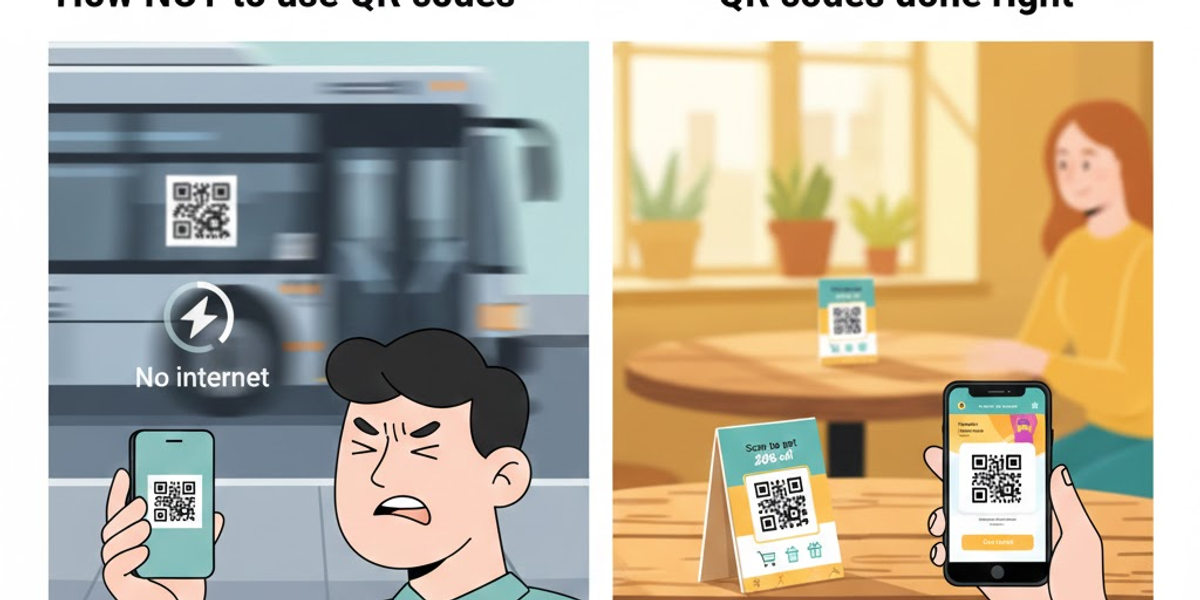
Every few years, marketing has a funeral.
Looking for a brand activation agency that creates unforgettable experiences? CupShup delivers AI-powered brand activations across 10,000+ campaigns in 300+ Indian cities — turning passive audiences into passionate brand advocates.
Email was declared dead. Display ads were pronounced useless. Billboards were apparently “over”. Someone even tried to cancel storytelling, which is ironic because they did it via a very long story on LinkedIn.
QR codes are the latest victim of this cycle in modern marketing.
And yet, here we are. Quietly scanning. Quietly converting. Quietly proving that QR codes were never the problem. The way we used them was.
If QR codes feel boring today, that’s not a red flag. That’s maturity. Jaise kehte hain na, jo cheez kaam karti hai, woh chill hoti hai.
The Data Is Clear. QR Codes Are Growing, Not Fading in Modern Marketing
Let’s start with facts, because vibes are great but numbers still pay the bills.
Globally, QR code scans grew by more than 323 % between 2021 and 2023. This didn’t happen because QR codes suddenly became cool again. It happened because scanning became effortless. Open camera. Scan. Done. No app downloads. No tutorials. No “wait, how does this work?”
Around 40 % of all QR scans today come from marketing use cases. Not payments. Not logistics. Marketing.
Dynamic QR codes now account for over 65 % of deployments and the category is growing at nearly 19 % CAGR. Anyone who has ever reprinted thousands of posters because a URL changed understands why this matters in experiential and offline to online marketing.
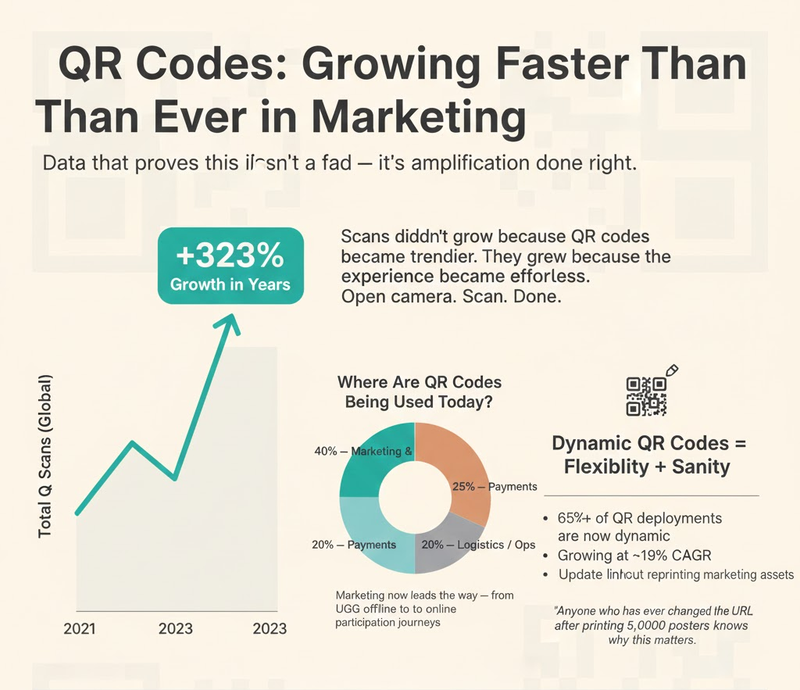
As Sourav once pointed out while reviewing dashboards with the team, static cheezein sirf calendar pe achi lagti hain. Marketing mein flexibility chahiye. That thinking shapes how mature teams approach QR today.
Why QR Codes Failed Before and Why That No Longer Matters
If you’ve been in marketing long enough, you remember the awkward QR phase.
Tiny black squares slapped onto posters like afterthoughts. “Scan me” with no context. Landing pages that looked like desktop websites trapped inside a phone screen, gasping for air.
That phase failed not because QR codes were bad, but because context was missing and participation was not designed for.
The big shift today is simple but powerful. QR codes are no longer destinations. They are transitions.
They don’t exist to send people somewhere random. They exist to continue a moment that has already begun, often in an experiential, offline to online journey.
This is something the content and marketing teams keep coming back to internally. As we often say while reviewing campaigns, people don’t scan because they are curious. They scan because they don’t want to break flow.
What a QR Code Is Actually Supposed to Do in Experiential Marketing
The real job of a QR code is not traffic generation. It is decision compression.
Good marketing reduces friction. Great marketing reduces hesitation.
A QR code works when it answers one silent question instantly. What do I get if I scan this right now?
Not later. Not “learn more”. Right now.
That’s why QR codes shine in moments of high intent and low patience. Waiting for food. Standing outside a property. Browsing packaging. Walking past outdoor media. Sitting at an event thinking ab kya?
These are classic experiential moments where participation matters.
As Deeksha once put it during a client discussion, agar scan ke baad user ko sochna pad raha hai, toh game over. It sounds blunt, but it’s true.
Offline to Online Is Not the Strategy. Continuity and Amplification Are.
Many brands still describe QR codes as offline to online. That’s incomplete thinking.
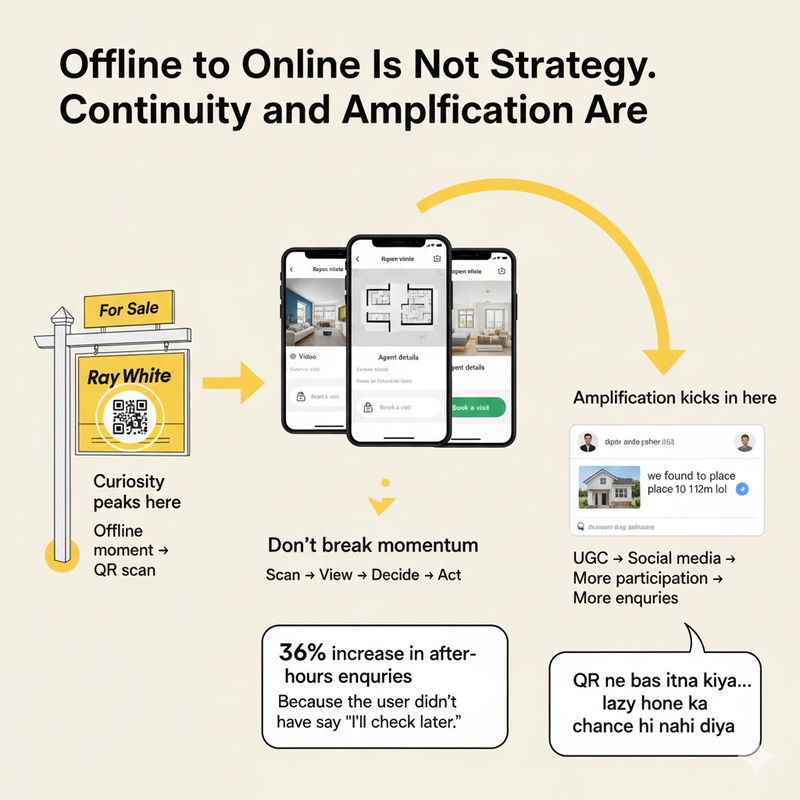
The real magic is offline to online to action, without breaking momentum, and then amplifying that action through social media and UGC.
A strong real-world example comes from Ray White. They placed QR codes on physical “For Sale” boards that linked directly to property walkthrough videos, floor plans, agent details, and booking links.
The result was a reported 36 % increase in after-hours enquiries.
Why this works is simple. The QR code appears exactly when curiosity peaks. It removes the “I’ll check later” loop, which everyone knows usually translates to kabhi nahi.
As Yuvana once joked while reviewing this case internally, QR ne kaam bas itna kiya ki logon ko lazy hone ka mauka hi nahi mila.
Dynamic QR Codes Are the Real Power Move for Marketing Teams
Here’s something experienced marketers learn early.
Static QR codes are risky.
Dynamic QR codes are strategic.
They let you update destinations after printing. They support geo-based redirection. They allow time-based logic for events. They unlock scan analytics that actually influence decisions, not just vanity metrics.
Maaz summed it up well during a campaign review. Agar hoardings update nahi ho sakte, toh kam se kam unke results toh ho sakte hain.
This is what turns QR codes from a nice add-on into a scalable marketing and amplification system.
Why Many QR Campaigns Underperform in Social Media-Led Marketing
Most QR campaigns don’t fail loudly. They fade quietly.
A few scans. Some clicks. No clear outcome. No UGC. No amplification.
This usually happens because teams ask the wrong question. Where should this QR lead?
More experienced teams ask something else. What decision is happening here and how does this encourage participation?
Linking to homepages, overloading landing pages, and treating QR as a side element instead of the hero are common mistakes.
What works better is designing QR-first experiences. Mobile-first. Fast. One scan, one action, often followed by a social media hook.
As Divyanshu from sales likes to say when numbers don’t move, scan toh hua, par phir kya? That phir kya is everything.
QR Codes, UGC, and First-Party Data
This is where QR codes quietly become very powerful.
In a world where cookies are disappearing and paid media is getting more expensive every quarter, QR codes offer something rare. Consensual, contextual, first-party interaction tied to real-world behavior.
Read next: From Dopamine to Loyalty: How Surprise creates Stickiness, Provocation vs Participation: Finding The Sweet Spot That..., and What Consumers Actually Take Away From Brand Activations ....
Read next: From Dopamine to Loyalty: How Surprise creates Stickiness, Provocation vs Participation: Finding The Sweet Spot That..., and What Consumers Actually Take Away From Brand Activations ....
Used well, QR codes enable zero-party data capture, CRM tagging by location, offline attribution, and retargeting pools built from physical touchpoints.
They also open doors for UGC and social media amplification when participation is designed thoughtfully.
Surya once pointed out during a review, offline se aane wale leads usually kam hote hain, par zyada serious hote hain. QR helps capture exactly that intent.
Trust, Security, and the Reality of QR Scams
Yes, QR-based phishing exists. Ignoring that would be irresponsible.
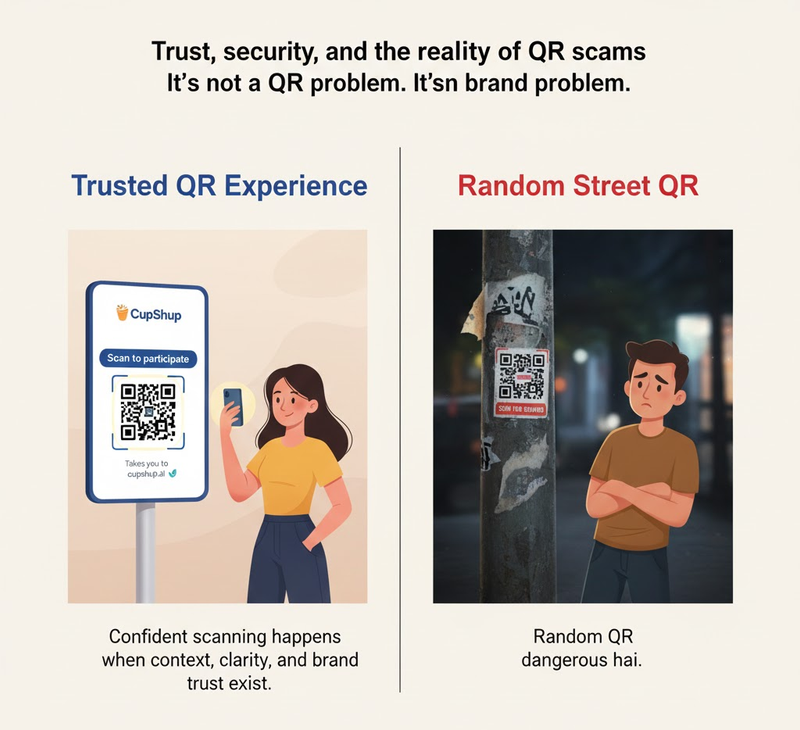
But experienced marketers understand something important. Trust is not a QR problem. It is a brand problem.
Strong brands create scanning confidence through clear placement, visual context, and transparent messaging, especially in experiential and offline environments.
As Sidharth from tech once said during an internal discussion, QR dangerous nahi hai. Random QR dangerous hai.
Why Brands Choose CupShup as Their Brand Activation Agency
CupShup isn't just another brand activation agency — we're a team that's built brand activation into the DNA of 10,000+ campaigns across 300+ Indian cities. From immersive pop-ups and sampling drives to AI-powered audience targeting and real-time activation dashboards, our hybrid experiential + digital approach delivers brand recall that pure-play agencies can't match.
The goal is not blind scanning. The goal is confident scanning.
Why QR Codes Feel Boring and Why That Is Good News for Marketing
The most powerful tools eventually become invisible.
Nobody gets excited about URLs, OTPs, or tap-to-pay anymore. They just work.
QR codes are entering that phase. And that is excellent news.
When novelty disappears, strategy takes over. And strategy is where experienced marketers thrive, especially when thinking about amplification and participation at scale.
The Quiet Checklist Experienced Marketers Use
Before launching any QR initiative, seasoned teams ask a few simple questions.
Is this solving a real-world interruption? Is the value immediate and obvious? Is the experience mobile-friendly? Can this be updated later? Do we know what success means beyond scans, participation, and amplification?
As Krithika once asked mid-meeting, agar hum khud scan nahi karenge, user kyun karega?
That question alone has saved more campaigns than most decks ever will.
So, Are QR Codes Dead?
Not even close.
They’ve just stopped shouting for attention.
Today, QR codes are practical, contextual, measurable, and quietly effective across marketing, experiential activations, offline to online journeys, UGC, and social media amplification.
QR codes didn’t die. They grew up.
Aur honestly, ab woh marketing se bhi thoda maturity expect karte hain.
Thinking of using QR codes for your next marketing or experiential campaign?
If you’re wondering whether QR codes make sense for your brand, your packaging, your retail presence, or your next offline to online activation, start small but start smart.
Design for the moment. Respect the user’s time. Build in participation. Plan for UGC and social media amplification. Track what actually matters.
And if you want more thinking like this, check out our other blogs and follow us on LinkedIn where we break down real-world marketing, experiential ideas, and offline to online strategies that actually work.
Because when QR codes are used right, they don’t just get scanned.
They get remembered.
Ready to Get Started? Talk to CupShup
Whether you're planning a high-impact campaign or looking for a brand activation agency that delivers real results — CupShup's team is ready to help. Book a Free Brand Activation Strategy Call →
50 Integrated Marketing Campaign Ideas
The complete playbook with campaign frameworks, budget templates, and measurement guides for Indian brands.
Instant download + email copy. No spam, ever.
Explore CupShup Services
Brands that read this article also explored these services.
Digital Marketing Agency
Full-stack digital marketing, performance, social, content, and programmatic campaigns.
Learn more AIAI-Powered Digital Marketing
AI-first marketing campaigns powered by data, automation, and predictive analytics.
Learn more ExperientialExperiential Marketing Agency India
Immersive brand experiences, pop-ups, product launches, live demos, and phygital events.
Learn moreAakriti Mishra
Senior Marketing Strategist at CupShup with over 8 years of experience in brand activation and integrated marketing campaigns. Aakriti specializes in creating data-driven strategies that deliver measurable results for modern brands.
Related Stories
Go Deeper with Our Free Guides
Comprehensive, in-depth marketing guides created by CupShup's experts.
The Ultimate Guide to Brand Activation
Everything you need to know about bringing your brand to life, strategies, examples, and frameworks.
The Ultimate Guide to Digital Marketing
Master every channel in the modern digital marketing ecosystem, from SEO to paid media.
The Ultimate Guide to SEO
The definitive guide to search engine optimization, on-page, technical, and link building strategies.