
Breaking Cultural Norms Without Breaking the Law
Or, how to say “thoda hatke” without saying “see you in court” in modern marketing
Looking for a brand activation agency that creates unforgettable experiences? CupShup delivers AI-powered brand activations across 10,000+ campaigns in 300+ Indian cities — turning passive audiences into passionate brand advocates.
Let’s start with an uncomfortable truth most marketing teams learn the hard way.
Culture is flexible. The law is not.
And yet, in brainstorming rooms everywhere, these two are treated like cousins who look similar but behave very differently. Someone says, “Let’s do something disruptive for marketing”. Someone else says, “This could really go viral on social media”. Five minutes later, Legal is looped in with a message that starts with “Quick check” and ends with panic emojis.
I’ve seen this play out more times than I can count. And honestly, everyone in our team has, especially while working on integrated marketing ideas that cut across offline and online.
And what we’ve learned over time is simple: some of the most meaningful cultural shifts in marketing do not come from rebellion, outrage, or chest-thumping boldness. They come from precision. From knowing exactly where culture ends, where law begins, and how far you can push before someone says, “Guys, stop”.
This is not a blog about stunts or shock value.
This is about smart cultural disruption in marketing. The kind that makes people pause, think, and eventually say, “Haan, that actually makes sense”.
Culture and law are not the same thing (samajh lo pehle) in marketing and social media
Cultural norms are social agreements. They are the unwritten rules we grow up absorbing. What we talk about openly, what we whisper, what we avoid entirely at family dinners, and what we hesitate to put out on social media.
Laws, on the other hand, are formal systems. Written, enforced, and very unforgiving when ignored, especially when marketing messages move from offline spaces into public digital platforms.
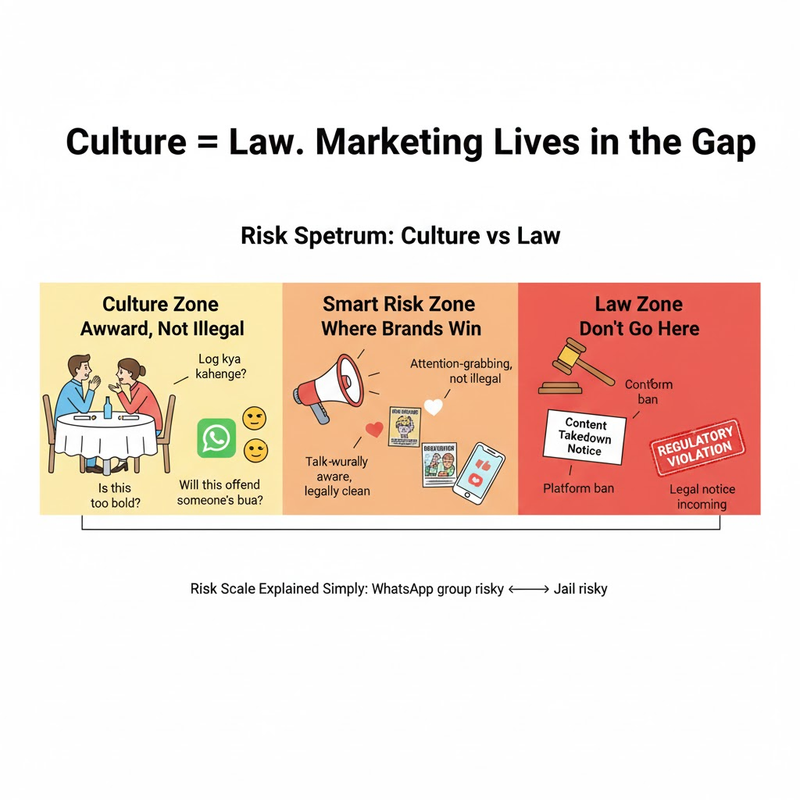
Most ideas that feel “risky” in marketing are not illegal. They are just uncomfortable. Unfamiliar. Thoda sa socially awkward.
And that gap between discomfort and illegality is where smart brands operate, whether through guerrilla marketing, integrated marketing campaigns, or clever social media amplification.
This comes up often in internal discussions. Someone will say, “This feels risky”. And then someone else, usually Maaz, will casually respond with, “Risky how? Jail-risky or WhatsApp group-risky?”. The room laughs, but the point lands.
Because here’s the thing: most resistance in marketing is emotional, not regulatory.
Experienced teams learn to separate “this makes people uneasy” from “this will get us sued”. The former is often where progress begins. The latter is where ideas go to die.
If an idea needs legal gymnastics to survive, it usually means the idea itself is not culturally sharp enough. The strongest norm-breaking marketing does not fight the system. It quietly finds the gaps and moves through them, often with the help of smart amplification.
Why breaking norms works (jab sahi tareeke se kiya jaaye) in marketing
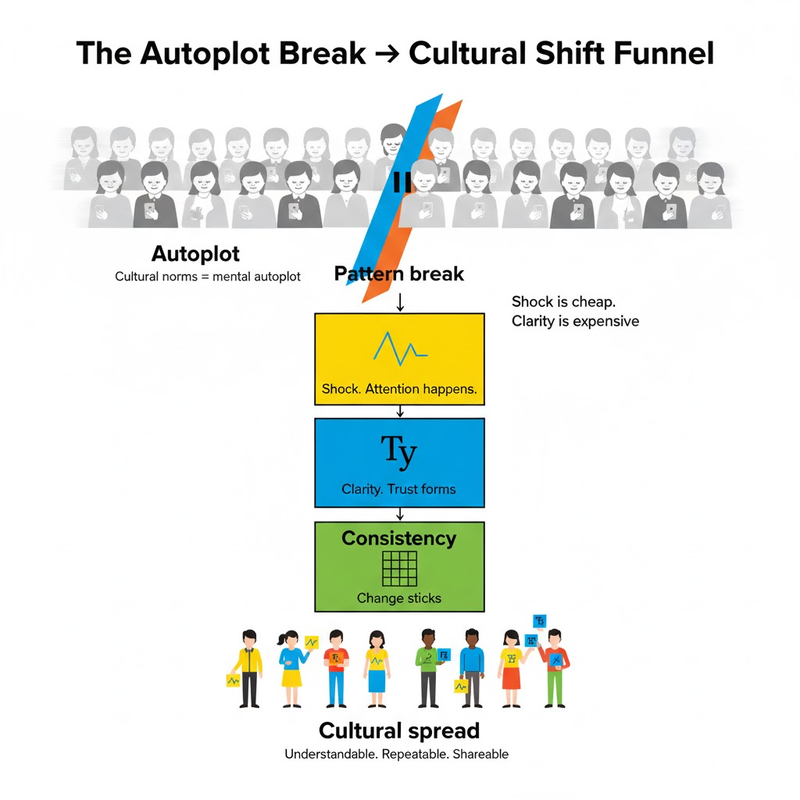
Norm-breaking does not work because it is loud. It works because it interrupts autopilot.
Humans love patterns. Cultural norms are mental shortcuts that help us function without constantly questioning everything. When something breaks that pattern cleanly, whether through a guerrilla marketing execution or a social media moment, the brain pauses.
That pause is attention.
But attention alone is not the win. Anyone can grab eyeballs for five minutes on social media. Cultural impact in marketing needs more.
This is something that comes up again and again in reviews. Yuvana once said, very simply, “Shock is cheap. Clarity is expensive”. And that sentence stuck with all of us working across integrated marketing campaigns.
The pattern we’ve seen over time looks like this:
- Shock gets attention
- Clarity builds trust
- Consistency creates change
Most marketing campaigns never make it past shock. They spike, trend on social media, get called “bold”, and quietly disappear without real amplification.
Real cultural change happens when the disruption is understandable, repeatable, and easy for people to pass along without explaining themselves. If someone has to add a paragraph of context before sharing your marketing work, scale becomes impossible.
The best norm-breaking marketing feels obvious later. Not because it was basic, but because it was precise.
The three invisible lines smart marketing teams never cross
This is where experience shows. Not in how wild the idea is, but in how carefully it avoids certain traps, especially in integrated marketing.
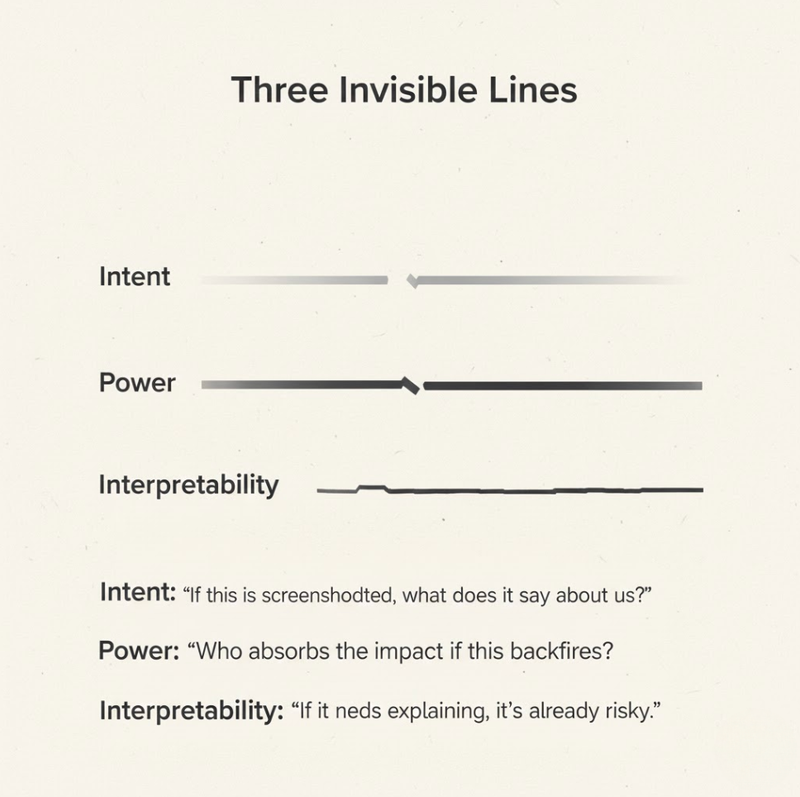
The intent line in marketing
Intent does not legally protect you, but it absolutely shapes perception.
There’s a question that comes up often in our discussions: if this becomes a headline tomorrow morning or a screenshot on social media, do we look thoughtful or do we look desperate?
Audiences can sense motive very quickly. If the intent feels constructive, even uncomfortable marketing ideas get room to breathe. If it feels opportunistic, even safe ideas invite backlash.
As Krithika once said during a discussion, half serious and half amused, “Bold tab tak hi bold hai jab tak lagta hai ki you actually care”. And that line has become a quiet internal filter for all our marketing work.
The power imbalance line in marketing and guerrilla marketing
This is where many brands slip without realising it.
Challenging dominant beliefs is brave. Making fun of vulnerable groups is reckless, even if it is technically allowed by advertising laws.
The difference lies in power.
Before signing off on anything, someone usually asks: who holds power here? Who absorbs the impact if this goes wrong? Who is not in the room but will feel this message when it is amplified on social media?
Punching up invites conversation. Punching down shuts it down instantly.
This is not about playing safe in marketing. It is about being accurate.
The interpretability line in integrated marketing
Here’s something counterintuitive but critical.
The bolder the idea, the simpler the execution needs to be.
Ambiguity works in art galleries. In mass communication, integrated marketing, and social media, it is dangerous. If people spend more time debating what you meant than what you said, you’ve lost narrative control.
Sourav summed this up perfectly once by saying, “If three people explain it three different ways, it’s not deep, it’s unclear”.
Clarity is not boring. Confusion is.
Read next: QR codes aren’t dead: Using them smarter, From Buyers to Believers: How Modern Brands Turn Customer..., and What Consumers Actually Take Away From Brand Activations ....
Read next: QR codes aren’t dead: Using them smarter, From Buyers to Believers: How Modern Brands Turn Customer..., and What Consumers Actually Take Away From Brand Activations ....
What experienced marketing teams do differently (jo textbook mein nahi likha hota)
The biggest difference is this: seasoned marketing teams do not panic at discomfort.
They understand that unfamiliarity often feels offensive at first. Not everything that triggers pushback on social media is harmful. Sometimes it is just new.
They also think beyond first reactions.
Instead of asking “Will this go viral?” the real marketing question becomes: what happens after it goes viral? Who will remix it? How will it age? What screenshots will outlive context?
This is where numbers and reality checks come in. Divyanshu once looked at post-campaign data and said, “Virality toh aa jaati hai, retention ka kya?”. It was said lightly, but it is a reminder integrated marketing teams do not forget easily.
Another big difference is how experienced teams work with legal and tech constraints. Sidharth has said more than once, “Constraints don’t kill ideas. Vague ideas die under constraints”.
Legal questions force clarity. Tech limitations force prioritisation. Both make marketing ideas sharper, not smaller.
Why Brands Choose CupShup as Their Brand Activation Agency
CupShup isn't just another brand activation agency — we're a team that's built brand activation into the DNA of 10,000+ campaigns across 300+ Indian cities. From immersive pop-ups and sampling drives to AI-powered audience targeting and real-time activation dashboards, our hybrid experiential + digital approach delivers brand recall that pure-play agencies can't match.
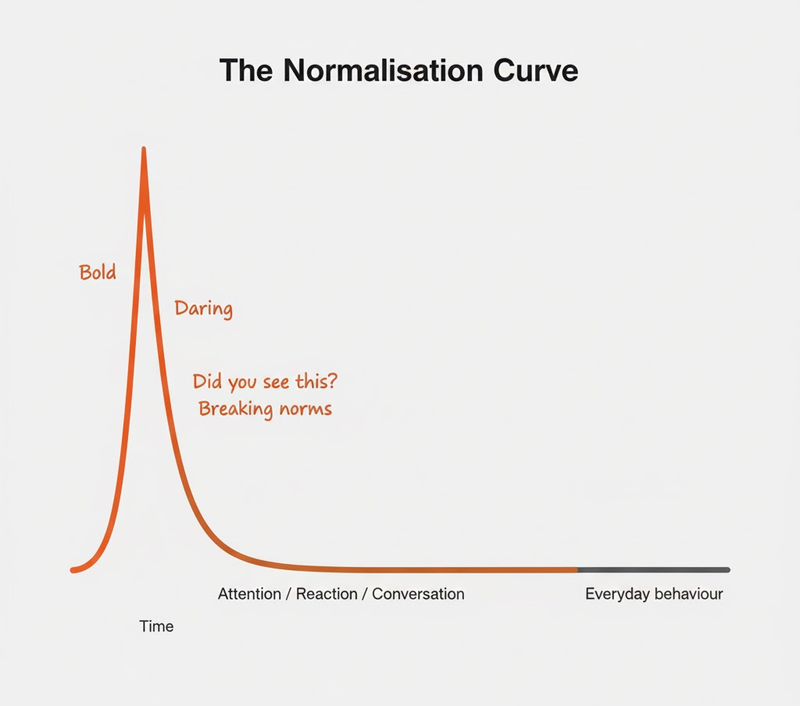
The real goal is not disruption. It is normalisation through marketing
Here’s the paradox most people miss.
The end goal of breaking a norm through marketing is to make it boring.
If six months later people are still calling your campaign “bold”, culture did not move. You just made noise without sustained amplification.
The real win is when something once uncomfortable becomes everyday. When it no longer needs applause or explanation on social media.
Surya put this beautifully while reviewing long-term results: “Jab log notice karna band kar dete hain, tab actual change hota hai”.
That is not failure. That is success quietly doing its job.
So what does smart norm-breaking actually require in marketing?
- It requires cultural literacy, not just trend awareness.
- It requires understanding people, not just platforms.
- It requires respecting legal boundaries without being paralysed by imagined ones.
It also requires internal alignment. When strategy, creative, data, tech, and execution are not speaking the same language, even the smartest integrated marketing idea collapses under its own weight.
Most importantly, it requires patience.
Culture does not change because a brand shouted the loudest on social media. It changes because someone framed a truth clearly enough, often enough, that people stopped questioning it.
Closing thought
Breaking cultural norms without breaking the law is not about being edgy marketing. It is about being precise.
Precise about human behaviour. Precise about social context. Precise about your role in the conversation.
In a world obsessed with going viral, the real flex is creating marketing work that changes behaviour without triggering defence mechanisms.
That is not rebellion. That is mastery.
Aur honestly, wahi kaam sabse zyada satisfying hota hai.
Want to build culture-moving marketing the smart way?
If you’re a brand or marketer trying to say something bold without crossing lines you can’t come back from, this is exactly the kind of thinking we love exploring.
Check out our blogs for more takes on marketing, guerrilla marketing, integrated marketing, and amplification that actually moves culture, not just metrics.
Let’s talk. Because “thoda hatke” works best when it’s also thoda socha-samjha.
Ready to Get Started? Talk to CupShup
Whether you're planning a high-impact campaign or looking for a brand activation agency that delivers real results — CupShup's team is ready to help. Book a Free Brand Activation Strategy Call →
50 Integrated Marketing Campaign Ideas
The complete playbook with campaign frameworks, budget templates, and measurement guides for Indian brands.
Instant download + email copy. No spam, ever.
Explore CupShup Services
Brands that read this article also explored these services.
Brand Activation Agency India
Turn brand awareness into real-world engagement with CupShup's 400+ activation track record.
Learn more BrandBrand Strategy Services
Brand identity, positioning, and messaging frameworks built for competitive Indian markets.
Learn more ExperientialExperiential Marketing Agency
Immersive on-ground experiences that convert consumers into customers and brand advocates.
Learn moreAakriti Mishra
Senior Marketing Strategist at CupShup with over 8 years of experience in brand activation and integrated marketing campaigns. Aakriti specializes in creating data-driven strategies that deliver measurable results for modern brands.
Related Stories

Go Deeper with Our Free Guides
Comprehensive, in-depth marketing guides created by CupShup's experts.
The Ultimate Guide to Brand Activation
Everything you need to know about bringing your brand to life, strategies, examples, and frameworks.
The Ultimate Guide to Digital Marketing
Master every channel in the modern digital marketing ecosystem, from SEO to paid media.
The Ultimate Guide to SEO
The definitive guide to search engine optimization, on-page, technical, and link building strategies.