
AI Marketing Automation in India: The System Stack That Grows Brands While You Sleep
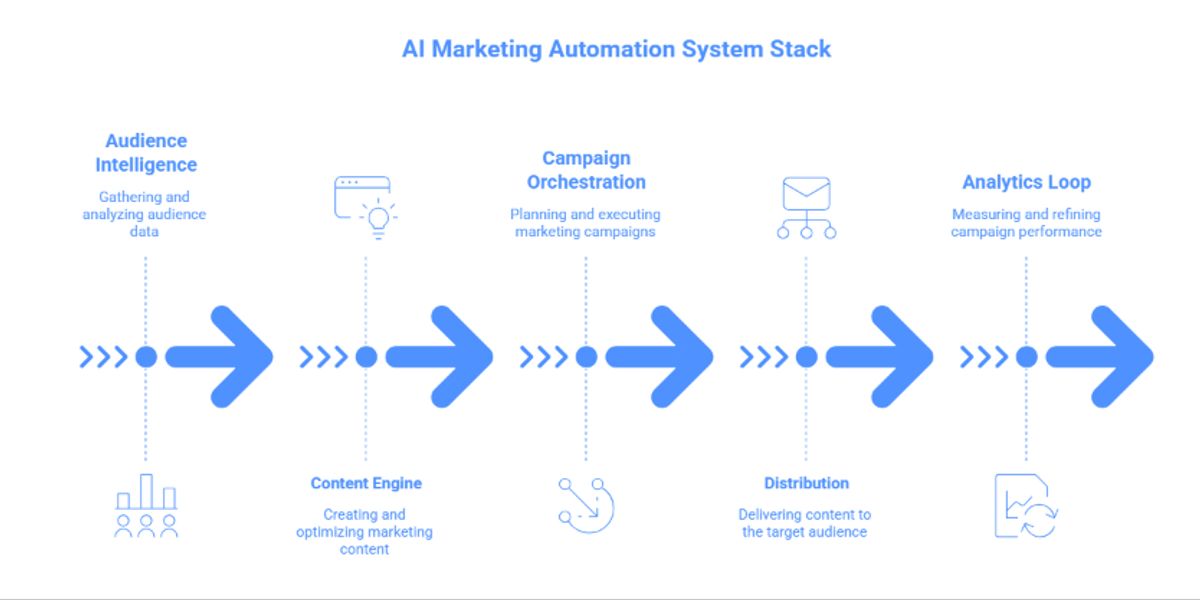
AI Marketing Automation in India: The System Stack That Grows Brands While You Sleep
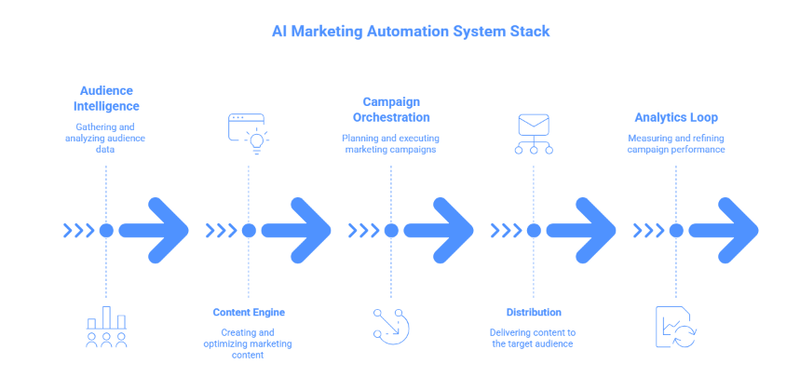
Most Indian brands run marketing like a kitchen without a recipe.
Every campaign is assembled from scratch. A designer here, a media buyer there, a WhatsApp to the agency for that one brief that's been sitting for three days. The brand grows a little. The chaos grows faster.
Meanwhile, a smaller set of brands, D2C companies, quick commerce players, fintech challengers, are running marketing like an operating system. Inputs go in, outputs come out, performance improves over time, and the team spends its energy on strategy rather than coordination.
The difference is AI marketing automation.
This is not a futuristic concept. It is not an enterprise-only toolkit. And it is not about replacing your marketing team. It is about building a system that works when your team isn't, and amplifies everything your team does when they are.
Here is what that system actually looks like in India in 2026.
The Problem With How Most Indian Brands Do Marketing
Before we get to the solution, let us be honest about the problem.
The average Indian brand, startup or scale-up, runs marketing in one of two ways.
Mode 1: Campaign-by-campaign. Each activation is a standalone project. New brief, new budget, new execution, new reporting. Nothing feeds into anything else. The data from one campaign does not inform the next one. You are essentially starting from zero every 30 days.
Mode 2: Agency-dependent. Everything routes through an agency or a freelancer. Speed is bottlenecked by communication. Quality is inconsistent. Institutional knowledge lives outside the brand. When you switch agencies, you start over.
Both modes have the same structural failure: they are built on people and coordination, not systems and data. They scale linearly, more campaigns mean more people, more cost, more complexity. A performance marketing agency built around automation avoids both traps by design.
The brands winning right now are doing something different. They are building a marketing infrastructure that learns, automates, and compounds.
What AI Marketing Automation Actually Means
AI marketing automation is the practice of using artificial intelligence and workflow software to handle repeatable marketing tasks, audience identification, content personalisation, campaign triggering, performance reporting, without manual intervention for each cycle. In practice, this means pairing AI marketing tools for targeting and content with an orchestration layer that ties everything together.
It is not one tool. It is a stack of interconnected systems where data flows from one layer to the next, creating a feedback loop that gets more accurate and more efficient over time. Choosing the right marketing automation tools for each layer is what separates a system that compounds from one that just adds complexity.
Automation vs Outsourcing, The Key Difference
Outsourcing removes work from your team. Automation removes repetition from your workflow.
When you outsource a lead nurture sequence to an agency, you still depend on them to update it, refresh it, and respond when something breaks. When you automate it with an AI-powered CRM, the sequence updates based on user behaviour, triggers based on actions, and reports on itself.
One creates dependency. The other creates capability.
The 5-Layer AI Marketing Automation Stack
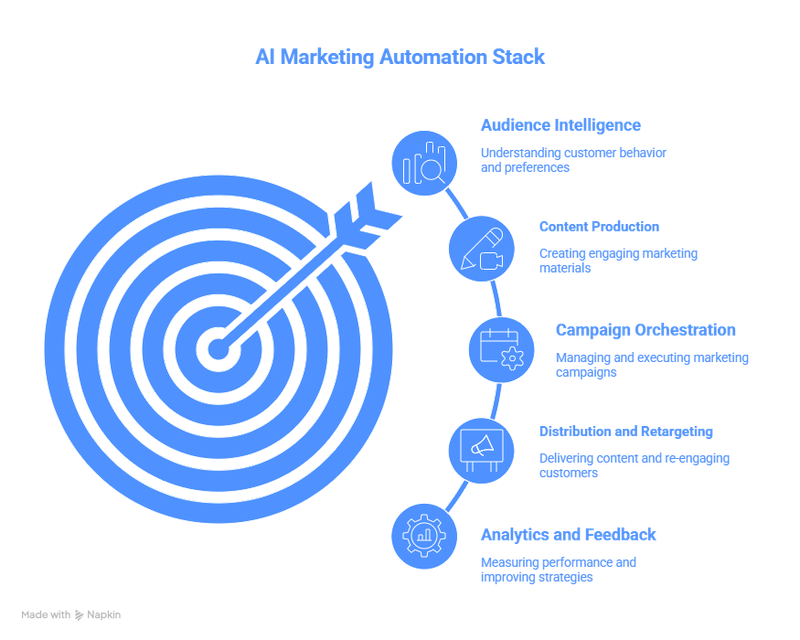
Layer 1, Audience Intelligence
This is where the system starts. Before you send anything to anyone, you need to know who they are, what they care about, and where they are in their decision journey.
The AI marketing tools in this layer analyse:
- First-party data from your website, CRM, and app
- Behavioural signals, pages visited, time spent, actions taken
- Lookalike modelling, who resembles your best customers
- Geographic and demographic clustering for hyperlocal campaigns
When CupShup AI ran campaigns for a quick commerce brand across 120 RWAs in Bangalore, audience intelligence was the first step. We identified which residential clusters had the highest density of tech-park-adjacent professionals with an existing quick commerce habit. That targeting precision is why the campaign achieved a 35% download-to-first-order conversion rate. That number does not happen by accident. It happens by design. This is the kind of precision a performance marketing agency delivers when targeting is treated as a data discipline rather than a guess.
Layer 2, Content Production Engine
The modern content production engine handles ad copy variants, email subject lines, WhatsApp message flows, social creative briefs, and blog outlines, all generated from campaign data and brand guidelines. The best marketing automation tools in this layer plug directly into your CMS and ad accounts so content ships without a manual export-import cycle.
The key word here is enginenot tool. A content engine is a repeatable process where inputs produce outputs at a consistent cadence without requiring a full creative team to activate every cycle.
Layer 3, Campaign Orchestration
This is the operational core, the layer that decides what happens next based on what just happened. Modern marketing automation tools handle this orchestration layer end to end, deciding the next best action in milliseconds rather than a weekly stand-up.
Orchestration tools manage:
- Trigger-based flows, user downloads app → onboarding sequence → 48 hrs no order → incentive
- Multi-channel coordination, WhatsApp + email + retargeting ad + push in sync
- A/B test management and auto-optimisation
- Budget pacing and reallocation based on real-time performance
Without automation, managing this for a campaign across 10 cities and 3 audience segments requires a full-time operations team. With orchestration tools, it requires a system that runs overnight and a human who reviews the morning dashboard. That is the core promise of marketing automation tools: replacing a growing headcount with a system that scales at the same cost.
Layer 4, Distribution + Retargeting
Retargeting is where distribution earns its ROI. When CupShup AI ran campaigns for HDFC Life across 500+ tech parks over 9 months, every on-ground interaction was captured as a data point, QR scans, lead form submissions, engagement duration. That data fed directly into digital retargeting sequences. The result: 12–13 lakh leads and ₹2 crore in measurable conversions. The on-ground activation and the digital retargeting were not separate campaigns. They were two layers of the same system. Few brands have the in-house bandwidth to run this loop alone, which is exactly why partnering with a performance marketing agency like CupShup AI pays off.
Layer 5, Analytics + Feedback Loop
The analytics layer is what makes the stack intelligent over time. This layer handles real-time dashboards, attribution modelling, cohort analysis, anomaly detection, and predictive lead scoring.
The goal is not just reporting. It is learning. Every campaign cycle feeds the next one with better data. After six months of running a proper feedback loop, your marketing system is materially smarter than it was on Day 1.
What CupShup AI's Automation Stack Delivers in Practice
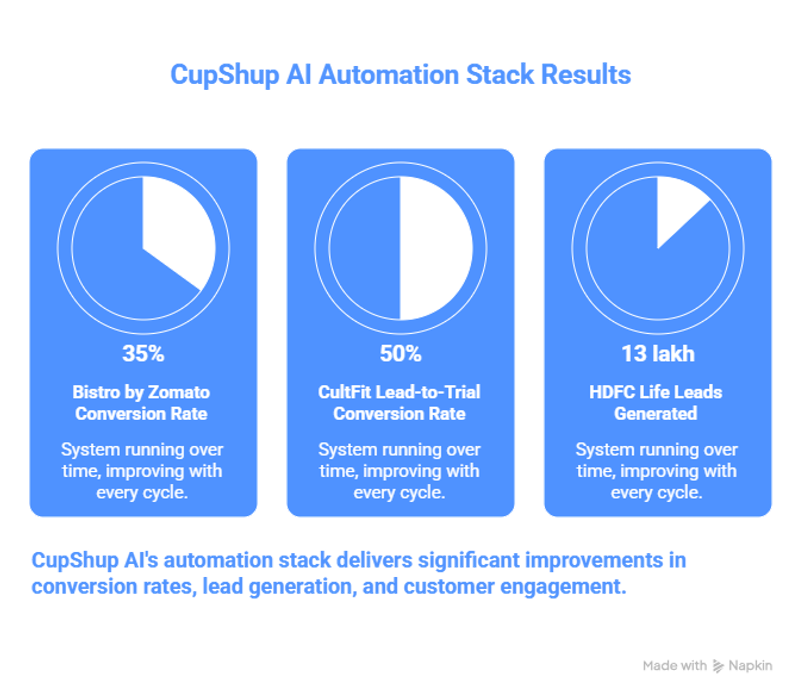
None of these are single campaigns. They are systems running over time, improving with every cycle. See our full case studies. Every one of them was built and run by a performance marketing agency team embedded inside the brand's growth goals, not a set-and-forget vendor.
How to Audit Your Current Marketing System
Before you build, you need to know what you are working with. Ask yourself four questions: Part of that audit is deciding which marketing automation tools deserve a seat in your stack and which ones are just noise.
1. Where does your audience data live? If the answer is 'in spreadsheets' or 'with our agency,' you do not have an audience intelligence layer.
2. How long does it take to produce one campaign's worth of content? If it takes more than a week, your content production is a bottleneck.
3. What happens to a lead after they first interact with your brand? If the answer is 'someone follows up eventually,' you do not have campaign orchestration.
4. What did last quarter's marketing spend teach you about this quarter? If the answer involves a lot of uncertainty, your feedback loop is broken.
Most brands fail on 3 of these 4. That is not a criticism, it is a starting point.
Building Your Stack in 30 Days
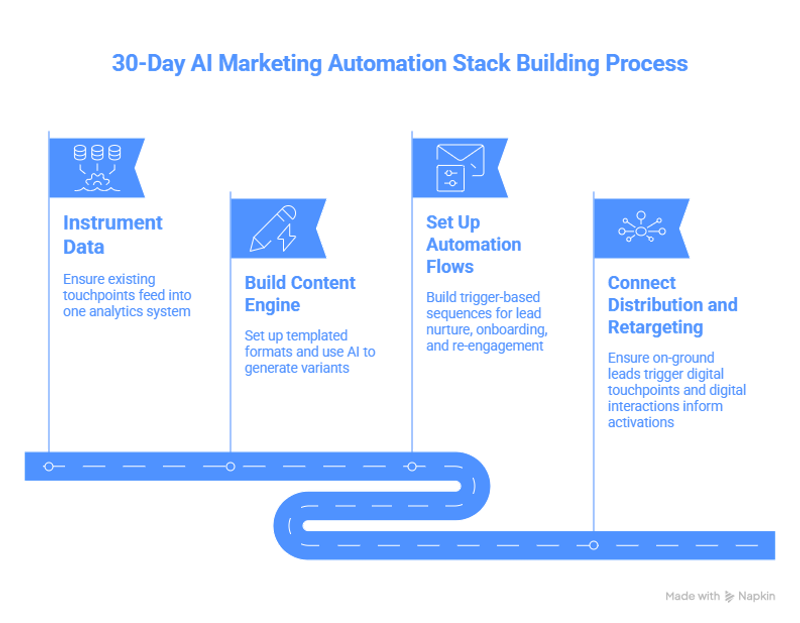
You do not need to build all 5 layers at once. Here is a realistic 30-day sequence:
Week 1, Instrument what you have. Make sure your existing touchpoints feed into one analytics system. Close the data gaps before adding new tools.
Week 2, Build the content engine. Set up templated formats. Use AI to generate variants. Cut your content production time by 50%.
Week 3, Set up basic orchestration. Build 3 trigger-based sequences: lead nurture, onboarding, and re-engagement. These three sequences alone will move your conversion rates.
Week 4, Connect distribution and retargeting. Ensure every on-ground lead triggers a digital touchpoint. Every digital interaction should inform the next activation.
Common Mistakes Brands Make With Marketing Automation
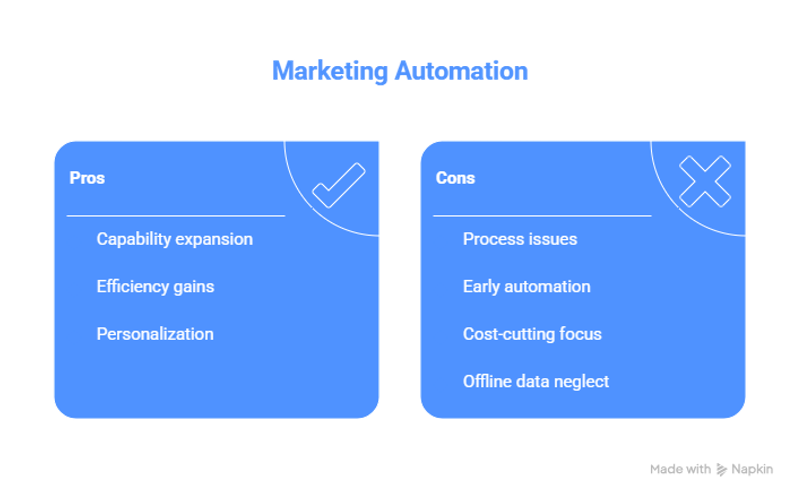
Buying tools before building processes. No tool will save a broken process. Map the workflow before buying the software. Marketing automation tools amplify a good process, they do not create one.
Automating too early. Automation amplifies what you have. Get the core message right first.
Treating automation as cost-cutting. The goal is capability expansion, doing things you could not do before, not headcount reduction.
Ignoring the offline data layer. In India, a significant portion of consumer journeys begin offline. If your stack does not integrate on-ground activation data, you are making decisions on half the picture.
What Marketing Automation Services Actually Deliver
For most Indian brands, the win is not chasing the buzzword, it is buying outcomes through marketing automation services. Marketing automation services connect the dots a manual team drops: lead capture, scoring, triggered follow-ups, and nurture flows that run while you sleep. The reason marketing automation services matter is timing, a lead acted on in minutes converts far better than one chased a day later. Paired with an experienced ai marketing agency, that automation gets smarter over time, because an ai marketing agency tunes the models and the messaging against real response. Choosing the right performance marketing agency partner is often the fastest way to get all five layers running without hiring a full internal team.
CupShup wires marketing automation services into on-ground and digital campaigns so no lead leaks, as in our MediBuddy healthtech activation case study, through our AI and marketing automation team.
Frequently Asked Questions
What is AI marketing automation and how does it work for Indian brands?
AI marketing automation uses software and machine learning to handle repeatable marketing tasks, audience targeting, content personalisation, campaign triggering, and performance reporting, without manual input for each cycle. For Indian brands, it typically involves connecting CRM, paid media, WhatsApp, and on-ground activation data into a single feedback loop. These AI marketing tools work best when they share data across CRM, paid media, and WhatsApp rather than operating in isolated silos.
How is AI marketing automation different from regular marketing automation?
Traditional marketing automation follows fixed rules. AI-powered automation learns from outcomes and adjusts its own rules over time. An AI-powered email campaign will identify which subject lines perform best and weight future sends accordingly, rather than continuing with the same approach until manually changed. Most legacy marketing automation tools are rule-based, while AI-native platforms behave differently by learning from outcomes.
How much does marketing automation cost for a startup?
Entry-level automation stacks can be built for ₹15,000–50,000/month in tool costs. Mid-tier stacks with advanced AI personalisation typically run ₹1–3 lakh/month. The more important question is ROI, a system that converts 35% of leads versus 3% changes your unit economics entirely. Those numbers reflect the licensing cost of the marketing automation tools themselves, not the strategy or setup work layered on top.
Can marketing automation work for offline campaigns and brand activations?
Yes, and this is where most brands leave significant value on the table. Offline activations generate enormous consumer data. When captured systematically and fed into digital automation systems, this creates a full-funnel marketing engine. CupShup AI's campaigns are built specifically around this offline-to-online model. Feeding that offline data into AI marketing tools is what turns a one-off activation into a repeatable, learning system.
How long does it take to see results from marketing automation?
First measurable improvements, faster lead response, better open rates, cleaner attribution, typically appear within 4–6 weeks. The compounding benefits of a fully integrated system become visible over 3–6 months.
The Bottom Line
The brands growing fastest in India right now are not outspending their competitors. They are outsmarting them, with systems that learn, automate, and compound. They are pairing sharper strategy with AI marketing tools that execute at a scale no manual team could match.
The first step, auditing where your current system breaks down, takes one afternoon. The question is not whether AI marketing automation is right for your brand. It is how much longer you can afford to grow without it.
CupShup AI builds tech-enabled marketing systems for ambitious brands. Want to see what this looks like for yours? Let's talk →
50 Integrated Marketing Campaign Ideas
The complete playbook with campaign frameworks, budget templates, and measurement guides for Indian brands.
Instant download + email copy. No spam, ever.
Explore CupShup Services
Brands that read this article also explored these services.
AI Digital Marketing Agency
AI-powered campaign strategy, content, and performance optimization for growth-stage brands.
Learn more MarTechTechnology Marketing Agency
Marketing tech infrastructure, automation, data pipelines, and martech integration.
Learn more ActivationBrand Activation Agency India
400+ brand activations across India, from corporate campuses to RWA societies and malls.
Learn moreCuppa CS
Digital Marketing Expert specializing in AI-powered marketing tools and automation. Cuppa CS helps brands leverage cutting-edge technology to optimize their digital presence and drive customer engagement.
Related Stories



Go Deeper with Our Free Guides
Comprehensive, in-depth marketing guides created by CupShup's experts.
The Ultimate Guide to Brand Activation
Everything you need to know about bringing your brand to life, strategies, examples, and frameworks.
The Ultimate Guide to Digital Marketing
Master every channel in the modern digital marketing ecosystem, from SEO to paid media.
The Ultimate Guide to SEO
The definitive guide to search engine optimization, on-page, technical, and link building strategies.