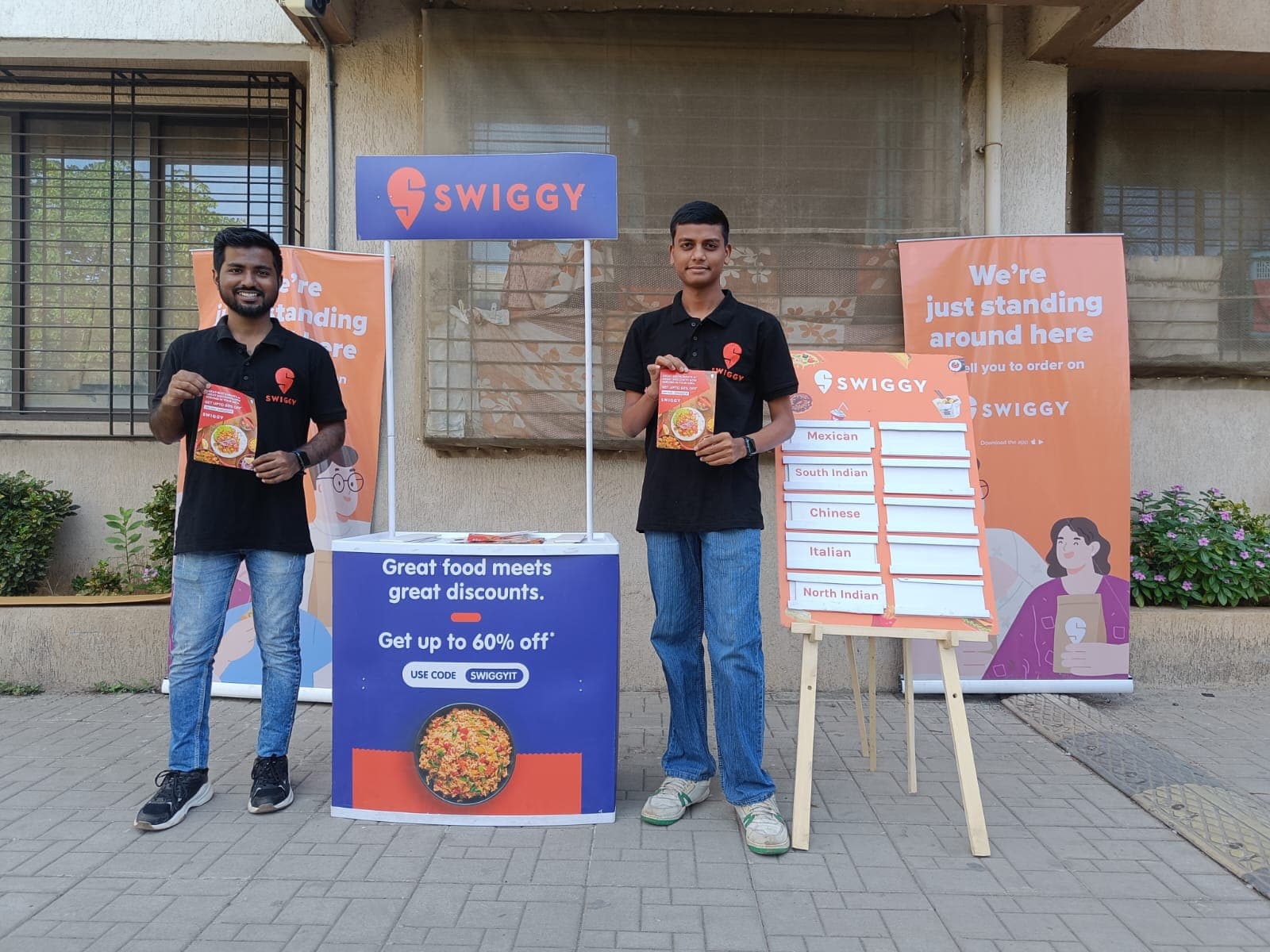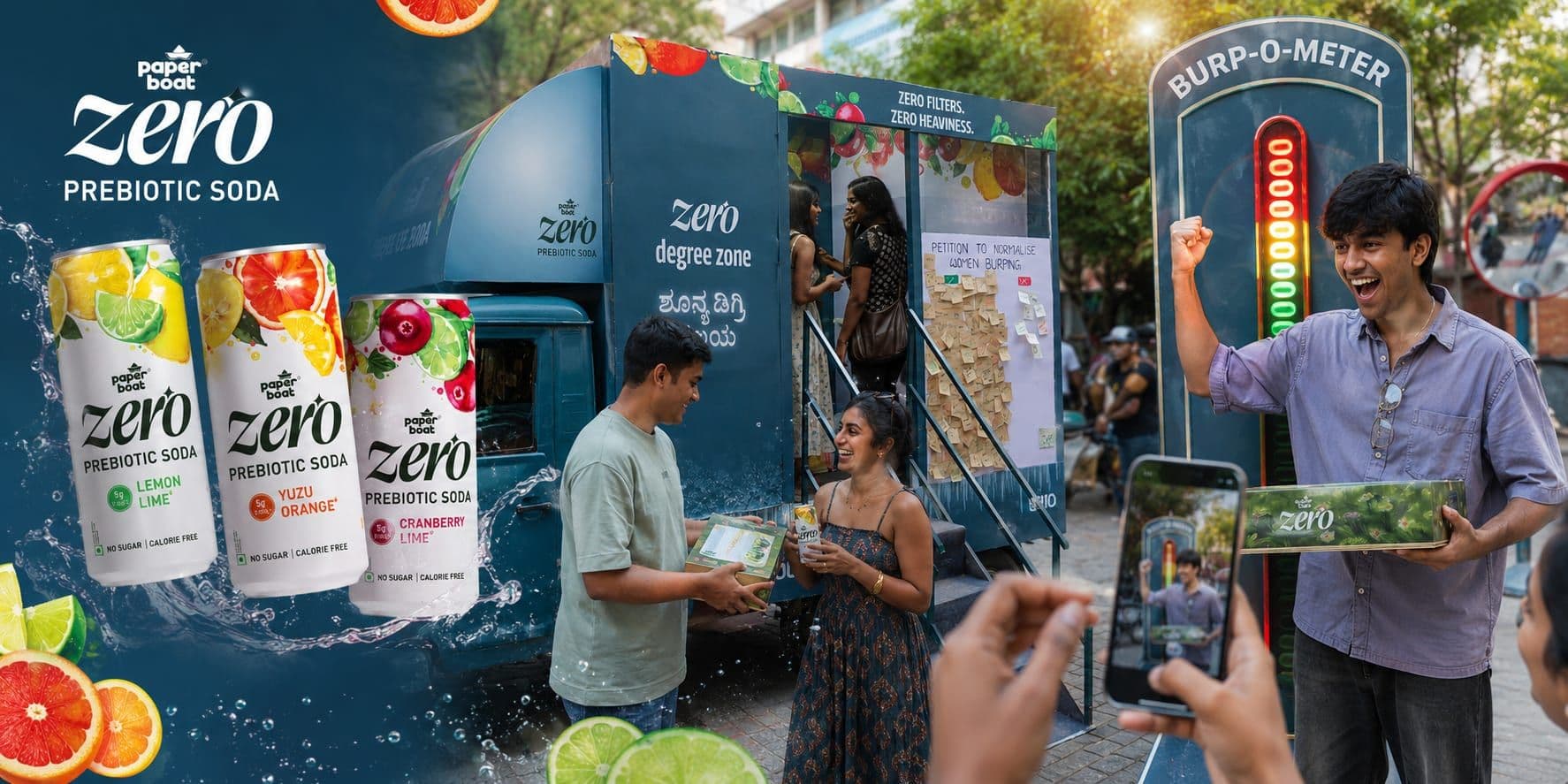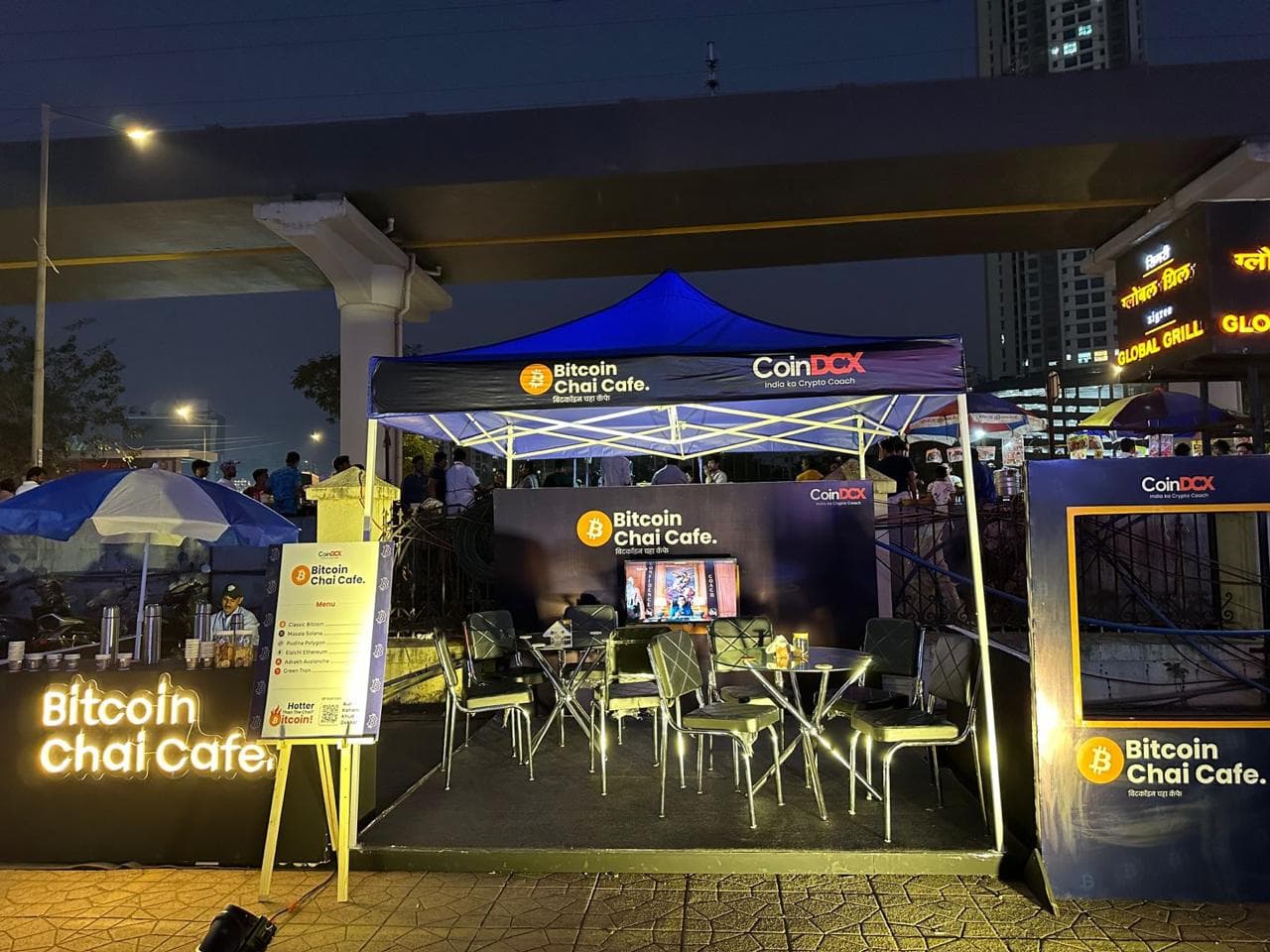
BigBasket built India's online grocery category. But by 2024, the streets of Delhi NCR told a different story: Blinkit hoardings at every market, Zepto stickers on every kirana, Swiggy Instamart standees at every RWA gate. CupShup, an AI-enabled brand activation agency, designed and deployed a high-frequency, multi-format hyperlocal BTL campaign across Gurgaon, Noida, Ghaziabad, and Delhi to reverse this. The result: 3,500+ pole brandings, 4,500+ no parking boards, 150+ RWA and market clusters covered, and 70-75 lakh+ monthly impressions, reclaiming dominance in the neighbourhoods that matter most.
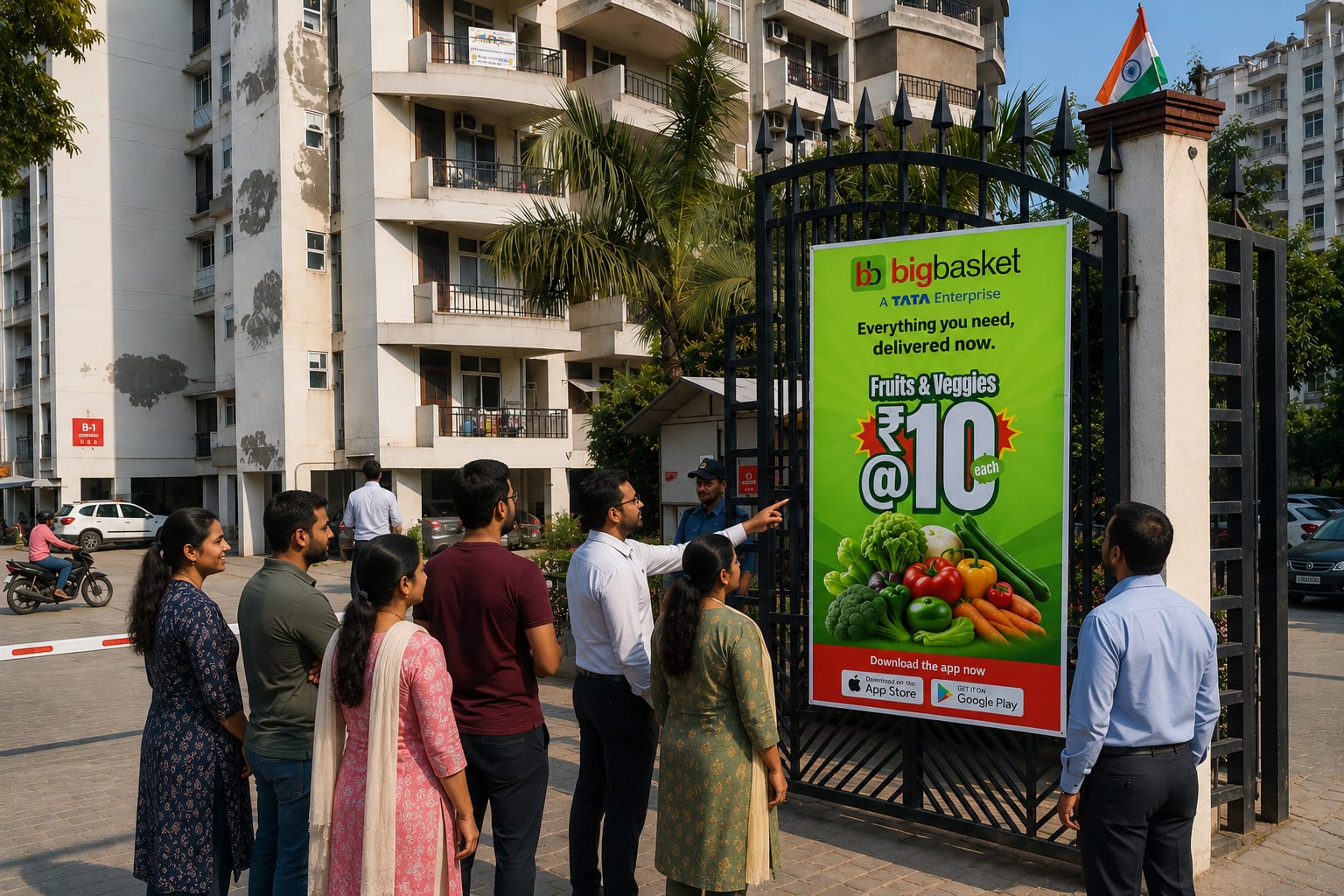
Table of Contents
- Executive Summary
- Campaign Overview
- Category Context: The Hyperlocal Visibility War in Quick Commerce
- The Problem: Declining Hyperlocal Recall Against Aggressive Competitors
- CupShup's Strategy: Multi-Format Hyperlocal BTL Dominance
- Phase 1: Geo Mapping and Cluster Identification
- Phase 2: Deployment Across Five BTL Formats
- Phase 3: Monitoring, Optimisation, and Expansion
- Post-Campaign: Conversion and Competitor Countering
- Results: What Scale Looks Like in Hyperlocal BTL
- Strategic Takeaways for Quick Commerce Brands
- Frequently Asked Questions
- Why BigBasket Chose CupShup
Executive Summary
This case study documents how BigBasket (India's largest online grocery platform) used a sustained, multi-format hyperlocal brand activation across Delhi NCR to counteract the on-ground visibility advantage their quick commerce competitors had built over two to three years. CupShup geo-mapped 300+ RWAs and 150+ high-footfall markets, then deployed five simultaneous BTL formats: pole branding, no parking boards (NPBs), door-to-door insertions, NPI branding, and full society and colony branding. The campaign launched in October and is ongoing. By the third month: 3,500+ pole brandings live, 4,500+ NPBs installed, 4,00,000+ NPIs activated, 1,00,000+ D2D flyers delivered, and 70-75 lakh+ monthly impressions generated across branded zones.
Campaign Overview
Campaign Gallery
Hover to expand media • Click for fullscreen photos
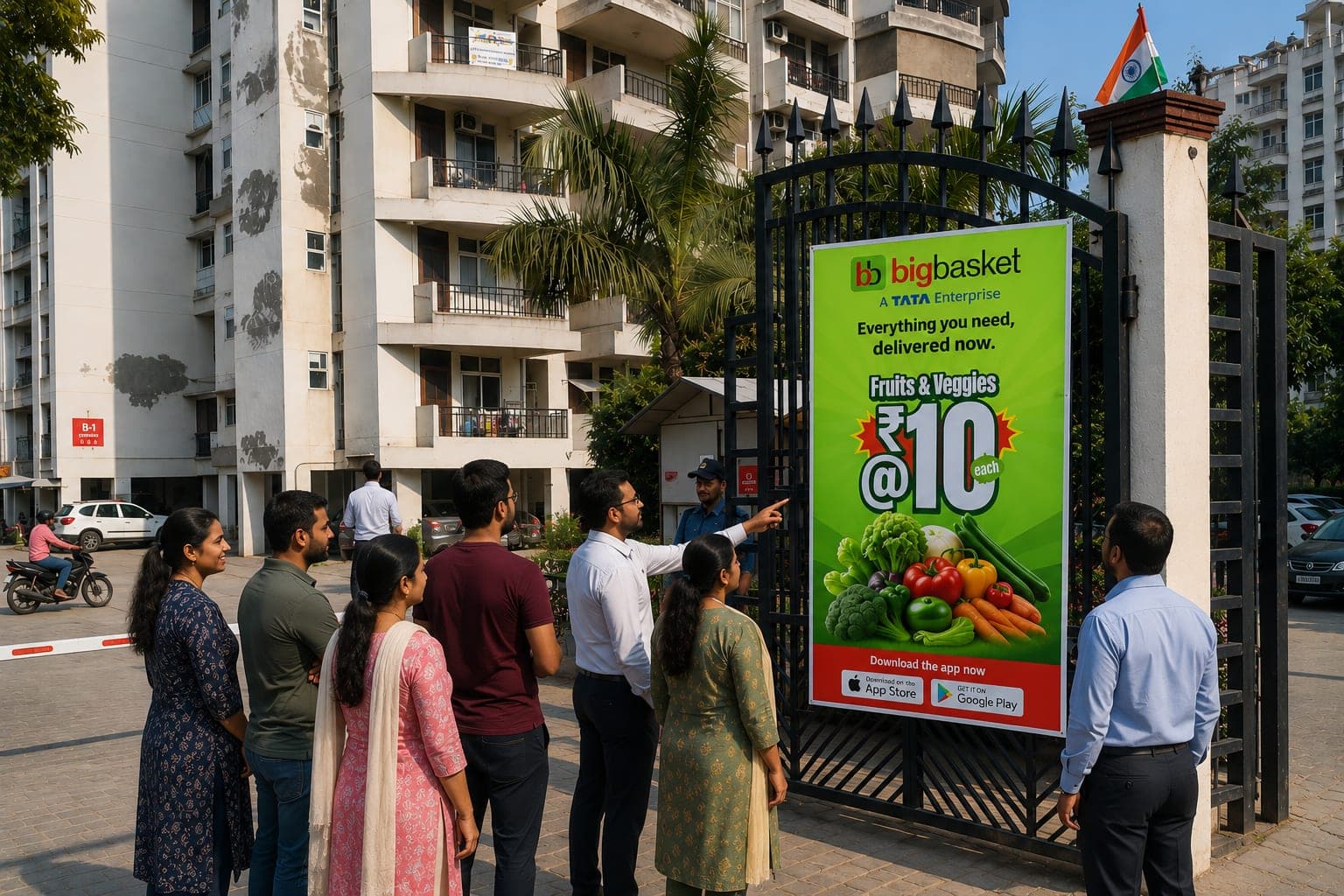
BigBasket hyperlocal brand activation Delhi NCR, pole branding and RWA activation
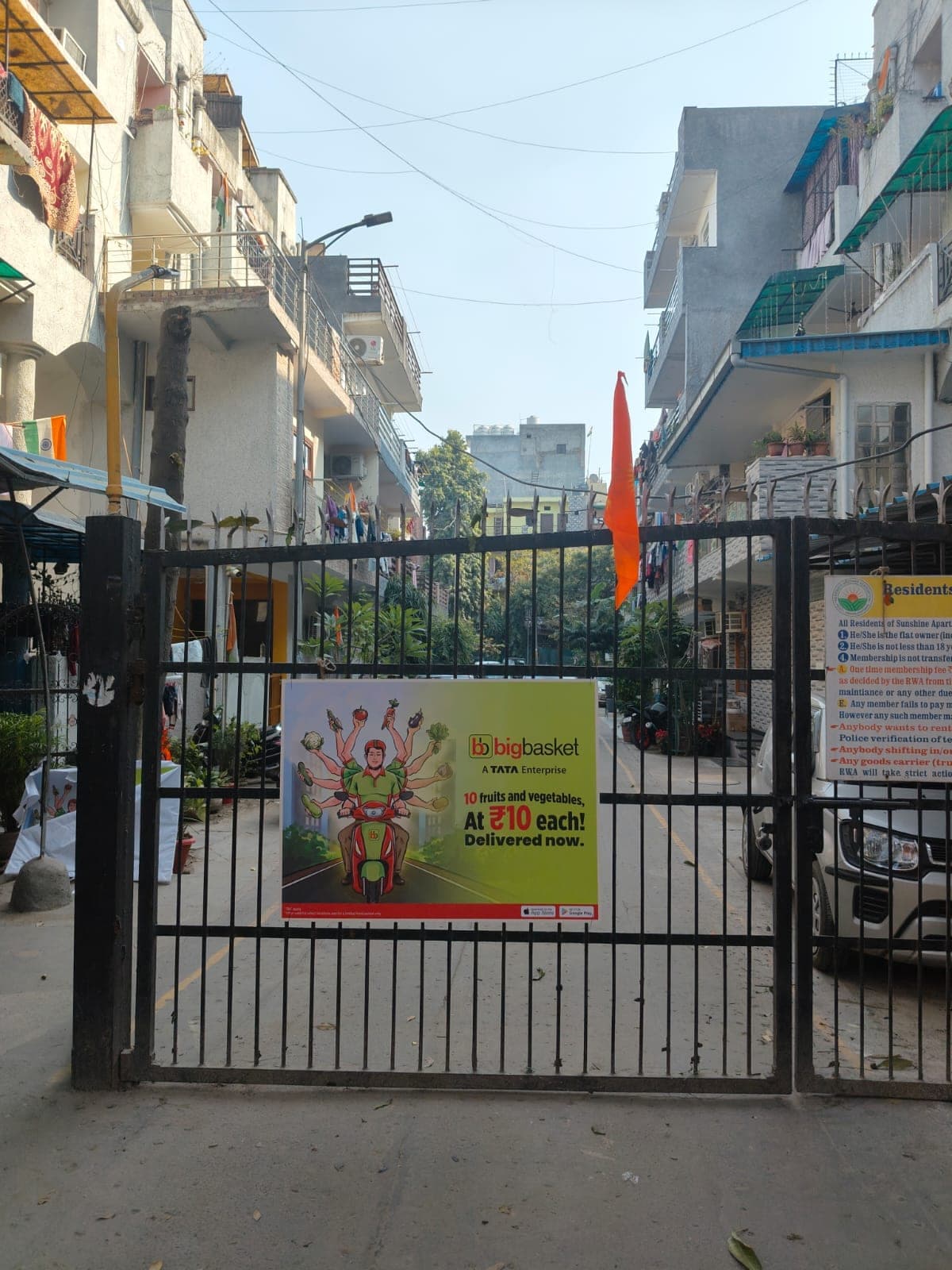
BigBasket Delhi NCR geo mapping and RWA cluster identification
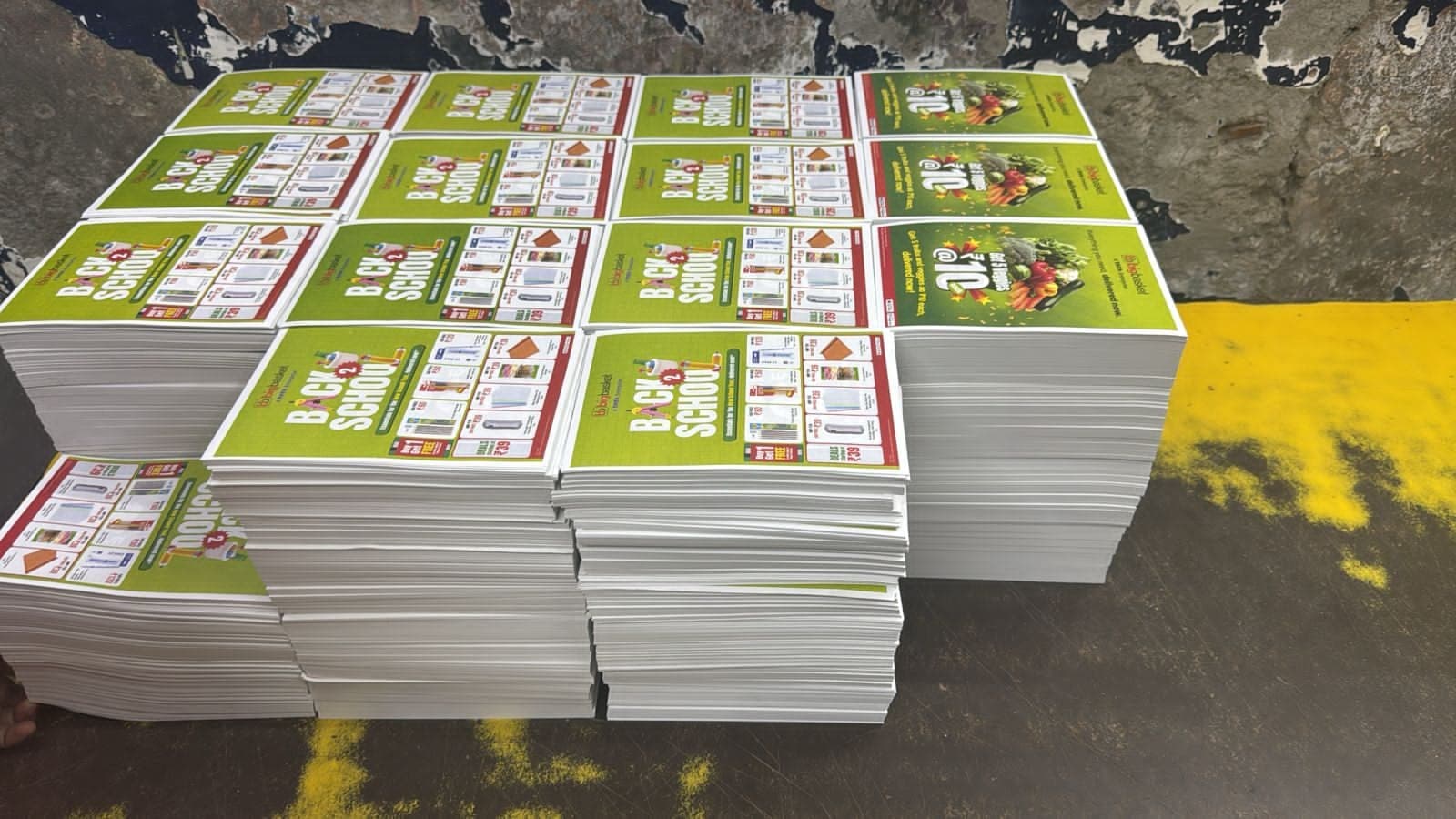
BigBasket pole branding Delhi NCR arterial roads and residential lanes
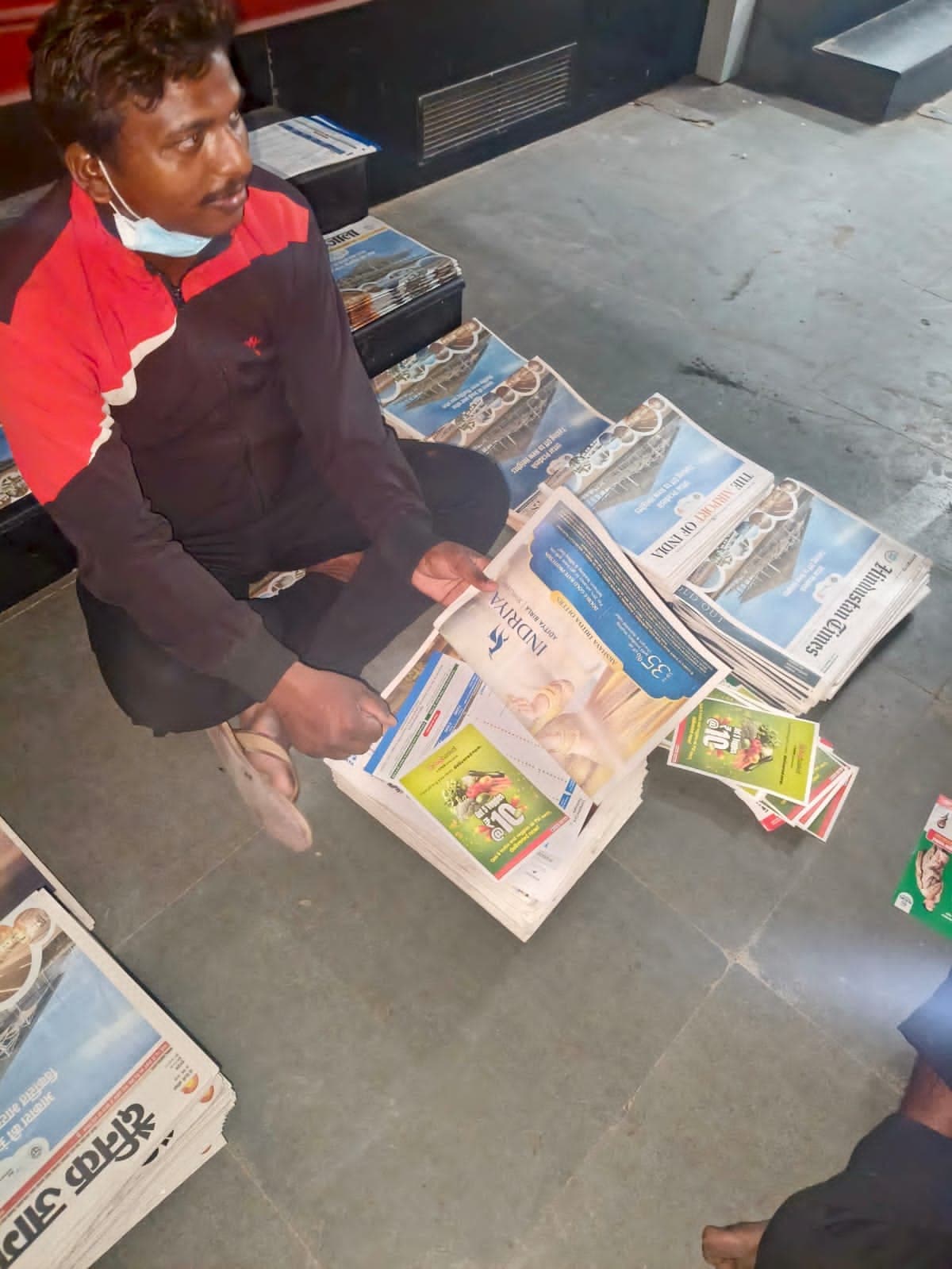
BigBasket society and colony branding, gate boards, lobby standees and RWA activation
BigBasket campaign monitoring, daily spot checks and geo-tagged reporting
BigBasket hyperlocal brand activation results, impressions, recall lift and cluster dominance
Client: BigBasket Category: Quick Commerce / Online Grocery Campaign: Hyperlocal Brand Visibility and Recall: Multi-Format BTL Activation Cities: Delhi NCR (Gurgaon, Noida, Ghaziabad, Delhi) Duration: October 2024, Ongoing Media Deployed: Pole Branding | No Parking Boards (NPBs) | Door-to-Door Insertions | NPI Branding | Society & Colony Branding Key Results: 70-75 lakh+ monthly impressions | 3,500+ pole brandings | 4,500+ NPBs | 150+ RWAs and markets covered | 3.5X recall lift in branded societies
Category Context: The Hyperlocal Visibility War in Quick Commerce
Between 2022 and 2024, the battleground for India's quick commerce category shifted from app stores to street corners. Blinkit, Zepto, and Swiggy Instamart understood something early that their pure-digital competitors missed: in a market where three to four apps offer ten-minute delivery of largely the same SKUs, the brand that owns the neighbourhood wins the order.
The mechanism is simple. A resident who walks past your branding at their society gate every morning, sees your sticker at the milk booth, and spots your board at the kirana around the corner has developed passive recall before they open any app. When hunger or a grocery need arises, the brand with the most recent physical touchpoint has a measurable advantage at the moment of intent.
This is the principle behind BTL marketing done at scale: not a single activation event, but omnipresent neighbourhood-level visibility that converts passive awareness into habitual recall. By October 2024, BigBasket's competitors had deployed this playbook aggressively across Delhi NCR. BigBasket needed to execute it faster, more comprehensively, and at higher frequency.
The Problem: Declining Hyperlocal Recall Against Aggressive Competitors
Gradual decline in hyperlocal visibility
Across key Delhi NCR residential clusters (Dwarka, Indirapuram, Vaishali, Vasundhara, Sohna Road, Noida Sector 50-62 belt) BigBasket's street presence had become sparse. Competitors had filled the gap.
Reduced brand recall in top residential clusters
Unaided brand recall for BigBasket had weakened in neighbourhoods where competitor NPBs and pole ads had taken over key sight lines.
Competitors overtaking presence at high-footfall locations
Market gates, kirana clusters, parking areas, and RWA noticeboards had been occupied by Blinkit and Zepto before BigBasket moved to reclaim them.
Lower conversion due to lack of physical reminders
App installs without reinforcing physical touchpoints decay. A consumer who has seen nothing since installing will default to a competitor they walk past every day.
BigBasket's brief to CupShup identified four interconnected problems, each of which grew from the same root cause: a gap in on-ground visibility strategy over the previous 24 months.
1. Gradual decline in hyperlocal visibility. Across key Delhi NCR residential clusters (Dwarka, Indirapuram, Vaishali, Vasundhara, Sohna Road, Noida Sector 50-62 belt) BigBasket's street presence had become sparse. Competitors had filled the gap.
2. Reduced brand recall in top residential clusters. Sample analysis across branded and unbranded zones showed that unaided brand recall for BigBasket had weakened in neighbourhoods where competitor NPBs and pole ads had taken over key sight lines. Consumers defaulted to whichever brand they saw most recently.
3. Competitors overtaking presence at high-footfall locations. Market gates, kirana clusters, parking areas, and RWA noticeboards, the highest-value hyperlocal real estate, had been occupied by Blinkit and Zepto before BigBasket moved to reclaim them.
4. Lower conversion due to lack of physical reminders. App installs without reinforcing physical touchpoints decay. A consumer who installed BigBasket six months ago and has seen nothing since will default to a competitor they walk past every day. Brand activation at the neighbourhood level is the only reliable mechanism to reverse this.
CupShup's Strategy: Multi-Format Hyperlocal BTL Dominance
The strategic insight was straightforward but execution-heavy: BigBasket could not win by being visible in one format. Competitors had established presence at individual touchpoints. The only way to achieve genuine dominance was to own every touchpoint simultaneously: pole, board, flyer, NPI, and society, within the same cluster, at the same time.
This is the core principle of multi-format BTL activation: when a consumer sees your brand at the market gate, at the parking barrier, on the lamp post outside their building, and in their letterbox on the same day, the cumulative effect is not additive. It is multiplicative. Recall builds through repetition across formats, not just repetition within a single format.
CupShup executed this strategy across three phases.
Phase 1: Geo Mapping and Cluster Identification
Before a single asset was deployed, CupShup's team conducted systematic geo mapping across Delhi NCR using AI-assisted consumption data and on-ground recce.
Cluster selection criteria:
- Residential density (households per sq km)
- Consumption affinity (grocery spend profile, BigBasket delivery history by pincode)
- Competitor presence and dominance index
- Historical brand activation performance by zone
Output of Phase 1:
- 300+ RWAs identified and mapped across Gurgaon, Noida, Ghaziabad, and Delhi
- 150+ high-footfall markets flagged for multi-format deployment
- Competitor presence mapped at the block level, with areas of highest competitor saturation prioritised for counter-deployment
- Deployment calendar built by micro-zone, phased by footfall peak timing
The AI mapping layer reduced wasted deployment by eliminating low-conversion zones before a single rupee was spent on assets. Every location selected had a data-backed case for high recall yield.
Phase 2: Deployment Across Five BTL Formats
Pole Branding
High-density pole ads across arterial roads, residential approach roads, and market clusters. 3,500+ pole brandings deployed and live.
No Parking Boards (NPBs)
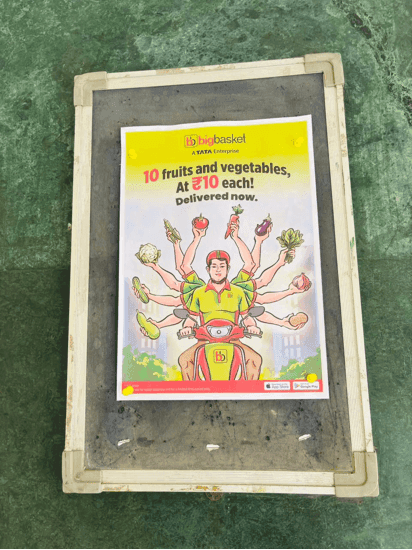
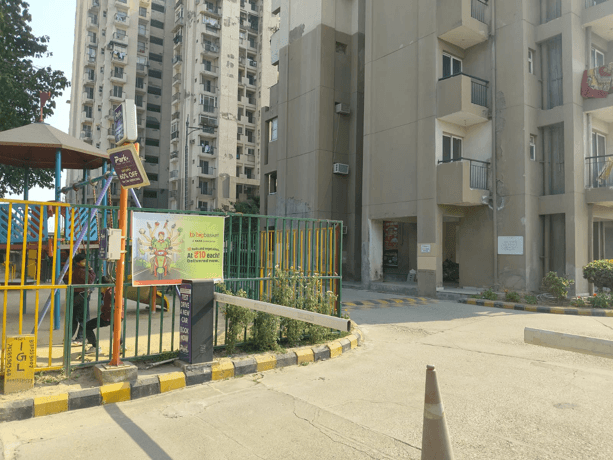
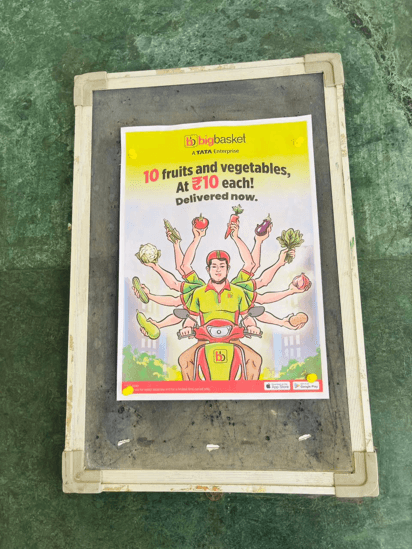
Installed at kirana stores, RWA entry/exit points, local shops, and parking hotspots for dwell-time visibility. 4,500+ NPBs installed.
Door-to-Door Insertions (D2D)
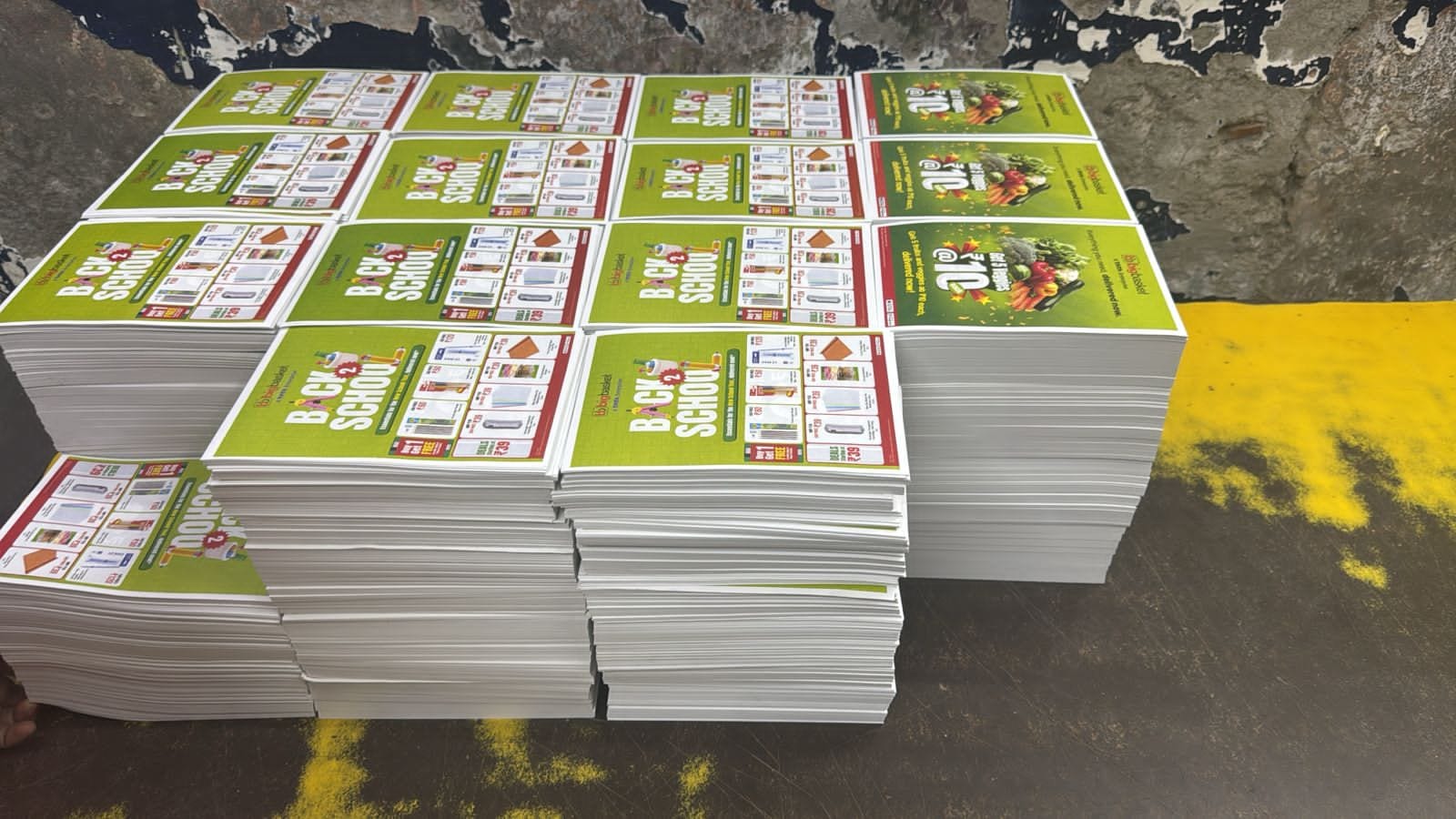
Branded flyers delivered directly to household letterboxes and doormats, reaching the primary grocery decision maker. 1,00,000+ D2D flyers distributed.
NPI (Near Point Installation) Branding
Branding at micro-retail points including milk booths, salons, chemists, small kirana stores, and tea stalls. 4,00,000+ NPIs activated.
Society and Colony Branding
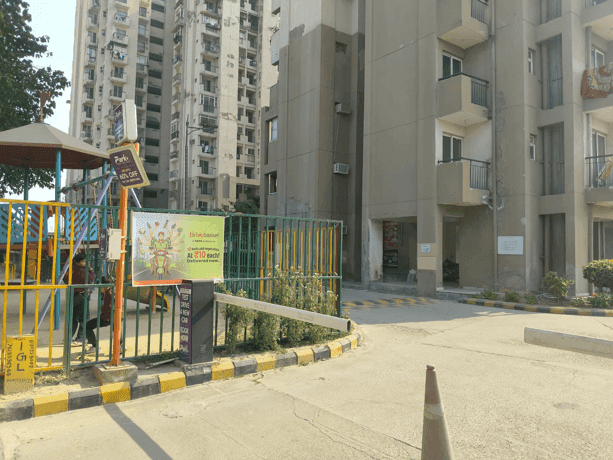
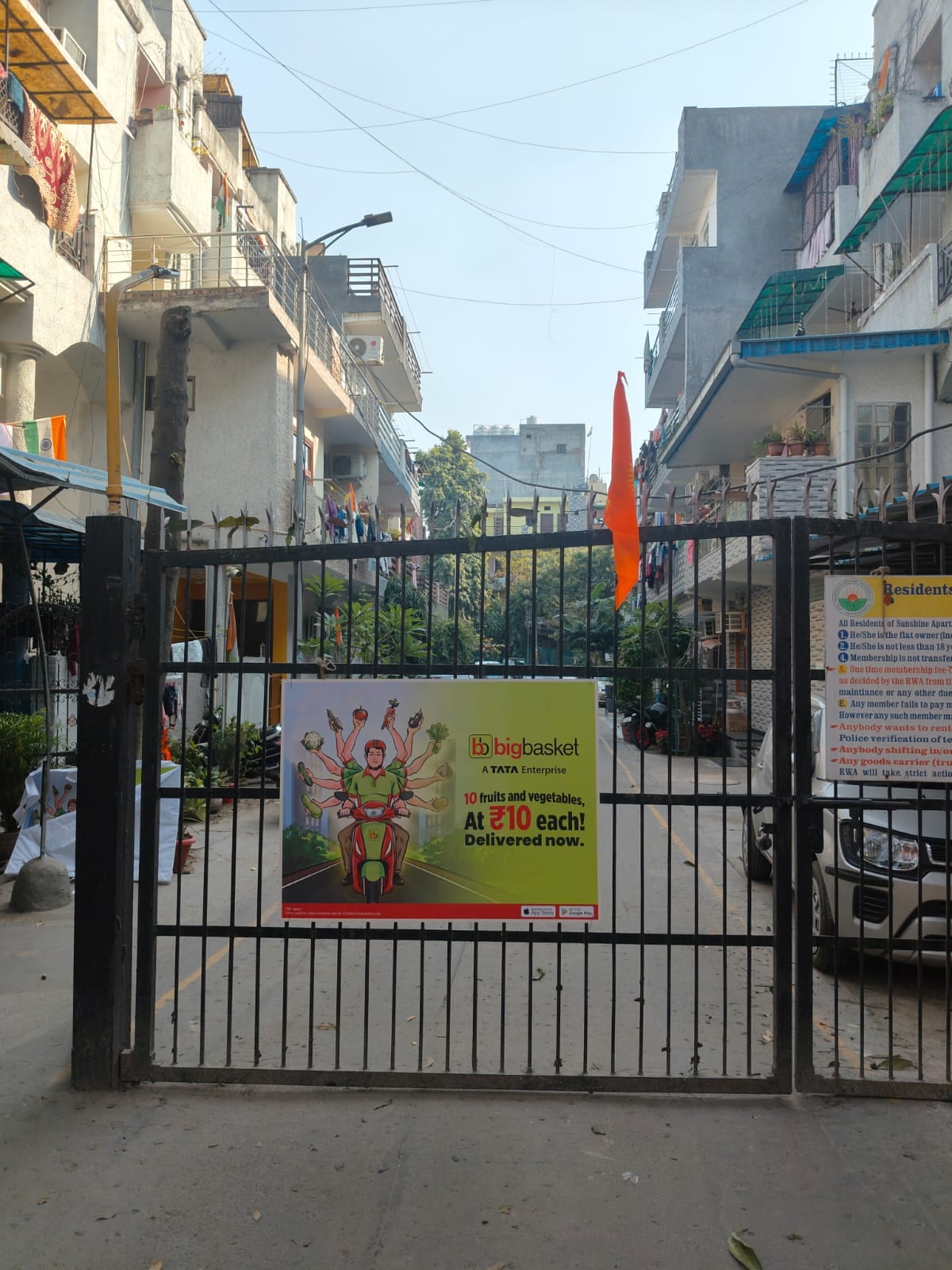
Gate boards, lift lobby standees, noticeboard branding, and flex installations across clubhouse and parking areas. 150+ RWAs and market clusters covered.
CupShup deployed five simultaneous BTL activity formats, each targeting a distinct touchpoint in the consumer's daily movement pattern.
1. Pole Branding
High-density pole ads placed across arterial roads, residential approach roads, and market clusters. Poles are the highest-frequency touchpoint for commuters and morning walkers. A resident walking to the market passes the same pole six to ten times per week. 3,500+ pole brandings were deployed and are live.
Placement logic: Main roads carry volume; residential lanes carry frequency. CupShup deployed both: broad coverage on arterials, deep recall on internal lanes.
2. No Parking Boards (NPBs)
Installed at kirana stores, RWA entry/exit points, local shops, and parking hotspots. NPBs provide dwell-time visibility. A driver stopping to park reads the board at close range, in a low-distraction moment. 4,500+ NPBs installed across the campaign zone.
NPB insight: The best NPB locations are not the most visible ones. They are the most frequently used ones. A small parking zone used 40 times a day outperforms a large, infrequently accessed area every time.
3. Door-to-Door Insertions (D2D)
Branded flyers delivered directly to household letterboxes and doormats, reaching the primary grocery decision maker at the point of purchase consideration. 1,00,000+ D2D flyers distributed across mapped residential clusters.
D2D insertions work because they reach the household, not the street. A pole ad builds awareness on the commute; a flyer in the letterbox converts awareness into action at the grocery planning moment.
4. NPI (Near Point Installation) Branding
Branding installed at micro-retail points including milk booths, salons, chemists, small kirana stores, and tea stalls, the hyperlocal touchpoints a resident visits two to five times per week. 4,00,000+ NPIs activated across the campaign zone.
NPI density creates the saturation effect that makes a brand feel omnipresent within a neighbourhood. When a consumer sees BigBasket branding at their morning milk booth, their evening kirana, and their weekend salon visit, the brand has achieved true top-of-mind in that micro-market.
5. Society and Colony Branding
Full branding packages deployed inside and around RWAs, including:
- Gate boards at entry and exit points
- Standee placements in lift lobbies
- Noticeboard branding in common areas
- Flex installations across clubhouse and parking areas
- Lift lobby branding (where committee permission was granted)
Dedicated on-ground teams coordinated directly with RWA managing committees for placement approvals and premium positioning. 150+ RWAs and market clusters covered with multi-layered visibility formats.
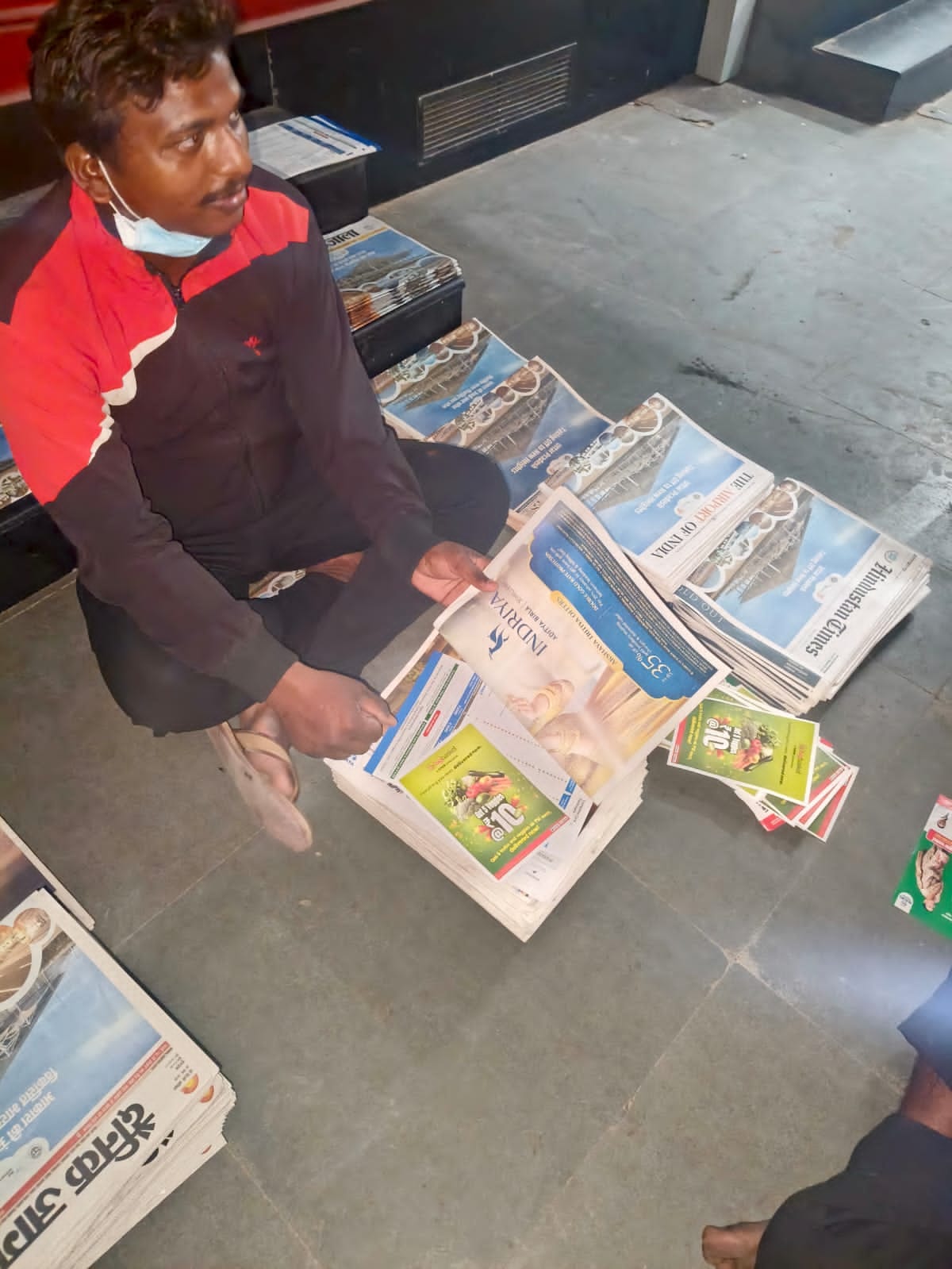
RWA activations are the highest-recall format in any residential neighbourhood campaign because they create branding inside the home territory, not on a road the consumer passes, but in the building they live in. The psychological effect of seeing a brand within your own community space is significantly stronger than external signage.
Phase 3: Monitoring, Optimisation, and Expansion
Deployment is the visible part of the campaign. The performance layer ran continuously in parallel.
Daily operations:
- On-ground spot checks at active deployment zones
- Photo-proof documentation submitted daily to BigBasket
- Damaged or displaced assets replaced within 24 hours
- Weekly geo-tagged reports with live asset status
Optimisation cycle:
- Weekly performance review against cluster-level recall indicators
- Underperforming zones deprioritised; high-recall zones expanded
- New residential clusters added based on BigBasket delivery growth data
- Competitor counter-deployment activated when new competitor assets were identified in mapped zones
Reporting:
- Live tracking sheet updated continuously
- WhatsApp-integrated field updates from deployment teams
- Monthly consolidated impact report shared with client
Post-Campaign: Conversion and Competitor Countering
After the initial deployment wave, CupShup shifted focus from coverage to conversion and competitive defence.
Sustaining visibility: 100% asset retention maintained across the deployment zone. Any worn-out or damaged material replaced immediately to prevent visibility gaps.
Increasing penetration: New colonies and markets added to the campaign based on performance insights and BigBasket's delivery polygon expansion.
Conversion funnel push: QR-integrated creatives deployed at gates, markets, and parking areas linking directly to app install and first-order offer pages. This created a direct measurement link between physical branding and app-level conversion.
Competitor countering: Specific zones where Blinkit, Zepto, and Swiggy Instamart had established dominance were identified and prioritised for higher-density BigBasket deployment. The strategy: match competitor presence in their strongest zones, and saturate BigBasket's strongest zones to prevent incursion.
Planned next phase: RWA sampling activations, grocery trial kiosks, and community engagement events to convert visibility recall into trial and habit.
Results: What Scale Looks Like in Hyperlocal BTL
| Metric | Result |
|---|---|
| Pole Brandings Deployed | 3,500+ |
| No Parking Boards Installed | 4,500+ |
| NPIs Activated | 4,00,000+ |
| D2D Flyers Delivered | 1,00,000+ |
| RWAs and Market Clusters Covered | 150+ |
| Monthly Impressions Generated | 70-75 lakh+ |
| Recall Lift in Branded Societies | 3.5X (sample analysis) |
| Cluster Dominance | 80% of mapped clusters |
Generated across branded zones in Delhi NCR
| Metric | Result |
|---|---|
| Pole Brandings Deployed | 3,500+ |
| No Parking Boards Installed | 4,500+ |
| NPIs Activated | 4,00,000+ |
| D2D Flyers Delivered | 1,00,000+ |
| RWAs and Market Clusters Covered | 150+ |
| Monthly Impressions Generated | 70-75 lakh+ |
| Recall Lift in Branded Societies | 3.5X (sample analysis) |
| Cluster Dominance | 80% of mapped clusters |
The 3.5X recall lift in branded versus unbranded societies is the number that matters most. It confirms the core hypothesis: multi-format, high-frequency hyperlocal BTL creates measurable recall lift that single-format or digital-only campaigns cannot replicate. Residents who live inside a BigBasket-branded zone have significantly stronger unaided recall than residents in adjacent unbranded zones with similar demographics.
Strategic Takeaways for Quick Commerce Brands
Hyperlocal visibility is not a brand-building play. It is a conversion play.
Every impression generated within a consumer's home neighbourhood is closer to the moment of purchase than any impression generated outside it. In quick commerce, the gap between awareness and order is measured in seconds. Hyperlocal branding closes that gap.
Multi-format saturation outperforms single-format scale.
Five formats at 150 RWAs outperforms one format at 500 locations. Consumers in a saturation zone encounter the brand at every touchpoint in their daily movement.
AI-assisted geo mapping eliminates wasted deployment.
Selecting 300 RWAs from a universe of 1,200 without data is guesswork. CupShup's AI-assisted planning ensures every location selected has a validated case for high recall yield based on consumption density, footfall patterns, and competitive activity.
Asset retention is half the campaign.
A pole branding campaign that runs at 70% retention after two weeks is a 30% loss every two weeks. CupShup's 24-hour replacement SLA is not a service feature. It is a performance guarantee.
RWA committee relationships are a moat.
Brands that invest in proper RWA permission processes and maintain respectful relationships with managing committees access premium placement zones that competitors cannot enter. See our brand activation guide.
1. Hyperlocal visibility is not a brand-building play. It is a conversion play. Every impression generated within a consumer's home neighbourhood is closer to the moment of purchase than any impression generated outside it. In quick commerce, the gap between awareness and order is measured in seconds. Hyperlocal branding closes that gap.
2. Multi-format saturation outperforms single-format scale. Five formats at 150 RWAs outperforms one format at 500 locations. Consumers in a saturation zone encounter the brand at every touchpoint in their daily movement. The cumulative recall effect is exponentially higher than frequency within a single format.
3. AI-assisted geo mapping eliminates wasted deployment. Selecting 300 RWAs from a universe of 1,200 without data is guesswork. CupShup's AI-assisted planning ensures every location selected has a validated case for high recall yield based on consumption density, footfall patterns, and competitive activity. The upfront investment in mapping pays back in every subsequent rupee of deployment.
4. Asset retention is half the campaign. A pole branding campaign that runs at 70% retention after two weeks is a 30% loss every two weeks. CupShup's 24-hour replacement SLA is not a service feature. It is a performance guarantee. Visibility gaps at key locations undo recall built over weeks.
5. RWA committee relationships are a moat. Brands that invest in proper RWA permission processes and maintain respectful relationships with managing committees access premium placement zones that competitors cannot enter. This is a structural advantage that compounds over time. See our brand activation guide for a detailed breakdown of how to approach RWA committee engagement.
Frequently Asked Questions: BigBasket Hyperlocal Brand Activation
What is hyperlocal brand activation and how did it help BigBasket?
Hyperlocal brand activation refers to concentrated, multi-format brand visibility programmes executed within specific residential or commercial micro-markets, typically at the neighbourhood or society level, rather than across a broad city-wide geography. For BigBasket, the hyperlocal approach was critical because quick commerce purchasing decisions are made within a consumer's immediate environment: their building, their market, their commute. By deploying pole branding, NPBs, D2D flyers, NPIs, and society branding simultaneously within the same residential clusters, CupShup created brand saturation that produced a measurable recall lift of 3.5X in branded versus unbranded societies.
What BTL formats did CupShup use for the BigBasket campaign?
CupShup deployed five BTL formats: pole branding (3,500+ locations), no parking boards (4,500+), near point installations or NPIs (4,00,000+), door-to-door flyer insertions (1,00,000+), and full society and colony branding across 150+ RWAs. Each format targets a different touchpoint in the consumer's daily movement: pole ads during commutes, NPBs during parking, flyers at the household decision point, NPIs at micro-retail visits, and society branding within the home community itself.
How did CupShup select which RWAs and markets to activate in Delhi NCR?
CupShup used AI-assisted geo mapping to identify and rank activation locations based on residential density, consumption affinity (grocery spend profile by pincode), competitor presence intensity, and historical campaign performance data. From a universe of 1,200+ potential RWAs and markets across Delhi NCR, the AI layer identified 300+ RWAs and 150+ high-footfall markets as priority deployment zones. This data-led selection ensured every deployment rupee was invested in locations with the highest expected recall yield.
What does pole branding cost and how effective is it for brand recall?
Pole branding in Delhi NCR typically costs Rs 800-2,500 per pole per month depending on location tier, permit requirements, and production specifications. At scale (3,500+ poles as deployed for BigBasket) the cost per monthly impression drops significantly, typically to Rs 0.08-0.15 per impression. The recall effectiveness is highest when poles are concentrated in residential lanes (high daily frequency for local residents) rather than purely on arterial roads (high volume but lower per-person frequency). CupShup's deployment mixed both: arterial coverage for broad reach, lane-level density for deep recall.
How do you measure the ROI of a hyperlocal BTL campaign at this scale?
At the awareness stage, CupShup tracks monthly impression volumes (70-75 lakh+ for the BigBasket campaign), asset retention rates, and cluster coverage depth. For recall measurement, sample surveys in branded versus unbranded societies provide comparative recall indices. The BigBasket campaign recorded a 3.5X recall lift in branded zones. For conversion measurement, QR-integrated creatives at key touchpoints track app installs and first-order completions directly attributable to hyperlocal branding exposure. Read more about BTL measurement frameworks in our brand activation guide.
Why BigBasket Chose CupShup
BigBasket's hyperlocal challenge required an agency that could execute at scale, manage on-ground complexity across four cities simultaneously, and deliver data-backed location selection rather than intuition-driven deployment.
CupShup's AI-enabled planning layer (mapping 300+ RWAs, scoring locations by consumption density and competitor activity, and building a deployment calendar by micro-zone) gave BigBasket confidence that every format placed was in the right location for the right reason.
The 24-hour asset replacement SLA, daily photo-proof reporting, and live geo-tagged tracking gave BigBasket the operational visibility to verify that the campaign was being executed as planned, not just promised.
The result is a campaign that is still expanding, adding new colonies and markets as BigBasket's delivery network grows, and transitioning from visibility-building to conversion-driving formats as the recall foundation has been established.
For brands planning a hyperlocal brand activation campaign in Delhi NCR or other Indian metros, the BigBasket case study demonstrates what sustained, multi-format BTL presence can deliver when location selection, deployment discipline, and monitoring infrastructure are built correctly from day one.
Planning Your Next Product Launch?
CupShup designs and executes high-impact brand activations, experiential trials, and creator amplification across 50+ Indian cities.