
Experiential Marketing Transforms On Ground Campaigns Into Digital Buzz: Experiential Marketing Examples
Imagine investing heavily in a brilliant on-ground activation, only for the buzz to disappear the moment the event ends. Most brands face this reality. However, leading experiential advertising agencies know how to make these moments live on, creating digital engagement that lasts. This is the power of turning on-ground campaigns into digital gold. This is exactly where an influencer marketing agency India earns its keep — turning a physical moment into a feed-native story.
Watch: the Optimist Drinks activation
Many on-ground marketing efforts are designed for immediate impact but lack a strategy for sustained digital life. This means missed opportunities for deeper customer connection and brand advocacy. This article will show you how to bridge the gap, ensuring your physical activations generate significant online conversations and results.
Building for Shareability: Beyond Just Visibility
An on-ground campaign's success isn't just about how many people see it at the event; it's about how many people share it online. Think of Amul’s iconic billboards. They’ve been a staple for decades, yet they continue to spark conversations and shares on social media today. Their secret? Simple, witty messaging that’s inherently shareable. A billboard that can be easily understood and appreciated in a screenshot has a much longer digital life.
At CupShup, we apply the "5-Second Test": can someone screenshot and share your creative within five seconds? If it’s too complex, it’s likely to be ignored online. We encourage our clients to ask if their campaign concept could double as a meme. If it can’t, it’s a sign to rethink the creative. This focus on shareability ensures that your physical presence translates into organic digital reach, turning passive viewers into active brand advocates. This is a core principle for any effective experiential advertising agency.
Seamless Offline-to-Online (O2O) Integration
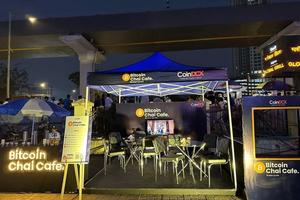
An on-ground activation without a digital hook is like a meal without its essential flavour. It might be satisfying in the moment, but it lacks lasting appeal. CoinDCX's "Bitcoin Chai Café" in Mumbai perfectly illustrated this. Attendees enjoyed a simple cup of chai, but a witty QR code offered a free crypto tip and a gateway to an online community. This turned a fleeting offline experience into an ongoing digital conversation, demonstrating how offline-to-online marketing should be simple, seamless, and sticky. This approach ensures that the momentum generated offline continues to build online.
We call this the "Boomerang Effect." Your campaign leaves the street, but it always swings back online, creating a continuous loop of engagement. To achieve this, it’s crucial to design the digital journey before the physical one. This includes creating compelling hashtags that generate FOMO, much like Zomato’s #ZomatoLoot, which encouraged users to share screenshots of incredible offers. This strategic integration ensures that every offline touchpoint serves as a launchpad for digital interaction. For brands looking to achieve this, exploring offline-to-online digital integrations is key.
Influencer Marketing: Amplifying the Experience
Even the most strategically placed billboard can fall flat if it doesn't generate online chatter. Zomato masterfully leveraged this by ensuring their witty Out-of-Home (OOH) advertisements were amplified by influencers and meme pages. This wasn't accidental; it was a deliberate strategy. Briefing influencers for authenticity, rather than a rigid script, yields more relatable and trustworthy content. Micro-influencers, with followings between 5,000 and 50,000, often provide a better return on investment due to their perceived closeness to their audience. A specialist influencer marketing agency India matches regional creators to each activation so the amplification feels native, not sponsored.
At CupShup, we favour working with a network of micro-creators. Instead of investing in one large celebrity, we engage 20-30 smaller creators. This approach spreads the buzz wider, feels more organic, and delivers superior results. This synergy between on-ground presence and online influence fuels wider conversations. For instance, the Godrej Yummiez FMCG activation we managed involved engaging local food bloggers who shared their tasting experiences online, driving significant digital engagement beyond the event itself. The right influencer marketing agency India also handles rights, briefs, and posting cadence so content lands while the buzz is fresh.
Gamification: Making Engagement a Game
Let's be honest: people don't typically post about "brand awareness." However, they will enthusiastically share their participation and wins in a game. Swiggy Instamart's "Greenverse" in Bengaluru is a prime example. Offline events were transformed into online challenges, offering instant eco-friendly rewards. This made posting not just an option, but an integral part of the game itself. The key to successful gamification lies in instant rewards; a coupon that arrives weeks later will lose its appeal.
Mechanics should also be simple: scan, post, win. Anything more complex risks losing audience interest. CupShup once turned simple chai cups into treasure hunts. By scanning a code, users could unlock a Spotify playlist or an AR lens, which they could then share online. This worked because the joy was immediate and inherently social. Similarly, the MX Player "Aashram" hyperlocal campaign included interactive elements at chai stalls where participants could win merchandise by answering trivia related to the show, encouraging social sharing of their wins.
Personalization: Speaking Directly to the Audience
Generic, one-size-fits-all campaigns no longer resonate with today's consumers. Zomato excels at this, with push notifications that feel like a message from a foodie friend rather than a corporate entity. On a larger scale, Deloitte achieved a 50% reduction in opt-out rates for a pharma campaign by using AI-driven personalization. Imagine applying this to OOH advertising: a billboard in Mumbai reading "Vada Pav > Venture Capital," and in Chennai, "Idli > iPhone." The core message remains, but the localized punchlines make each city feel uniquely addressed.
Personalization should extend beyond the initial moment to the follow-up. Using AI to understand regional trends allows for real-time campaign adaptation. CupShup's AI stack is capable of generating regional copy, predicting trending meme formats, and tailoring campaigns for individual cities. This ensures that offline-to-online strategy is deeply personalized, making each interaction more meaningful and effective. This level of data-driven personalization is a hallmark of advanced ai marketing agency services.
Snackable Content: Shrinking Stunts for the Feed
While grand stunts capture attention in real life, their impact fades quickly if they aren't distilled into easily digestible online content. Micro-videos, under 30 seconds, are currently the most ROI-positive content format. Adobe, for example, localized bite-sized LinkedIn videos in India to shift brand perception. The key is to capture content while the energy of the event is still high. Don't wait for user-generated content; have meme templates, Reels, and GIFs ready to deploy while the event is still buzzing.
We create a "digital starter pack" for every offline activation. This includes ready-to-post memes, Reels, and GIFs because buzz has a short shelf life. A smart offline-to-online strategy focuses on how easily the experience can be shared online, not just on the scale of the physical stunt. The Wispr Flow auto-branding activation in Bangalore, for instance, involved creating visually striking elements that were perfect for Instagram Stories and Reels, ensuring the brand's presence extended far beyond the physical location.
Tech as Your Campaign Wingman
Even the most creative concepts require data to achieve their full potential. Tools like Google Analytics, Trends, and AI insights are invaluable for understanding what to launch, when to launch, and which conversations to join. Salesforce utilized AI-driven localized LinkedIn campaigns to reshape brand perception in India. At CupShup, we employ AI to predict meme trends, craft witty copy, and track the virality of even the smallest campaign elements, like branding on chai cups. Data allows us to close the loop, ensuring that offline efforts are measurable and optimized.
Before launching, it's crucial to test your concepts. Google Trends can reveal if your chosen theme is gaining traction or already declining. Automating reporting is also essential; if you can't measure how offline activities drive online results, your campaign is based on intuition rather than strategy. This integration of data and creativity is where online and offline marketing truly converge, with data informing creative decisions and creativity driving virality. PhonePe, for example, likely uses extensive data to inform its marketing strategies, ensuring their campaigns resonate effectively across both physical and digital touchpoints.
WhatsApp Amplification: The Direct Line to Your Audience
In India, WhatsApp is more than just a messaging app; it's a powerful marketing channel. Integrating WhatsApp into your on-ground campaigns can create a direct and personal line of communication with your audience. Imagine a QR code at an event that, when scanned, initiates a WhatsApp chat with the brand. This could be used to deliver exclusive content, offer personalized discounts, or even run simple polls and quizzes related to the activation. This immediate, conversational approach fosters deeper engagement than passive observation. Pairing WhatsApp with an influencer marketing agency India keeps the conversation going long after the event ends.
For instance, after an on-ground sampling event, a brand could use WhatsApp to send follow-up messages with recipes or usage tips, keeping the brand top-of-mind. This is particularly effective for FMCG brands. By collecting opt-ins at the event, brands can build a direct communication channel for ongoing engagement, promotions, and customer service. This form of whatsapp marketing ensures that the offline interaction doesn't end at the event venue but continues through a platform that consumers use daily. This is a crucial component for any modern experiential advertising agency aiming for comprehensive offline-to-online digital integrations.
Key Takeaways
- Design every on-ground touchpoint with a clear digital bridge, such as QR codes, NFC tags, or unique hashtags. An influencer marketing agency India multiplies every on-ground rupee.
- Prioritize shareability by creating content that is instantly understandable and engaging for social media.
- Integrate influencers, especially micro-influencers, to amplify your offline message and build authentic online conversations.
- Employ gamification with instant rewards and simple mechanics to encourage participation and social sharing.
- Utilize data and AI to personalize campaigns for specific regions and audience segments, both offline and online.
- Transform large-scale events into "snackable" content formats like short videos and memes for maximum digital reach.
- Leverage WhatsApp for direct, conversational engagement post-event, extending the campaign's life and fostering loyalty.
From On-Ground Buzz to Measurable Pipeline
Experiential advertising agencies that last are the ones that connect the street to the dashboard. An on-ground campaign creates real-world attention; performance marketing turns that attention into tracked, retargetable demand. Without that bridge, the buzz fades and the spend cannot be justified. As an AI marketing agency, CupShup wires each activation into a live measurement dashboard.
This is the difference between vendors and real experiential advertising agencies: the good ones wire every activation into performance marketing and an ai marketing agency layer that predicts, captures, and optimises. The on-ground moment generates first-party demand; performance marketing scales it; AI makes the whole loop smarter each cycle.
CupShup plans on-ground campaigns as the top of a measured funnel, real-world activation connected to performance marketing and an AI-led stack, so the digital buzz you create is buzz you can actually bank.
Frequently Asked Questions
What is the core difference between on-ground marketing and experiential marketing?
On-ground marketing refers to any promotional activity that takes place in a physical location, like a product display or a flyer distribution. Experiential marketing, however, focuses on creating immersive, memorable experiences that allow consumers to interact with a brand on an emotional level. While on-ground can be part of an experiential campaign, experiential marketing aims to create a deeper, more engaging connection.
How can a brand measure the success of its offline-to-online strategy?
Success is measured by tracking key metrics like QR code scan rates, unique clicks from event-specific UTM links, social media mentions and user-generated content volume, app installs attributed to the activation, and the lift in branded search queries post-event. Comparing the cost-per-lead from the activation against digital-only benchmarks also provides valuable insights.
What makes a campaign "Instagrammable" or "shareable"?
Shareable campaigns are visually appealing, emotionally resonant, or humorous, making people want to show them to their friends. This often involves unique photo opportunities, interactive elements, witty slogans, or visually striking designs that stand out in a crowded social media feed. The goal is to create moments that people naturally want to capture and share.
How can AI enhance offline-to-online campaigns?
AI can analyze vast amounts of data to identify regional trends, predict popular meme formats, and personalize messaging for different demographics. This allows for more targeted and effective campaign execution, from generating localized ad copy to optimizing content distribution strategies. An ai marketing agency can help integrate these capabilities. Many brands pair this with an influencer marketing agency India to scale the winning creative across creators.
What role does WhatsApp play in amplifying offline campaigns?
WhatsApp serves as a direct communication channel to engage attendees after an event. Brands can use it to share exclusive content, offer personalized discounts, collect feedback, or run interactive polls, extending the campaign's reach and fostering a stronger connection. This is a powerful tool for ongoing engagement and whatsapp marketing.
Conclusion
In today's connected world, the line between physical and digital experiences is increasingly blurred. Leading experiential advertising agencies understand that the most impactful campaigns are those that live in both realms. By strategically building for shareability, integrating seamlessly online, and leveraging technology, brands can transform their on-ground activations into digital movements that resonate long after the event concludes. Partnering with an experienced influencer marketing agency India is the fastest way to convert on-ground buzz into measurable digital pipeline.
Ready to run a winning experiential advertising agencies campaign? Talk to CupShup, India's leading experiential advertising agencies agency. Get in touch and we'll build a campaign tailored to your brand.
Related Reading
- On-Ground Activation in India: The Experiential Marketing Playbook
- RWA activation playbook
50 Integrated Marketing Campaign Ideas
The complete playbook with campaign frameworks, budget templates, and measurement guides for Indian brands.
Instant download + email copy. No spam, ever.
On-Ground to Digital: Related Resources
Explore more about converting on-ground campaigns into digital buzz with these related resources from CupShup.
Digital Integration Services
Bridge offline activations with digital amplification
Social Media Management
Amplify on-ground campaigns through social media strategy
Blending Offline and Online for Max Impact
Strategies for integrated offline-online campaigns
Wakefit Sofa on Wheels Campaign
How Wakefit turned an experiential activation into viral content
Explore CupShup Services
Brands that read this article also explored these services.
Experiential Marketing Agency India
Immersive brand experiences, pop-ups, product launches, live demos, and phygital events.
Learn more ActivationBrand Activation Services
On-ground engagement campaigns with tech-enabled tracking and verified results.
Learn more PerformancePerformance Marketing Agency
ROI-driven paid media, Google, Meta, programmatic. CPL-focused campaigns with daily reporting.
Learn moreCuppa CS
Digital Marketing Expert specializing in AI-powered marketing tools and automation. Cuppa CS helps brands leverage cutting-edge technology to optimize their digital presence and drive customer engagement.
Related Stories
Go Deeper with Our Free Guides
Comprehensive, in-depth marketing guides created by CupShup's experts.
The Ultimate Guide to Experiential Marketing
A comprehensive guide covering experiential marketing from strategy to execution. Learn about event experiences, pop-ups, immersive experiences, retail activation, sensory marketing, gamification, community building, storytelling, production, staffing, amplification, and measurement. Includes 50+ term glossary and action plans.
BTL Marketing: The Complete Guide to Below-the-Line Strategies in India
Practical below-the-line strategies and field examples tailored to the Indian market. Covers in-store activations, product sampling, retail engagement, and measurable ROI.
The Ultimate Guide to Performance Marketing
A comprehensive guide covering performance marketing from strategy to execution. Learn about paid search (PPC), paid social, display advertising, affiliate marketing, native advertising, retargeting, performance creative, landing pages, conversion tracking, attribution, audience targeting, bidding strategies, A/B testing, and campaign scaling. Includes 50+ term glossary and action plans.